
Carl Nägeli
Swiss botanist who studied the microscopic structure of plants and proposed a theory of evolution · 1817–1891
- Born
- March 26, 1817
- Died
- May 10, 1891
- Country
- Switzerland
- Section
- Biology
Biography
Karl Wilhelm von Nägeli (1817-1891) was a Swiss botanist working in the decades when the microscope began to reveal the inner structure of plants. Today he is remembered mainly for his link with Gregor Mendel, whom he discouraged from pursuing research on heredity, and for defending a theory of evolution that did not last. His work on plant anatomy and growth, however, was broad and influential.
He was born in Kilchberg, near Zurich, the son of a physician. In 1836 he began studying medicine at the University of Zurich, but soon switched to botany, learning from naturalists such as Lorenz Oken and Oswald Heer. Between 1839 and 1840 he studied in Geneva under the Swiss botanist A. P. de Candolle, and he earned his doctorate in Zurich with a thesis on the thistles of Switzerland. From 1842 he worked in Jena with the German botanist Matthias Schleiden, who directed his attention to the microscopic study of plants.
His academic career took him from Zurich, where he became an extraordinary professor in 1849, to Freiburg, where he held the chair of botany from 1852 to 1856. He then settled in Munich, where he taught general botany and microscopy until his retirement in 1889. From there he published a long series of works on algae, plant physiology and classification, and with Gustav Albert Peter he wrote a two-volume study of the hawkweeds of Central Europe.
His most debated contribution concerns cell division. For a long time it was thought that he had first observed cell division during pollen formation around 1842, and he was even credited with discovering chromosomes. The Australian geneticist Henry Harris questions these claims: in his view, Nägeli did not clearly describe the division of the nucleus and did not grasp at that time how important the nucleus was to the life of the cell. The exact credit for his observations remains uncertain.
His work on plant tissues is better documented. In 1846, together with the German botanist Hugo von Mohl, he distinguished the cell wall from the contents inside it, which Mohl named protoplasm. That same year, with Wilhelm Hofmeister, he advanced the so-called apical cell theory, an attempt to explain how the meristems, the growing tissues at the tips of shoots, form and function. In 1858 he coined the terms meristem, xylem and phloem, which are still in use. In 1857 he described the microsporidia, parasites that cause pebrine, a disease that devastated silk production in Europe.
His correspondence with Mendel between 1866 and 1873 is now his best-known episode. Nägeli, already an established authority, saw little value in the pea crosses that Mendel was studying in his Moravian monastery, and the exchange led nowhere. Mendel was not recognised during his lifetime, and Nägeli failed to appreciate his work.
In 1884 Nägeli published Mechanisch-physiologische Theorie der Abstammungslehre, where he proposed the idioplasm, a hypothetical substance within the protoplasm that would carry inherited traits. In that book he defended orthogenesis, the idea that evolution follows an internal direction guided by a principle of perfection, and he opposed Darwin's natural selection, arguing that many evolutionary changes were not adaptive. The writer Simon Mawer notes that the book never mentions Mendel. The term orthogenesis was coined in 1893, two years after Nägeli's death.
His legacy lies mainly in plant anatomy and cytology, whose vocabulary and methods are still used. His name, however, is now tied to the history of genetics as an example of a scientist who did not recognise the value of an idea that would transform biology.
Main contributions
- 1846Apical cell theory, developed with Wilhelm Hofmeister to explain how plant shoots grow from their meristems.
- 1846Distinction between the cell wall and the cell's inner contents, made with Hugo von Mohl, who named the latter protoplasm.
- 1857Description of microsporidia, parasites that cause pebrine in silkworms.
- 1858Coinage of the terms meristem, xylem and phloem, which are standard in botany.
- 1884Mechanisch-physiologische Theorie der Abstammungslehre, in which he proposes the idioplasm as a hypothetical carrier of heredity.
Teachers and students
Studied under:
Taught:
Trivia and anecdotes
A book without Mendel
According to Simon Mawer, the 1884 work never mentions Mendel, even though Nägeli had corresponded with him.
A name that came late
The term orthogenesis, linked to his ideas, was coined in 1893, two years after his death.
Their contemporaries
While Carl Nägeli was alive (1817–1891)…
Alive at the same time
Discovered or invented in those years
- 1846NeptuneThe eighth and most distant planet of the Solar System, an ice giant found through mathematical prediction before any direct sighting.
- 1859EvolutionThe process by which the heritable traits of living populations change over generations, explaining the diversity of life from common ancestors.
- 1869Periodic tableAn arrangement of the chemical elements into rows (periods) and columns (groups), ordered by atomic number, that reveals recurring chemical behaviour and lets scientists predict properties.
- 1869Deoxyribonucleic acidA double-stranded molecule that carries the genetic instructions of nearly all living things and many viruses.
- 1876TelephoneA device that carries the human voice over distance by turning sound into electrical signals and back into sound at the other end of the line.
- 1884CarA road vehicle with four wheels and its own engine, mainly built to carry people.
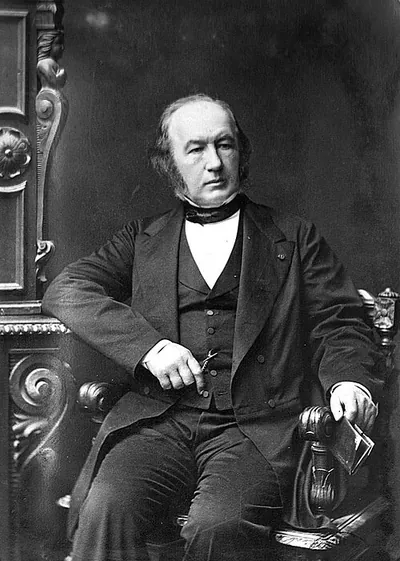 Claude Bernard1813–1878 · Biology
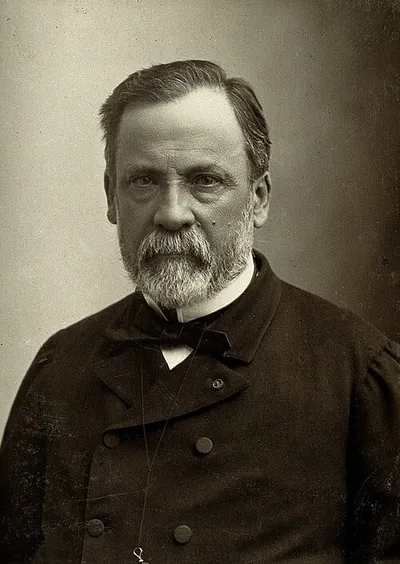 Louis Pasteur1822–1895 · Biology
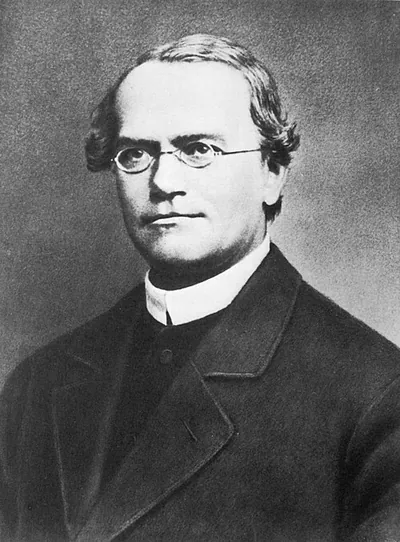 Gregor Mendel1822–1884 · Biology
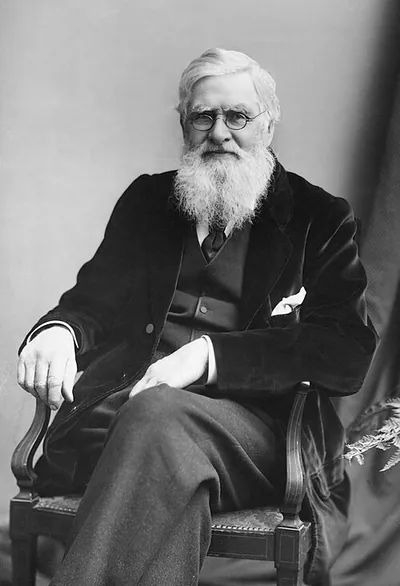 Alfred Russel Wallace1823–1913 · Biology
 Theodor Schwann1810–1882 · Biology
 Charles Darwin1809–1882 · Biology
