
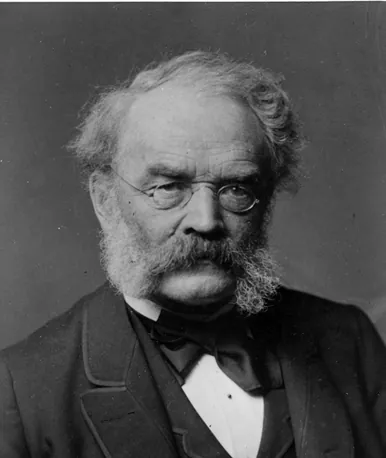
Carl Wilhelm Siemens
German-British electrical engineer and businessman, pioneer of telegraphy, submarine cables and the regenerative furnace · 1823–1883
- Born
- April 4, 1823
- Died
- November 19, 1883
- Country
- Kingdom of Prussia, United Kingdom of Great Britain and Ireland
- Section
- Energy
Biography
Carl Wilhelm Siemens (1823-1883), known in England as Sir Charles William Siemens, was a German-British electrical engineer and businessman. His regenerative furnace, which reuses the heat of outgoing gases to preheat air and fuel, gave its name to the Siemens-Martin process for making steel, while his work in telegraphy and submarine cables helped expand global communications in the nineteenth century.
He was born in Lenthe, near Hanover, the fourth of fourteen children, and his father was a tenant farmer. In the autumn of 1838, at fifteen, he began training as an engineer at a respected commercial school in Magdeburg. His eldest brother, Werner, taught him mathematics in exchange for English lessons, an arrangement that proved valuable to both. After their parents died, he studied at the University of Göttingen, where he briefly worked with the physicist Wilhelm Weber at his magnetic observatory. He then trained as a mechanical engineer, and his apprenticeship was cut from two years to one.
In 1843 he travelled to London as an agent for Werner, hoping to sell a patent and earn money to help educate his many younger siblings. He paid for the journey by selling an improvement to gold and silver plating, one of Werner's inventions, to George Richards Elkington. He knew the trip might come to nothing, but he stayed in England. In 1859 he married Anne Gordon of Edinburgh and became a British subject.
His first major work was about heat rather than electricity. Inspired by new ideas that treated heat as a form of energy, in 1847 he built at Bolton an engine of four horsepower with a condenser that recovered heat through regenerators. The design was not fully successful because superheated steam caused many practical problems, but the Society of Arts awarded him a gold medal in 1850. That year he opened the London sales office of Siemens & Halske, the firm Werner had founded in Berlin, and began selling telegraph equipment. The branch became Siemens Brothers in 1858 and entered the business of laying ocean cables. In 1867 the company completed the Indo-European telegraph line from Calcutta to London.
Around 1860 he built an experimental gas engine, but he abandoned it to concentrate on furnaces. His regenerative principle was applied in France in 1865 by Pierre-Émile Martin, creating the Siemens-Martin process, which transformed industrial steelmaking. Siemens had been a Fellow of the Royal Society since 1862 and became the first president of the Society of Telegraph Engineers in 1872. He was knighted a few months before he died in London on the night of 19 November 1883. He was buried at Kensal Green Cemetery, and Westminster Abbey installed a memorial stained-glass window in his honour.
Main contributions
- 1847Regenerative condenser: an experimental steam engine that recovers heat to reduce fuel use.
- 1858Siemens Brothers: the firm that took telegraphy and submarine cable laying to a large scale.
- 1860Experimental gas engine: a combustion engine that never got beyond the testing stage.
- 1865Siemens-Martin process: a steelmaking method in open-hearth furnaces based on his regenerative furnace.
- 1867Indo-European telegraph line: a telegraph connection from Calcutta to London.
- 1871Electric thermometer: an instrument for measuring ocean temperature at different depths during the Challenger expedition.
- 1881Electric street lighting in Godalming: a generator driven by a water mill powered the town's first public electric lighting.
Trivia and anecdotes
A one-pound journey
By his own account, the 1843 trip to London cost him one pound sterling, and he paid for it by selling Werner's plating improvement to Elkington.
Two oaths in one day
He liked to joke that on 19 March 1859 he swore loyalty to two women in a single day: Queen Victoria and his fiancée.
Related discoveries and inventions
- 1900Electric arc furnaceA furnace that melts and heats metal using an electric arc, a discharge of current that jumps between graphite electrodes and the charge.
Their contemporaries
While Carl Wilhelm Siemens was alive (1823–1883)…
Alive at the same time
Discovered or invented in those years
- 1839PhotographyA technique for creating lasting images by recording light, either on a light-sensitive material or with an electronic sensor.
- 1846NeptuneThe eighth and most distant planet of the Solar System, an ice giant found through mathematical prediction before any direct sighting.
- 1859EvolutionThe process by which the heritable traits of living populations change over generations, explaining the diversity of life from common ancestors.
- 1869Periodic tableAn arrangement of the chemical elements into rows (periods) and columns (groups), ordered by atomic number, that reveals recurring chemical behaviour and lets scientists predict properties.
- 1869Deoxyribonucleic acidA double-stranded molecule that carries the genetic instructions of nearly all living things and many viruses.
- 1876TelephoneA device that carries the human voice over distance by turning sound into electrical signals and back into sound at the other end of the line.
 Ignacy Łukasiewicz1822–1882 · Energy
 Étienne Lenoir1822–1900 · Energy
 Zénobe Gramme1826–1901 · Energy
 Charles Tellier1828–1913 · Energy
 George Henry Corliss1817–1888 · Energy
 Werner von Siemens1816–1892 · Energy
