
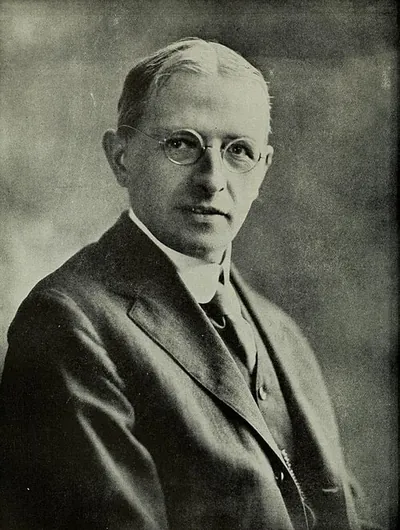
Charles Greeley Abbot
American astronomer who studied solar radiation and served as Secretary of the Smithsonian Institution · 1872–1973
- Born
- May 31, 1872
- Died
- December 17, 1973
- Country
- United States
- Section
- Astronomy and space
Biography
Charles Greeley Abbot (Wilton, New Hampshire, 1872 – Maryland, 1973) was an American astrophysicist who spent much of his life measuring the energy the Sun gives off. He later ran the Smithsonian Institution, the large scientific and museum body based in Washington. He lived through the shift from visual astronomy to precise physical measurement, and he is remembered for combining laboratory research with the running of a large institution.
Abbot was the youngest of four children born to farmers. As a boy he built his own tools and machines, including a forge for repairing tools, a water wheel that powered a saw, and a bicycle. He left school at thirteen to work as a carpenter, and two years later returned to study at Phillips Academy. He went with a friend to Boston to sit the entrance exam for the Massachusetts Institute of Technology, and when he felt uneasy about wandering the city alone, he decided to take the exam himself. He passed, and his family raised the money for a year of study. He began with chemical engineering, moved towards physics, and graduated in 1894 with a master's degree in physics.
In Boston he met Samuel Pierpont Langley, who was visiting the campus looking for an assistant. In 1895 Abbot joined the Smithsonian Astrophysical Observatory, where Langley hired him for his laboratory skills despite his lack of astronomical experience. Langley gradually turned his attention to aeronautics, and Abbot took over solar radiation research. He designed and built instruments to measure it. One was an improved bolometer, a device that detects heat from radiation, which let him measure the inner corona of the Sun during the eclipse of 28 May 1900 at Wadesboro, North Carolina. He later joined eclipse expeditions to Sumatra and travelled to Algeria, Egypt, South Africa and Australia, often with the National Geographic Society.
The central question was the solar constant, the amount of energy the Sun delivers per unit area per unit time to the top of the atmosphere. Abbot judged its accepted value to be poorly estimated and proposed a more exact figure of 1.93 calories per square centimetre per minute. Modern units, which use watts per square metre, express the same quantity differently. To answer critics who doubted ground-based readings, he attached pyrheliometers, instruments that measure direct sunlight, to balloons that rose to about 25 kilometres. He was the first American scientist to do this, and one flight gave him the solar constant at the highest point of the atmosphere. He also argued that the Sun was a variable star that affected the weather, an idea many colleagues rejected. In 1953 he claimed to have found a link between solar variations and climate, which he said could predict general climate patterns fifty years ahead; that claim should be read with caution. Later he focused on harnessing solar energy. He invented a solar cooker, first built at Mount Wilson Observatory, and a solar boiler, and held fifteen other patents related to solar power.
After Langley died in 1906, Abbot formally took charge of the observatory and kept the post until his retirement. In 1918 he became Assistant Secretary of the Smithsonian, overseeing the libraries, the International Exchange Service and the observatory. He helped launch the Smithsonian Scientific Series, which helped raise funds. On 10 January 1928 he succeeded Charles Doolittle Walcott as Secretary. His tenure spanned the Great Depression and the Second World War. The institution took part in Works Progress Administration projects, including the Federal Art Project, and started a radio programme, The World is Yours, which ended in 1942 because of the war. He failed to bring the National Gallery of Art into the Smithsonian. He retired in 1944, becoming the first Smithsonian Secretary to leave office alive, and handed his museum duties to Alexander Wetmore.
Outside work he sang and played the cello, performing for guests at the first Smithsonian holiday party. He was a deacon at the First Congregational Church in Washington and played tennis often. He belonged to the American Philosophical Society, the United States National Academy of Sciences and the American Academy of Arts and Sciences, and received the Henry Draper Medal in 1910 and the Rumford Medal in 1916. In 1955 the Smithsonian held a birthday party for him and presented a bronze bust, later donated to the National Gallery of Art. He died in Maryland on 17 December 1973, aged 101.
His legacy lives on in solar science and astronomy. A lunar crater has borne his name since 1973, and the American Solar Energy Society gives an award in his honour for solar research. His measurements and instruments helped establish the study of the Sun from high in the atmosphere, although some of his ideas about climate were never confirmed.
Main contributions
- 1900Measurement of the Sun's inner corona during the Wadesboro eclipse, using an improved bolometer he designed to detect radiant heat.
- 1906Direction of the Smithsonian Astrophysical Observatory after Langley's death, a post he held until retirement.
- 1925Publication of 'The Earth and the Stars', a popular work on the universe.
- 1925Publication of 'Great Inventions', a book on major inventions in history.
- 1929Publication of 'The Sun' and opening of the Radiation Biology Laboratory, which studied the effects of radiation on plants and other organisms.
- 1953A claimed link between solar variations and planetary climate, which he said allowed general climate patterns to be predicted fifty years ahead.
- A more exact value for the solar constant, 1.93 calories per square centimetre per minute, the solar energy reaching the atmosphere.
- Solar radiation readings from balloons reaching about 25 kilometres, the first of their kind by an American scientist.
Trivia and anecdotes
From carpenter to university
Abbot left school at thirteen to work as a carpenter and returned to study two years later.
A cello at the party
At the first Smithsonian holiday party he sang and played the cello for the guests.
An exam taken on a whim
He went to Boston with a friend for the MIT entrance exam and, feeling uneasy alone in the city, decided to sit it himself.
Their contemporaries
While Charles Greeley Abbot was alive (1872–1973)…
Alive at the same time
Discovered or invented in those years
- 1876TelephoneA device that carries the human voice over distance by turning sound into electrical signals and back into sound at the other end of the line.
- 1884CarA road vehicle with four wheels and its own engine, mainly built to carry people.
- 1903AirplaneA fixed-wing aircraft, heavier than air, powered by engines or rockets, that stays aloft because its wings generate lift.
- 1925TelevisionA system that sends moving pictures and sound over distance and shows them on a receiver, the television set.
- 1945ComputerA programmable machine that takes in data, processes it by following stored instructions, and produces results, able to switch tasks simply by running different software.
- 1969InternetA global network of interconnected computer networks that communicate using the TCP/IP protocol suite.
 Karl Schwarzschild1873–1916 · Astronomy and space
 Ejnar Hertzsprung1873–1967 · Astronomy and space
 Henrietta Swan Leavitt1868–1921 · Astronomy and space
 Henry Norris Russell1877–1957 · Astronomy and space
 Milutin Milanković1879–1958 · Astronomy and space
 Annie Jump Cannon1863–1941 · Astronomy and space
