
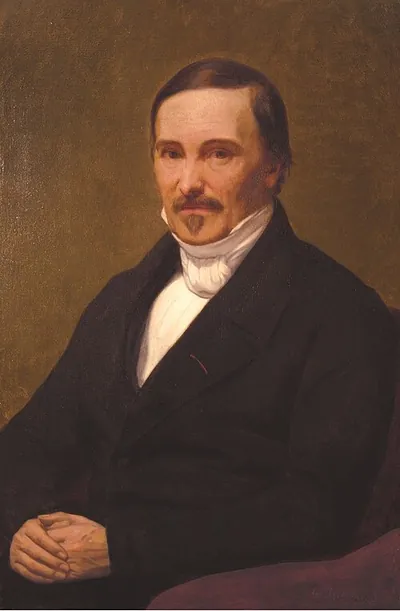
Claude-Louis Navier
French civil engineer and physicist, a pupil of Fourier and a pioneer of elasticity theory and fluid equations · 1785–1836
- Born
- February 10, 1785
- Died
- August 21, 1836
- Country
- France
- Section
- Engineering and construction
Biography
Claude-Louis Navier (Dijon, 1785 – Paris, 1836) was a French engineer and physicist who worked at the point where bridge building meets the mathematical study of materials and fluids. He lived through a France that was emerging from the Revolution and investing heavily in public works such as roads, canals and railways. His importance lies in bringing mathematics into structural design and in giving his name to equations that are still used to describe how fluids move.
His father, who had sat in the National Assembly during the Revolution, died in 1793, when Navier was about eight. His mother then left his education to his uncle, Émiland Gauthey, an engineer in the state Corps of Bridges and Roads, who steered him towards the same career. Navier entered the École polytechnique in 1802 and moved on to the École des Ponts et Chaussées in 1804, graduating in 1806. Sources describe him as a pupil of Joseph Fourier, and that connection shows in his determination to apply abstract analysis to practical problems.
He succeeded his uncle as inspector general of the Corps and directed the building of bridges at Choisy, Asnières and Argenteuil, in the Seine department. In Paris he built a footbridge to the Île de la Cité. His grand project, a suspension bridge near the Invalides, ended in failure. His 1824 design left too small a safety margin beyond what his calculations showed, and after cracks appeared the bridge had to be taken down. Earlier, opposition from the Paris municipal council had already stalled the scheme. A government committee criticised him for relying too heavily on mathematics, and his reputation as a builder suffered.
In theory, Navier gave elasticity, the ability of a material to return to its shape after being deformed, a general mathematical form in 1821, which made it usable by engineers. In 1819 he worked out the neutral line of a beam under bending, the line that is neither stretched nor squeezed, correcting results that had earlier been attributed to Galileo. In 1826 he treated the elastic modulus, a number describing how stiff a given material is, as a property of the material itself. His assumption that plane cross-sections stay plane after deformation became a foundation for structural calculation. He also wrote on navigation canals, proposed a railway between Paris and Le Havre, and studied railways during visits to England.
His best-known achievement came from a memoir on the laws of fluid motion, read in 1822. In it he described the flow of an incompressible fluid, one whose volume does not change under pressure, using a set of equations now known as the Navier–Stokes equations, named jointly with George Gabriel Stokes, who later contributed to their modern form. He entered the Académie des sciences in 1824. In 1830 he became a professor at the national school of bridges and roads and, the following year, professor of analysis and mechanics at the École polytechnique, replacing Cauchy, who had left the post.
Navier died in Paris in 1836. His legacy is divided between engineering, which inherited his methods of calculation, and mathematical physics, which still uses his equations. His name is one of the 72 inscribed on the Eiffel Tower, a recognition that reflects his standing as a central figure in the history of applied science.
Main contributions
- 1816Memoirs on navigation canals, a key subject of public works at the time.
- 1819Determination of the neutral line of stress in a beam under bending, correcting results attributed to Galileo.
- 1821A general formulation of elasticity theory in a mathematical form that engineers could use.
- 1822Equations describing the motion of an incompressible fluid, now known as the Navier–Stokes equations.
- 1826Establishment of the elastic modulus as a property belonging to each material.
- 1826Proposal for a railway between Paris and Le Havre, and a study of rail transport.
- 1830A report and memoir on suspension bridges, defending this type of structure.
Teachers and students
Trivia and anecdotes
A name on the Eiffel Tower
His name is among the 72 scientists and engineers inscribed on the Eiffel Tower.
The Invalides bridge
The collapse of his bridge near the Invalides cost him much of his reputation as a builder, and the criticism focused on his excessive trust in calculations.
Their contemporaries
While Claude-Louis Navier was alive (1785–1836)…
Alive at the same time
Discovered or invented in those years
- 1789UraniumA radioactive metal with atomic number 92, used as fuel in nuclear power plants and in nuclear weapons, and in various military and civilian applications.
- 1789CarbonA chemical element with symbol C and atomic number 6, the basis of organic chemistry and a component of all known life, found in materials as different as diamond and pencil lead.
- 1803AtomThe basic unit of a chemical element: a nucleus of protons and usually neutrons surrounded by a cloud of electrons.
- 1811MoleculeAn electrically neutral group of at least two atoms held together by chemical bonds in a defined arrangement.
- 1821ElectricityThe set of physical phenomena linked to the presence and movement of electric charge, and one of the most versatile forms of energy in modern life.
- 1825AluminiumA light, silvery metal, very abundant in Earth's crust, with symbol Al and atomic number 13, mainly obtained from bauxite ore.
 Marc Seguin1786–1875 · Engineering and construction
 Jean-Victor Poncelet1788–1867 · Engineering and construction
 Joseph Paxton1803–1865 · Engineering and construction
 Henry Darcy1803–1858 · Engineering and construction
 Isambard Kingdom Brunel1806–1859 · Engineering and construction
 John Augustus Roebling1806–1869 · Engineering and construction
