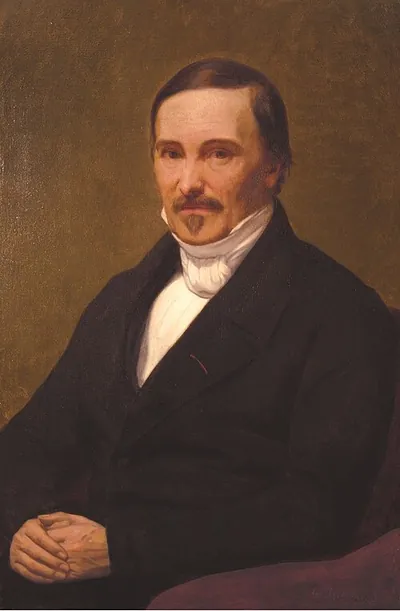
Jean-Victor Poncelet
French military engineer and mathematician who revived projective geometry · 1788–1867
- Born
- July 1, 1788
- Died
- December 22, 1867
- Country
- France
- Section
- Engineering and construction
Biography
Jean-Victor Poncelet (Metz, 1788 – Paris, 1867) was a French military engineer and mathematician best known for reviving projective geometry, the branch of mathematics that studies how figures keep certain properties when they are seen or projected from different viewpoints. His work turned this field into a central part of nineteenth-century pure mathematics, and his applied studies in mechanics and hydraulic engineering left a lasting mark on the design of machines.
Born on 1 July 1788 in Metz, he was the illegitimate son of a local lawyer and landowner, later legitimated. After his secondary schooling in his home town, he entered the École polytechnique in Paris, where he studied between 1808 and 1810 under teachers such as Gaspard Monge, Lazare Carnot and André-Marie Ampère. He then joined the military engineers and became a lieutenant in the same year he graduated, which some sources date to 1812.
That same year he took part in Napoleon's invasion of Russia. During the retreat, his unit was cut off from Marshal Michel Ney's army at the battle of Krasnoi and he was taken prisoner. His biographer says he was marched to Saratov on the Volga over the Russian winter, while other accounts claim he had been presumed dead. He remained in captivity from 1813 to 1814 without books or instruments. It was in that confinement, relying on memory, that he began shaping the principles of projective geometry that earlier thinkers such as Pappus, Girard Desargues and Pascal had explored. The story that modern projective geometry was born in that prison is often repeated, though it should be treated with some caution.
After returning to France in 1814, he could not publish his ideas right away. In 1822 his Traité des propriétés projectives des figures appeared, and it is regarded as the founding text of modern projective geometry. Joseph Diaz Gergonne had been writing on the subject in the journal he edited, and the two men fell into a bitter dispute over priority for the principle of duality, which links points and lines in a reciprocal way.
Between 1825 and 1835 he taught mechanics at the application school in Metz, his home town. There he improved the design of turbines and water wheels, drawing on the Provençal mill, and he worked on the use of mechanical work as a calculable quantity; he is credited with coining the phrase "mechanical work", though his independent contribution alongside Coriolis is debated. In 1837 a chair of physical and experimental mechanics was created for him at the Sorbonne. His book Introduction à la mécanique industrielle brought him fame among engineers of his day.
In 1848 he became commanding general of the École polytechnique, a post he held until his retirement in 1850. In those years he also published Applications d'analyse et de géométrie, which served as an introduction to his earlier work. He had become a foreign member of the Royal Society in 1842, and in 1865 was elected a foreign honorary member of the American Academy of Arts and Sciences. He died in Paris on 22 December 1867.
His legacy is twofold: the projective geometry he promoted became a key tool of modern mathematics, and his work on applied mechanics shaped the engineering of hydraulic machines. His name appears on the Eiffel Tower, and the Poncelet Prize, set up in 1868 by his widow, is still awarded by the French Academy of Sciences.
Main contributions
- 1822Traité des propriétés projectives des figures: a work that lays the foundations of modern projective geometry, with the principles of duality and continuity.
- 1822Poncelet–Steiner theorem: shows that compass-and-straightedge constructions can be done with a straightedge alone if a single circle and its centre are given.
- 1822Poncelet's porism: if a polygon is inscribed in one conic and circumscribed about another, it belongs to an infinite family of polygons with the same property.
- 1826Cours de mécanique appliquée aux machines: a course on applied mechanics for machines, based on his teaching in Metz.
- 1829Introduction à la mécanique industrielle: his best-known engineering work, in which he develops the use of mechanical work.
- 1838Improved design of turbines and water wheels, inspired by the Provençal mill.
Teachers and students
Trivia and anecdotes
A prison and a geometry
It is often repeated that modern projective geometry was born during his captivity in Saratov, but this story should be taken with caution.
His name on the Eiffel Tower
He is one of the 72 French scientists and engineers whose names are inscribed on the first stage of the Eiffel Tower.
Their contemporaries
While Jean-Victor Poncelet was alive (1788–1867)…
Alive at the same time
Discovered or invented in those years
- 1803AtomThe basic unit of a chemical element: a nucleus of protons and usually neutrons surrounded by a cloud of electrons.
- 1811MoleculeAn electrically neutral group of at least two atoms held together by chemical bonds in a defined arrangement.
- 1821ElectricityThe set of physical phenomena linked to the presence and movement of electric charge, and one of the most versatile forms of energy in modern life.
- 1839PhotographyA technique for creating lasting images by recording light, either on a light-sensitive material or with an electronic sensor.
- 1846NeptuneThe eighth and most distant planet of the Solar System, an ice giant found through mathematical prediction before any direct sighting.
- 1859EvolutionThe process by which the heritable traits of living populations change over generations, explaining the diversity of life from common ancestors.
 Marc Seguin1786–1875 · Engineering and construction
 Claude-Louis Navier1785–1836 · Engineering and construction
 Joseph Paxton1803–1865 · Engineering and construction
 Henry Darcy1803–1858 · Engineering and construction
 Isambard Kingdom Brunel1806–1859 · Engineering and construction
 John Augustus Roebling1806–1869 · Engineering and construction
