
Isambard Kingdom Brunel
British civil and marine engineer, responsible for the Great Western Railway and some of the largest steamships of his era · 1806–1859
- Born
- April 9, 1806
- Died
- September 15, 1859
- Country
- United Kingdom of Great Britain and Ireland
- Section
- Engineering and construction
Biography
Isambard Kingdom Brunel (Portsmouth, 1806 - London, 1859) was a British civil and marine engineer, one of the central figures of the Industrial Revolution and, according to many historians, the most eminent engineer of the Victorian age. He designed the main line of the Great Western Railway between London and Bristol, built some of the largest steamships of his time, and planned bridges and viaducts that changed how Britons travelled and moved goods. His career had notable technical successes, but also financial setbacks and serious accidents.
He was born on 9 April 1806 in Portsmouth, the only son of the Franco-British engineer Marc Isambard Brunel and Sophia Kingdom, the daughter of an English naval contractor. He had two elder sisters, Sophia and Emma. The family lived with great financial strain: his father was jailed for debt in 1821 and was freed only after a government loan that required him to remain in Britain. Marc Brunel was also his son's first teacher. He taught drawing, geometry and the basics of engineering, and young Isambard showed an early aptitude for mathematics and mechanics. At fourteen he was sent to France, first to the Henri IV college in Caen and then to the Lycée Henri-IV in Paris. As a foreigner he could not enter the famous École Polytechnique, so in 1822 he trained with the clockmaker Abraham-Louis Breguet, who taught him the precision of skilled handwork with metals and mechanisms.
Back in England from 1823, he worked with his father on projects including a plan for a canal in Panama, a floating pier in Liverpool and the Kensal Green Cemetery. That same year Marc Brunel devised a gas engine, an alternative to the steam engine that would run on gases expanding when heated. Isambard devoted almost a decade to the scheme, at great expense and without success, because the thermodynamic work of Sadi Carnot would later show that the engine could not work as hoped. By 1833 he acknowledged that about 15,000 pounds and much of his time had been wasted.
His real opportunity came in 1824, when his father was appointed engineer of a tunnel under the Thames between Rotherhithe and Wapping. The challenge was immense, since the riverbed was quicksand and waterlogged gravel. Marc Brunel took his inspiration from the shipworm, a mollusc that bores through wood, and designed an iron shield that protected the miners while they dug section by section. Isambard first worked as an assistant and in 1827 took charge of the works. In September 1826 he remained inside the tunnel for 96 hours, and on several occasions he risked his life rescuing workers. His biggest conflict, however, was with the Thames Tunnel Company, which put speed before safety and rejected drainage schemes proposed by his father on grounds of cost.
On 6 January 1828 the tunnel collapsed while Brunel was digging with the shield alongside two other miners. Six workers died, including the two who had been working with him, and Brunel survived with serious injuries after being nearly swept away by the water. He spent six months recovering, and work stopped for years. Some biographers link the accident to his declining health in later life. The tunnel was finally completed in 1843 to a different design, without his involvement, and was opened to trains in 1869.
While recuperating in Clifton, Bristol, he began designing a suspension bridge over the Avon Gorge. In the 1829 competition he submitted four proposals, but a committee led by Thomas Telford rejected them. After a second competition his design was again not chosen. Work started in 1831 but stopped for lack of funds and because of the Bristol riots of that year, which broke out when the House of Lords blocked electoral reform. Brunel died before the bridge was finished. His colleagues at the Institution of Civil Engineers raised new funds and completed it in 1864, altering the original design considerably.
In 1833 he was appointed chief engineer of the Great Western Railway, linking London with Bristol. He made two controversial choices: a track gauge of 2.14 metres, much wider than the Stephenson gauge used on most British lines, and a route that avoided the major towns of the region. He argued that his broad gauge gave more stability, higher speeds and greater carrying capacity. He designed viaducts, stations and tunnels, among them the Box Tunnel, then the longest in the world. After his death, Parliament required the network to be converted to standard gauge, a change completed in May 1892.
Another bold venture was the atmospheric railway between Exeter and Newton. Trains were pulled by pumps that created a partial vacuum in a pipe laid between the rails. The leather flap that sealed the pipe was softened with tallow, which attracted rats that gnawed it, so the system ran only from September 1847 to September 1848. Meanwhile Brunel brought his engineering to Atlantic crossings. He held that a ship's cargo capacity grows with the cube of its dimensions, while its resistance grows only with the square. The Great Western, launched in 1838, reached New York in 15 days and five hours, arriving with a third of its coal still on board. Next came the Great Britain, an iron-hulled ship driven by a propeller, launched in 1843 and crossing the Atlantic in 1845. She ran aground in 1846 but later served on routes to Australia, and today she has been restored in Bristol.
His last great naval project was the Great Eastern, begun in 1852, the largest ship of its day, fitted with both a propeller and paddle wheels. Financial and technical difficulties dogged her, and she never achieved commercial success as a transatlantic liner. Brunel died in London on 15 September 1859, shortly after a major explosion aboard this vessel. His legacy is twofold: his works remain in use, such as the Thames tunnel, now part of the London Overground, and his ships anticipated techniques that would later become standard. In 2002 the BBC voted him the second greatest Briton in history.
Main contributions
- 1825Thames Tunnel, designed by his father and directed by Isambard from 1827; the first tunnel under a navigable river, built through a long and dangerous process.
- 1831Clifton Suspension Bridge over the River Avon, designed by Brunel, whose works stopped and which was completed in 1864 with changes to his plan.
- 1833Great Western Railway, the London to Bristol line whose route and works were Brunel's, although its broad gauge was eventually abandoned.
- 1838Maidenhead Railway Bridge, with flat brick arches of great span, still in use and the world's flattest brick arch bridge in terms of rise to span.
- 1838Great Western, the first steamship designed for regular Atlantic crossings, using a theory on ship size that was proven in practice.
- 1843Great Britain, an iron-hulled ship driven by a propeller, which crossed the Atlantic in 1845 and is considered a precursor of modern ships.
- 1847South Devon atmospheric railway, a system that pushed trains by vacuum and failed because of the deterioration of its leather seal.
- 1859Royal Albert Bridge over the Tamar estuary, with two central spans of 139 metres, completed shortly before his death.
Teachers and students
Trivia and anecdotes
A tunnel aligned with the sun
It is said that the Box Tunnel was aligned so that the sun lit its full length on Brunel's birthday. It is a popular story that documents do not confirm.
Relics from a coat
After visiting the workers during their dinner in the Thames Tunnel, he was greeted with applause, and the workers' wives cut pieces from his coat to keep as keepsakes.
Rats on the atmospheric railway
The leather seal of the atmospheric system was greased with tallow to keep it flexible, which made it very attractive to rats that ended up eating it.
Their contemporaries
While Isambard Kingdom Brunel was alive (1806–1859)…
Alive at the same time
Discovered or invented in those years
- 1811MoleculeAn electrically neutral group of at least two atoms held together by chemical bonds in a defined arrangement.
- 1821ElectricityThe set of physical phenomena linked to the presence and movement of electric charge, and one of the most versatile forms of energy in modern life.
- 1838ProteinLarge biomolecules made of chains of amino acids that carry out structural, catalytic, transport, defensive and regulatory functions in living things.
- 1839PhotographyA technique for creating lasting images by recording light, either on a light-sensitive material or with an electronic sensor.
- 1846NeptuneThe eighth and most distant planet of the Solar System, an ice giant found through mathematical prediction before any direct sighting.
- 1859EvolutionThe process by which the heritable traits of living populations change over generations, explaining the diversity of life from common ancestors.
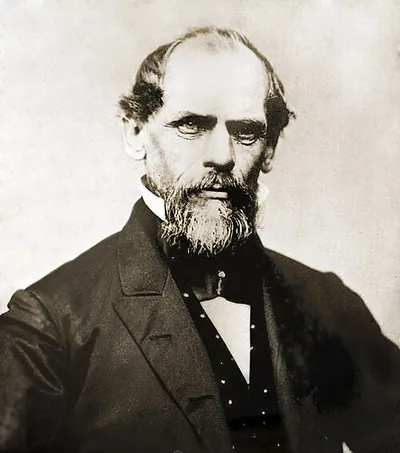 John Augustus Roebling1806–1869 · Engineering and construction
 Cyrus McCormick1809–1884 · Engineering and construction
 Joseph Paxton1803–1865 · Engineering and construction
 Henry Darcy1803–1858 · Engineering and construction
 Henry Bessemer1813–1898 · Engineering and construction
 Ildefons Cerdà1815–1876 · Engineering and construction
