
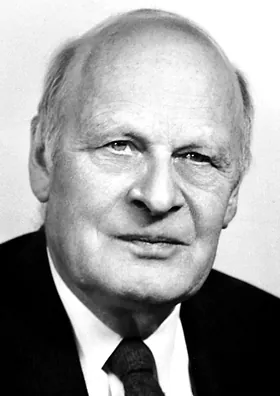
Cyril Norman Hinshelwood
British chemist specialising in chemical kinetics, awarded the 1956 Nobel Prize in Chemistry for his work on the mechanisms of chemical reactions · 1897–1967
- Born
- June 19, 1897
- Died
- October 9, 1967
- Country
- United Kingdom
- Section
- Chemistry
- Awards
- Nobel Prize in Chemistry
Biography
Sir Cyril Norman Hinshelwood (London, 1897 - London, 1967) was a British physical chemist who spent his career working out how fast chemical reactions happen and which steps they follow along the way. In 1956 he shared the Nobel Prize in Chemistry with the Soviet chemist Nikolay Semenov for their research into the mechanisms of chemical reactions. He lived through the first half of the twentieth century, when physical chemistry was becoming a discipline of its own, and his work matters because it showed that many transformations do not happen in a single step but through intermediate stages that can be studied one at a time.
He was born in London on 19 June 1897, the son of Norman Macmillan Hinshelwood, a chartered accountant, and Ethel Frances Smith. His early childhood was spent in Canada, where the family had moved. After his father's death, he returned to England in 1905 and settled with his family in a flat in Chelsea, the district where he would live for the rest of his life. He was educated first at Westminster City School and then at Balliol College, Oxford, the university that would become the centre of his working life.
During the First World War he worked as a chemist in an explosives factory, an experience that brought him into close contact with fast reactions and with the conditions that make them dangerous or controllable. After the war he was a tutor at Trinity College, Oxford, from 1921 to 1937, and in the latter year he became Dr Lee's Professor of Chemistry at the university. His doctoral supervisor had been Harold Hartley, a prominent figure in Oxford chemistry whose influence on him was considerable. He also served on several advisory councils on scientific questions for the British Government, which drew him into debates about science beyond the laboratory.
His research started from a simple question: a chemical reaction does not simply happen when substances are mixed, and it often passes through intermediate steps that are not visible at first. Chemical kinetics is the study of how quickly reactions occur and which factors change that speed, such as temperature, pressure or the presence of other substances. Hinshelwood believed that by measuring how the speed changes, one could work out the path the molecules follow when they react. His early studies of molecular kinetics led to The Kinetics of Chemical Change in Gaseous Systems in 1926, a book that organised the field of gas reactions. In the same year he also published Thermodynamics for Students of Chemistry, which explained the principles of energy in reactions for newcomers.
The case that occupied him most was the combination of hydrogen and oxygen. Together with Harold Warris Thompson he studied the explosive reaction between the two gases and described what is now called a chain reaction: once started, each step produces the conditions for the next one to occur, so the process feeds itself. This explained why a mixture of gases could seem stable and then suddenly explode. Hinshelwood set out much of this work in The Reaction between Hydrogen and Oxygen, published in 1934.
His conclusions largely agreed with those of Semenov, who had pursued the same question independently. The two were rewarded in 1956 for their investigations into how chemical reactions proceed. Hinshelwood had been a Fellow of the Royal Society since 1929 and served as its president from 1955 to 1960. He was knighted in 1948 by King George VI and was appointed to the Order of Merit in 1960. He received many other honours and honorary degrees, and he presided over several scientific bodies, among them the Chemical Society and the Faraday Society.
In his personal life, Hinshelwood never married. He was fluent in seven classical and modern languages, and his main interests were painting, collecting Chinese pottery and reading foreign literature. As an artist he painted scenes of Oxford and portraits of university figures, including one of Harold Hartley, his former doctoral supervisor. That portrait now belongs to the Royal Society, while several of his other paintings are held by Trinity College. He died at home in Chelsea on 9 October 1967.
His legacy falls into several areas. His work on chemical change in the bacterial cell, gathered in The Chemical Kinetics of the Bacterial Cell (1946), proved important for later research on antibiotics and therapeutic agents, and a follow-up volume on growth and regulation in bacterial cells appeared in 1966. In 1951 he published The Structure of Physical Chemistry, which Oxford University Press reissued in 2005 in its series of classic texts in the physical sciences. The Langmuir-Hinshelwood process in heterogeneous catalysis also bears his name: it describes how, when reactants stick to a surface, that adsorption step can set the pace for the whole reaction. A lunar crater is also named in his memory.
Main contributions
- 1926The Kinetics of Chemical Change in Gaseous Systems: a book that organised the study of reaction speeds in gases.
- 1934The Reaction between Hydrogen and Oxygen: a study of the explosive mixture of both gases, describing the chain reaction.
- 1946The Chemical Kinetics of the Bacterial Cell: a study of chemical changes inside bacteria, useful for later research on antibiotics.
- 1951The Structure of Physical Chemistry: a synthesis of the principles of the discipline, reissued by Oxford in 2005.
- Chain reaction: a process in which each step creates the conditions for the next, so the reaction feeds itself.
- Langmuir-Hinshelwood process: a model of surface catalysis in which the sticking of reactants can be the step that sets the speed of the whole reaction.
Teachers and students
Studied under:
Taught:
Trivia and anecdotes
A medal with a history
His Nobel medal was sold by his estate to a collector in 1968, who resold it in 1976 for 15,000 dollars. In 2017 it was sold at auction for 128,000 dollars.
A portrait painter
Alongside his science, he painted scenes of Oxford and portraits of university figures, including one of his former doctoral supervisor, Harold Hartley.
A crater on the Moon
A lunar crater bears his name in his memory, an unusual honour for a chemist.
Their contemporaries
While Cyril Norman Hinshelwood was alive (1897–1967)…
Alive at the same time
Discovered or invented in those years
- 1897ElectronA negatively charged subatomic particle found in every atom, and key to electricity and chemical bonding.
- 1903AirplaneA fixed-wing aircraft, heavier than air, powered by engines or rockets, that stays aloft because its wings generate lift.
- 1925TelevisionA system that sends moving pictures and sound over distance and shows them on a receiver, the television set.
- 1925Quantum mechanicsPhysical theory describing how matter and light behave at atomic and subatomic scales, where energy is exchanged in minimal packets and results are expressed as probabilities.
- 1931Big BangA cosmological model describing how the universe expanded from an early state of extreme density and temperature, about 13.8 billion years ago.
- 1945ComputerA programmable machine that takes in data, processes it by following stored instructions, and produces results, able to switch tasks simply by running different software.
 Wallace Carothers1896–1937 · Chemistry
 Linus Pauling1901–1994 · Chemistry
 Harold Urey1893–1981 · Chemistry
 Lars Onsager1903–1976 · Chemistry
