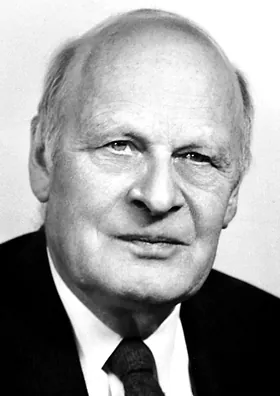
Lars Onsager
Norwegian-American physical chemist and theoretical physicist, 1968 Nobel laureate in Chemistry · 1903–1976
- Born
- November 27, 1903
- Died
- October 5, 1976
- Country
- Norway, United States, Kingdom of the Netherlands
- Section
- Chemistry
- Awards
- Nobel Prize in Chemistry
Biography
Lars Onsager (Oslo, 1903 - Coral Gables, 1976) was a Norwegian-born physical chemist and theoretical physicist who spent most of his career in the United States. Working between physical chemistry and statistical physics, he explained how substances behave when they dissolve, spread out and change state. He received the Nobel Prize in Chemistry in 1968. His career unfolded at a time when theoretical physics was reshaping chemistry, and his work linked the two fields.
He was born in Oslo, then called Kristiania, which still belonged to a personal union with Sweden: the two countries shared a king, Oscar II, but Norway had its own constitution and government. His father was a lawyer. After secondary school he enrolled at the Norwegian Institute of Technology (NTH) in Trondheim and graduated as a chemical engineer in 1925. While there he worked independently through A Course of Modern Analysis, a textbook of mathematical analysis that stayed with him throughout his career and later proved crucial.
In 1925 he examined the Debye-Hückel theory of electrolyte solutions, which describes salts and other substances that conduct electricity when dissolved in water. The theory explained how ions arrange themselves around each charged particle. Onsager proposed a correction that accounted for the Brownian motion of the ions, the random jostling of particles suspended in a fluid, and published it in 1926. He travelled to Zurich to confront Peter Debye, telling him his theory was mistaken. The young engineer impressed the physicist so much that Debye invited him to become his assistant at the Swiss Federal Institute of Technology (ETH), where he stayed until 1928.
That year he crossed the Atlantic to take a teaching post in chemistry at Johns Hopkins University in Baltimore. He was assigned introductory classes, and it soon became clear that although he was brilliant at building theories, he had little talent for teaching them. He left after one semester. He then moved to Brown University in Providence, where he taught statistical mechanics to chemistry graduate students. This field explains the properties of matter from the collective behaviour of its atoms and molecules. He was no better as a teacher there, but his contributions to statistical mechanics and thermodynamics were significant. His students nicknamed his course "Sadistical Mechanics".
His research at Brown focused on how temperature gradients affect diffusion, the way substances mix on their own. This work produced the Onsager reciprocal relations, a set of equations published in 1929 and expanded in 1931. For years their importance went largely unnoticed. Their value became clear in the decades after the Second World War, and by 1968 they were considered important enough to earn him the Nobel Prize. One of his graduate students, Raymond Fuoss, worked under him and eventually joined the chemistry faculty at Yale.
In 1933 the Great Depression reduced Brown's budget, and the university let him go, since it could not keep a staff member who was useful only as a researcher. That year he travelled to Austria to visit the electrochemist Hans Falkenhagen. There he met Margrethe Arledter, Falkenhagen's sister-in-law. They married on 7 September 1933 and had three sons and a daughter.
Yale hired him as a postdoctoral fellow, only to discover that he had never received a doctorate. The NTH had judged his outline of the reciprocal relations too incomplete to serve as a dissertation, and Yale offered him the option of submitting one of his published papers. He preferred to undertake a new research project. His dissertation, on solutions of the Mathieu equation, provided the mathematical basis for explaining deviations from Ohm's law in weak electrolytes, solutions that conduct current poorly. It was so advanced that the chemistry and physics faculty could not follow it. The mathematician Einar Hille and other colleagues argued that it deserved a degree, and the doctorate in chemistry was granted in 1935. He had already been appointed assistant professor in 1934 and promoted to associate professor in 1940. His statistical mechanics courses were nicknamed "Advanced Norwegian I" and "Advanced Norwegian II" because students found them incomprehensible.
In the late 1930s he studied the dipole theory of dielectrics, insulating materials whose molecules behave like tiny electric magnets, and improved on a topic Debye had already investigated. When he submitted the paper to a journal Debye edited, in 1936, it was rejected. Debye did not accept his ideas until after the war.
During the 1940s he turned to the statistical theory of phase transitions in solids, the changes in internal order that occur when a material shifts state, such as a magnet losing its magnetism when heated. In 1944 he obtained the exact solution of the two-dimensional Ising model in zero magnetic field, a simple model of particles with orientations on a flat lattice. It is widely regarded as a tour de force of mathematical physics. To solve it he diagonalised matrices of growing size, from 2 by 2 up to 64 by 64, and uncovered an algebraic structure now known as the Onsager algebra. He later said he had plenty of spare time during the war to pursue the problem.
After the war he turned to liquid helium. In 1949 he proposed a theoretical explanation for its superfluidity, the ability to flow without friction, and two years later the physicist Richard Feynman reached the same conclusion independently. He also worked on liquid crystals, the electrical properties of ice and the magnetism of metals. He became a naturalised American citizen in 1945, the same year he was named J. Willard Gibbs Professor of Theoretical Chemistry, a fitting title, since like Gibbs he applied mathematics to problems in physics and chemistry. He retired from Yale in 1972 and moved to the University of Miami, where he continued to guide young researchers. He died in Coral Gables in 1976 from an aneurysm.
His legacy takes several forms. In 1993 the NTH created a professorship and a lecture series in his name, and the American Physical Society established a prize in statistical physics that same year. In 1997 his children donated his scientific papers to the university in Trondheim, his alma mater, where they are now kept in the Lars Onsager Archive.
Quotes
“To be any more immaculate they will have to begin sterilizing the paper as well as the theorem !”
“The results are not bad when you consider the enormity of the swindle which I have perpetrated!”
“It is like trying to discover how the telephone system works by measuring the fluctuations in the electric power used by the telephone company.”
“There are a lot of folks, some quite talented, who arm themselves with methods and then go hunting for vulnerable problems; but to accept a problem on its own terms and then forge your own weapon--now that's real class!”
Main contributions
- 1925A correction to the Debye-Hückel theory of electrolyte solutions, accounting for the Brownian motion of the ions.
- 1929The Onsager reciprocal relations, equations describing how irreversible processes such as diffusion and heat flow influence one another, published in expanded form in 1931.
- 1935Doctoral dissertation on the Mathieu equation, laying the groundwork for explaining deviations from Ohm's law in weak electrolytes.
- 1944Exact solution of the two-dimensional Ising model in zero field, describing magnetic ordering and phase changes on a flat lattice.
- 1949A theoretical explanation of the superfluidity of liquid helium, its ability to flow without friction.
Teachers and students
Studied under:
Taught:
Trivia and anecdotes
"Sadistical Mechanics"
Students at Brown nicknamed his statistical mechanics course this way, a playful reference to how hard it was.
A late doctorate
He worked at Yale as a fellow without ever having earned a doctorate, which was finally granted in 1935 after mathematicians backed his dissertation.
An asterisk on the gravestone
His original gravestone read simply "Nobel Laureate". When his wife died in 1991, their children added an asterisk and "etc." in the lower corner.
Related discoveries and inventions
- 1931Onsager reciprocal relationsAn equality linking the cross-flows of systems out of equilibrium to the thermodynamic forces that drive them, formulated by Lars Onsager in 1931.
Their contemporaries
While Lars Onsager was alive (1903–1976)…
Alive at the same time
Discovered or invented in those years
- 1903AirplaneA fixed-wing aircraft, heavier than air, powered by engines or rockets, that stays aloft because its wings generate lift.
- 1925TelevisionA system that sends moving pictures and sound over distance and shows them on a receiver, the television set.
- 1925Quantum mechanicsPhysical theory describing how matter and light behave at atomic and subatomic scales, where energy is exchanged in minimal packets and results are expressed as probabilities.
- 1931Big BangA cosmological model describing how the universe expanded from an early state of extreme density and temperature, about 13.8 billion years ago.
- 1945ComputerA programmable machine that takes in data, processes it by following stored instructions, and produces results, able to switch tasks simply by running different software.
- 1969InternetA global network of interconnected computer networks that communicate using the TCP/IP protocol suite.
 Giulio Natta1903–1979 · Chemistry
 Linus Pauling1901–1994 · Chemistry
 Willard Libby1908–1980 · Chemistry
 Cyril Norman Hinshelwood1897–1967 · Chemistry
 Dorothy Hodgkin1910–1994 · Chemistry
