
David Ruelle
Belgian-born, naturalized French mathematical physicist known for work on dynamical systems and statistical physics · 1935
- Born
- August 20, 1935
- Country
- Belgium, France
- Section
- Physics
Biography
David Pierre Ruelle is a Belgian-born, naturalized French mathematical physicist, born on 20 August 1935. His work sits at the border between physics and mathematics, and he is best known for coining, together with Floris Takens, the term strange attractor, a tool for understanding systems whose behaviour changes chaotically. His work matters because it connected fields that had largely developed separately: quantum field theory, statistical mechanics and the study of dynamical systems.
Ruelle studied physics at the Free University of Brussels, where he earned his PhD in 1959 under the supervision of Res Jost, a theoretical physicist working on the mathematical foundations of quantum field theory. He then spent two years at ETH Zurich (1960–1962) and another two at the Institute for Advanced Study in Princeton (1962–1964), one of the most influential centres for theoretical research of the period. In 1964 he joined the Institut des Hautes Études Scientifiques (IHES) at Bures-sur-Yvette, near Paris, where he spent most of his career.
In quantum field theory, his most important contribution was a rigorous account of scattering processes, the way particles collide and fly apart, built on Wightman's axiomatic approach, which sets out the basic mathematical rules a quantum field theory must obey. The method is known as Haag–Ruelle scattering theory, named after him and Rudolf Haag.
He later turned to statistical mechanics, the field that explains the behaviour of large groups of particles from their individual motion. Ruelle helped build a rigorous foundation for equilibrium in this area. His work covered the thermodynamic limit, which describes how a system behaves as its size grows without bound, the equivalence of ensembles (different ways of describing the same system at equilibrium) and the convergence of Mayer's series, a set of tools for calculating the properties of gases. The Asano–Ruelle lemma, which helps locate the zeros of certain polynomial functions that arise in these models, also carries his name.
Studying infinite systems led him to sharpen the definitions of Gibbs states, which describe equilibrium locally, and of equilibrium states, which describe it globally. Working with Roland Dobrushin and Oscar Lanford, he showed that translationally invariant Gibbs states are exactly the equilibrium states, linking the two viewpoints.
His work on turbulence is perhaps the best known beyond academia. With Takens he proposed that the turbulence of fluids could be described by strange attractors, geometric structures towards which a system's motion settles and whose movement is chaotic, meaning very sensitive to initial conditions. The idea changed how scientists thought about the move from order to chaos in fluids, although the original proposal was debated and later refined.
Ruelle has received many honours. He has been a member of the French Academy of Sciences since 1985, gave the Josiah Willard Gibbs Lecture in Atlanta in 1988, and has been a member of the Academia Europaea since 1993 and of the US National Academy of Sciences since 2002. His awards include the Dannie Heineman Prize for Mathematical Physics (1985), the Boltzmann Medal (1986), the Holweck Prize (1993), the Matteucci Medal (2004), the Henri Poincaré Prize (2006) and the Max Planck Medal (2014). In 2022 he shared the ICTP Dirac Medal with Elliott Lieb and Joel Lebowitz.
He is now emeritus professor at the IHES and distinguished visiting professor at Rutgers University, a position he has held since 2000. His legacy lies in showing that mathematical rigour and physical intuition can strengthen each other, and in giving the physics of chaos a geometric language that researchers still use.
Main contributions
- 1959Haag–Ruelle scattering theory: a rigorous formulation of particle collision and scattering processes within quantum field theory.
- 1968With Dobrushin and Lanford, a proof that translationally invariant Gibbs states are the equilibrium states.
- 1969A rigorous theory of equilibrium statistical mechanics, covering the thermodynamic limit and the equivalence of ensembles.
- 1970Asano–Ruelle lemma: a result that helps study the location of the zeros of certain polynomial functions used in statistical mechanics.
- 1971Strange attractor: a concept proposed with Floris Takens to describe the chaotic motion of a system towards a geometric structure.
- 1971A description of hydrodynamic turbulence based on strange attractors, proposed with Floris Takens.
Teachers and students
Their contemporaries
While David Ruelle was alive (1935–)…
Alive at the same time
Discovered or invented in those years
- 1945ComputerA programmable machine that takes in data, processes it by following stored instructions, and produces results, able to switch tasks simply by running different software.
- 1957Artificial satelliteAn artificial satellite is a human-made object placed in orbit around a celestial body, usually Earth, to collect information, relay signals, or carry out a specific task.
- 1969InternetA global network of interconnected computer networks that communicate using the TCP/IP protocol suite.
- 1971EmailA network service that lets users send and receive digital messages through addressed mailboxes, much like postal mail but electronic.
- 1973Mobile phoneA handheld wireless phone that lets people make and receive calls while moving across a cellular network area.
- 1989World Wide WebA system of linked documents and resources, connected by hyperlinks and accessed over the Internet with web browsers.
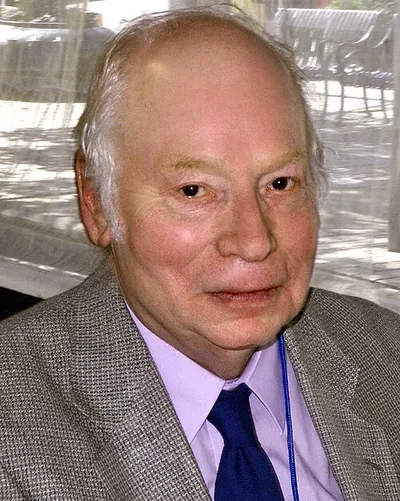 Steven Weinberg1933–2021 · Physics
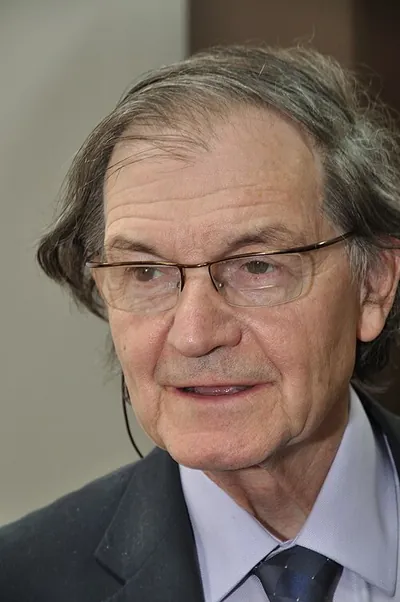 Roger Penrose1931 · Physics
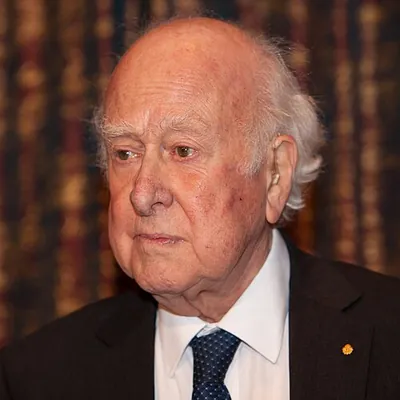 Peter Higgs1929–2024 · Physics
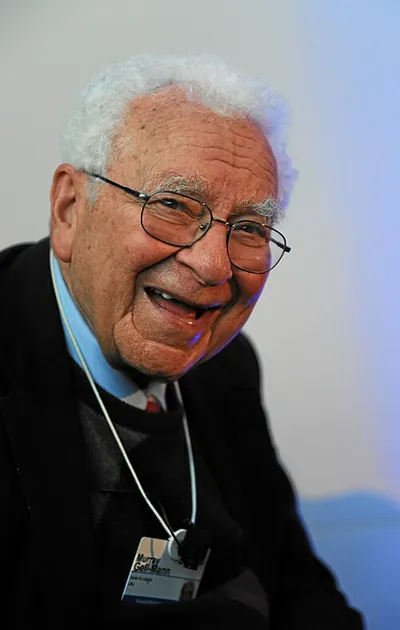 Murray Gell-Mann1929–2019 · Physics
 John Stewart Bell1928–1990 · Physics
 Stephen Hawking1942–2018 · Physics
