
Eric Allin Cornell
American physicist who, with Carl Wieman, created the first Bose-Einstein condensate and shared the 2001 Nobel Prize in Physics · 1961
- Born
- December 19, 1961
- Country
- United States
- Section
- Physics
- Awards
- Nobel Prize in Physics
Biography
Eric Allin Cornell (born in Palo Alto, California, in 1961) is an American physicist who, together with Carl Wieman, produced the first Bose-Einstein condensate in 1995. This is a state of matter in which a cloud of very cold atoms starts to behave like a single quantum wave. For this work he shared the 2001 Nobel Prize in Physics with Wieman and Wolfgang Ketterle. The achievement matters because it turned a prediction made decades earlier by Satyendra Bose and Albert Einstein into something that could be observed in a laboratory, and it opened a research field that remains active.
Cornell was born in Palo Alto while his parents were finishing graduate degrees at nearby Stanford University. Two years later the family moved to Cambridge, Massachusetts, where his father was a professor of civil engineering at MIT. He grew up there with his younger brother and sister and spent year-long stays in Berkeley and Lisbon, accompanying his father during sabbaticals. He attended Cambridge Rindge and Latin School, but the year before graduating he moved back to California with his mother and finished high school at Lowell High School in San Francisco, a public magnet school for academically gifted students.
At Stanford he worked as an assistant in several campus groups that studied low-temperature physics, and his grades and lab work pointed toward a scientific career. He was not certain, though, that physics was the path he wanted, and he also considered a future in literature or politics. Halfway through his undergraduate years he spent nine months in China and Taiwan as a volunteer, teaching conversational English and studying Chinese. When he returned to Stanford he committed to physics and graduated in 1985 with honors and distinction.
For his doctorate he went back to MIT and joined David Pritchard's group. The team was running an experiment to measure the mass of the electron neutrino, a tiny particle with almost no mass that is emitted when tritium undergoes beta decay. Cornell did not manage to pin down the neutrino's mass, but he earned his PhD in 1990.
After his doctorate he joined Carl Wieman's group at the University of Colorado Boulder as a postdoctoral researcher, working on a small laser cooling experiment. Laser cooling uses light to slow atoms and lower their temperature. During his two postdoctoral years he devised a plan to combine laser cooling with evaporative cooling inside a magnetic trap. Evaporative cooling works a little like blowing on a hot cup of coffee: the most energetic particles escape, and the rest of the sample becomes colder. His proposal earned him a permanent position at JILA, the joint institute of the university and NIST in Boulder.
In 1995 Cornell and Wieman produced the first Bose-Einstein condensate, cooling a dilute gas of atoms to temperatures close to absolute zero. That same year he married Celeste Landry, only months before the experiment succeeded. In 1997 the physicist Deborah S. Jin joined his group at JILA, and in 2003 she led the team that produced a fermionic condensate, a related state made from a different class of particles called fermions. Cornell received the Lorentz Medal in 1998 and the Nobel Prize in 2001, which recognized the achievement of Bose-Einstein condensation in dilute gases of alkali atoms and the early fundamental studies of the condensates' properties. Today he is a professor at the University of Colorado Boulder and a physicist at the National Institute of Standards and Technology (NIST) of the United States Department of Commerce, with his laboratory at JILA. He was elected a Fellow of the American Academy of Arts and Sciences in 2005.
In his personal life, in October 2004 he suffered a severe infection called necrotizing fasciitis, and surgeons amputated his left arm and shoulder to stop its spread. He left the hospital in mid-December, recovered from the infection, and returned to work part-time in April 2005. He and Celeste have two daughters, born in 1996 and 1998. Since moving to Boulder in 1990 he has run the Bolder Boulder race several times, most recently in 2022.
Cornell's legacy lies in creating a new form of matter that now serves to study quantum phenomena on a visible scale. His combination of laser and evaporative cooling became a standard tool in laboratories that work with ultracold atoms, and his work helped make quantum physics something that can be examined directly in the lab.
Main contributions
- 1990Proposal to combine laser cooling with evaporative cooling in a magnetic trap, the method that made the condensate possible.
- 1995First Bose-Einstein condensate made from a dilute gas of atoms, a state of matter in which the atoms behave as a single quantum wave.
- 2001Nobel Prize in Physics, shared with Carl Wieman and Wolfgang Ketterle, for Bose-Einstein condensation in dilute gases of alkali atoms.
- 2003Fermionic condensate produced by Deborah S. Jin's team within Cornell's group, a variant of the condensate made from a different class of particles.
Teachers and students
Trivia and anecdotes
A neutrino experiment without a result
During his doctorate at MIT he tried to measure the mass of the electron neutrino but did not determine it. He still earned his degree in 1990.
A year of volunteering in Asia
Halfway through his undergraduate studies he spent nine months in China and Taiwan teaching conversational English and studying Chinese, before returning to Stanford to focus on physics.
Back to work after an amputation
After the 2004 amputation he returned to work part-time in April 2005, and since 1990 he has run the Bolder Boulder race several times.
Their contemporaries
While Eric Allin Cornell was alive (1961–)…
Alive at the same time
Discovered or invented in those years
- 1969InternetA global network of interconnected computer networks that communicate using the TCP/IP protocol suite.
- 1971EmailA network service that lets users send and receive digital messages through addressed mailboxes, much like postal mail but electronic.
- 1973Mobile phoneA handheld wireless phone that lets people make and receive calls while moving across a cellular network area.
- 1975Global warmingThe long-term rise in Earth's average surface temperature, driven mainly by greenhouse gases released through human activity.
- 1989World Wide WebA system of linked documents and resources, connected by hyperlinks and accessed over the Internet with web browsers.
- 1990Web browserA program that lets people access the web by fetching a page's files from a server and displaying them on screen as an interactive page.
 Donna Strickland1959 · Physics
 Stephen Hawking1942–2018 · Physics
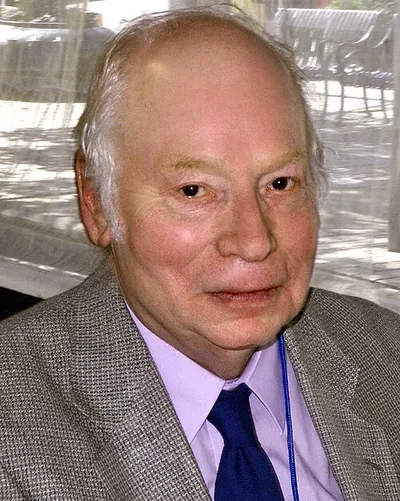 Steven Weinberg1933–2021 · Physics
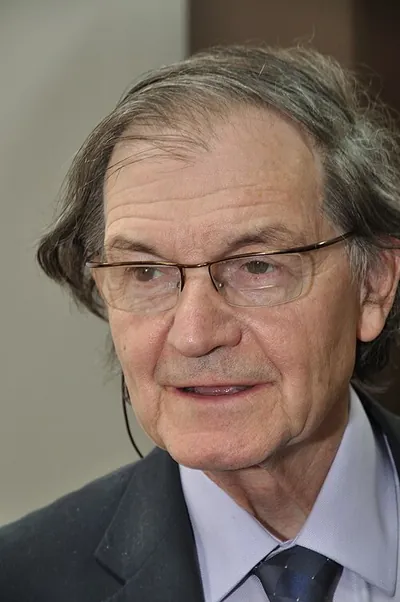 Roger Penrose1931 · Physics
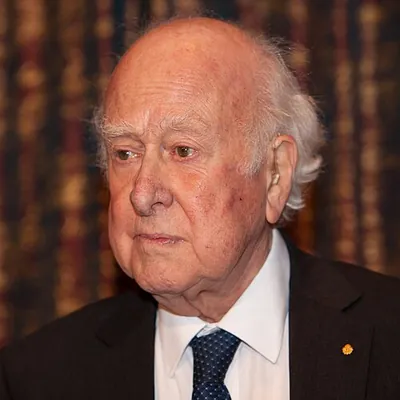 Peter Higgs1929–2024 · Physics
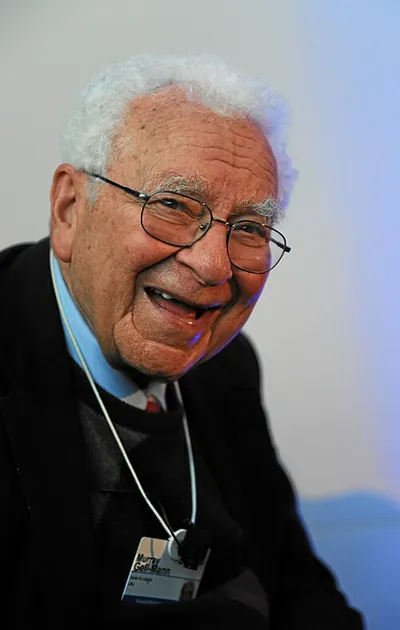 Murray Gell-Mann1929–2019 · Physics
