
Wolfgang Ketterle
German physicist, MIT professor, co-creator of the atomic Bose-Einstein condensate and 2001 Nobel Prize in Physics laureate · 1957
- Born
- October 21, 1957
- Country
- Germany
- Section
- Physics
- Awards
- Nobel Prize in Physics
Biography
Wolfgang Ketterle is a German physicist and professor at the Massachusetts Institute of Technology (MIT). He is known for experiments that trap and cool atoms to temperatures close to absolute zero, the lowest temperature possible. In 1995 his group was among the first to produce a Bose-Einstein condensate, a state of matter predicted in the 1920s by Satyendra Nath Bose and Albert Einstein, in which many thousands of atoms behave as a single giant wave. For this achievement, and for early fundamental studies of these condensates, he shared the 2001 Nobel Prize in Physics with Eric A. Cornell and Carl E. Wieman. His work belongs to the field of ultracold atoms, which studies matter under conditions far removed from everyday life.
Ketterle was born in Heidelberg, in the German state of Baden-Württemberg, and attended school in the nearby towns of Eppelheim and Heidelberg. In 1976 he enrolled at the University of Heidelberg, but two years later he moved to the Technical University of Munich, where he earned the equivalent of a master's diploma in 1982. He then pursued doctoral studies at the Ludwig Maximilian University of Munich, completing a PhD in 1986 in experimental molecular spectroscopy. Spectroscopy studies the light that molecules absorb or emit in order to deduce their structure and behaviour. He carried out this work under the supervision of Herbert Walther and Hartmut Figger at the Max Planck Institute for Quantum Optics in Garching. Afterwards he did postdoctoral research in Garching and at the University of Heidelberg.
In 1990 he joined the group of David E. Pritchard at the Research Laboratory of Electronics at MIT, a centre where atoms and light were studied together. He was appointed to the MIT physics faculty in 1993 and has held the John D. MacArthur Professorship of Physics since 1998. In 2006 he became associate director of the laboratory and began directing MIT's Center for Ultracold Atoms, a role that reflects how central this research line became to his career.
The core of his work is cooling clouds of atoms with lasers and magnetic fields until quantum effects, normally hidden at human scales, become observable. At such temperatures, particles lose much of their individuality and gather into a shared quantum state. That is the Bose-Einstein condensate his group produced in dilute gases in 1995. Two years later the team made two colliding condensates interfere with each other, showing that these clouds of atoms behave like waves, much as light does. In the same period they built the first "atom laser", the atomic counterpart of an optical laser: a coherent beam of atoms, whose waves are aligned and in step, instead of a coherent beam of light.
His later research continued along these lines. In 2003 his group created a condensate made of molecules rather than single atoms. In 2005 it reported evidence for superfluidity at what was considered a "high" temperature in a condensate of fermions. Fermions are particles, such as electrons, that cannot occupy the same quantum state as an identical particle. Superfluidity is a state in which a fluid flows without friction and without losing energy. These results position ultracold gases as a laboratory for studying quantum phenomena that are hard to observe in other systems.
Ketterle has also taken part in public debates about the support of basic science. In May 2008 he was one of twenty American Nobel laureates in physics who signed a letter to President George W. Bush. The letter urged him to reverse the damage done to basic research in the 2008 fiscal year budget, asking for emergency funding for the Department of Energy's Office of Science, the National Science Foundation and the National Institute of Standards and Technology.
Outside the laboratory, Ketterle is a long-distance runner. He was featured in the December 2009 issue of Runner's World in a section about runners. He completed the 2013 Boston Marathon in 2 hours, 49 minutes and 16 seconds, and in 2014, again in Boston, he ran a personal best of 2 hours, 44 minutes and 6 seconds. He has recalled bringing his running shoes to Stockholm when he received the Nobel Prize, and running in the early evening there. He was married to Gabriele Ketterle from 1985 to 2001, and they had three of his five children. Since 2011 he has been married to Michèle Plott. He sits on the board of trustees of the Center for Excellence in Education, which runs the Research Science Institute, a programme for high-school students. His son Jonas attended that programme in 2003.
Ketterle's legacy is tied to the creation of Bose-Einstein condensates in atomic gases and to the techniques his group developed to control them. These experiments turned ultracold atoms into a tool for studying quantum effects that had previously existed only in theory, and they opened a line of research that remains active in laboratories around the world.
Main contributions
- 1995Bose-Einstein condensate in dilute atomic gases: a state of matter in which many atoms occupy the same quantum state.
- 1997Interference between two condensates: two colliding clouds of atoms show wave-like behaviour, as light does.
- 1997First atom laser: a coherent beam of atoms, the atomic equivalent of an optical laser.
- 2003Molecular condensate: a condensate made of molecules rather than only single atoms.
- 2005Evidence of superfluidity at a temperature considered high in a fermion condensate, made of particles such as electrons.
Teachers and students
Studied under:
Taught:
Trivia and anecdotes
Running shoes in Stockholm
Ketterle has said he brought his running shoes to Stockholm, where he received the Nobel Prize, and went running in the early evening.
A record in Boston
In 2014 he ran the Boston Marathon in 2 hours, 44 minutes and 6 seconds, his personal best.
A letter to the president
In 2008 he signed, with nineteen other American physics Nobel laureates, a letter to President Bush asking for funding for basic science.
Their contemporaries
While Wolfgang Ketterle was alive (1957–)…
Alive at the same time
Discovered or invented in those years
- 1957Artificial satelliteAn artificial satellite is a human-made object placed in orbit around a celestial body, usually Earth, to collect information, relay signals, or carry out a specific task.
- 1969InternetA global network of interconnected computer networks that communicate using the TCP/IP protocol suite.
- 1971EmailA network service that lets users send and receive digital messages through addressed mailboxes, much like postal mail but electronic.
- 1973Mobile phoneA handheld wireless phone that lets people make and receive calls while moving across a cellular network area.
- 1989World Wide WebA system of linked documents and resources, connected by hyperlinks and accessed over the Internet with web browsers.
- 1990Web browserA program that lets people access the web by fetching a page's files from a server and displaying them on screen as an interactive page.
 Donna Strickland1959 · Physics
 Stephen Hawking1942–2018 · Physics
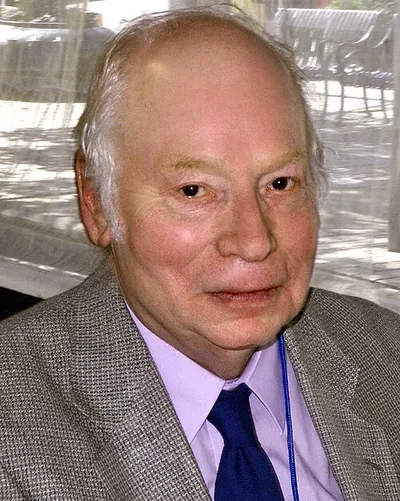 Steven Weinberg1933–2021 · Physics
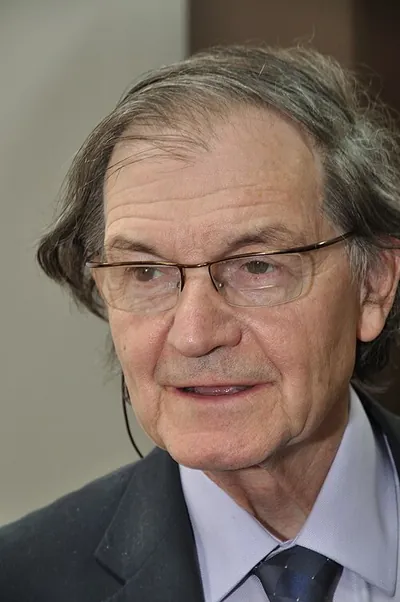 Roger Penrose1931 · Physics
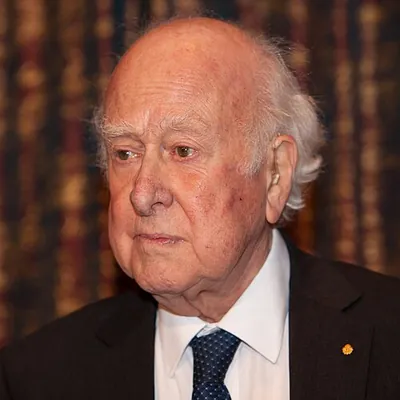 Peter Higgs1929–2024 · Physics
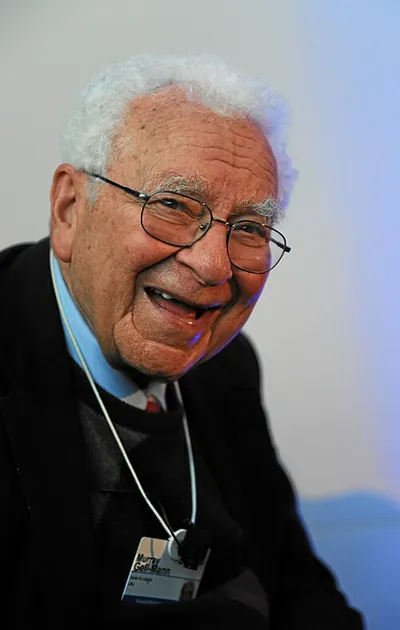 Murray Gell-Mann1929–2019 · Physics
