Esther Szekeres
Hungarian-born Australian mathematician who was part of a circle of young mathematicians in Budapest and later promoted maths enrichment for high-school students in Australia · 1910–2005
- Born
- February 20, 1910
- Died
- August 28, 2005
- Country
- Australia
- Section
- Mathematics
Biography
Esther Szekeres (Budapest, 1910 - Adelaide, 2005) was a mathematician of Hungarian Jewish origin who spent most of her later life in Australia. Her name is linked to a combinatorial problem that gave rise to one of the best-known stories in twentieth-century mathematics, and above all to a long-running programme of mathematical enrichment for secondary-school students that is still active decades after it began.
Born Esther Klein on 20 February 1910 in Budapest, then in the Kingdom of Hungary, she came from a Jewish family. She studied physics in the Hungarian capital at a time when the city hosted a remarkable circle of young people who loved hard mathematical puzzles. Among them were Paul Erdős, George Szekeres, Pál Turán and her former schoolfriend Márta Svéd, who met to discuss problems, often at a cafe in Budapest's City Park.
In 1933 Esther put a geometry puzzle to the group: among any five points scattered on a plane, with no three in a line, some four always form a convex quadrilateral, a shape with no inward dents. Erdős called it the Happy Ending problem, because it led Esther to her marriage to George Szekeres in 1937, and the couple had two children. Erdős and George went on to publish work on the question, though Esther's part in that later research is rarely mentioned. The name has stuck as a light-hearted reminder of how the puzzle brought the two together.
When the Second World War broke out in 1939, the couple left Europe. They spent the war years in Hongkew, a district of Shanghai that housed refugees, and reached Australia in 1945. They first settled in Adelaide, where they shared a small flat with the Svéds for about three years, and moved to Sydney in 1964.
In Sydney, Esther lectured at Macquarie University and became deeply involved in enriching the maths education of high-school pupils. In 1984 she co-founded a weekly maths meeting for students which grew into a network of about thirty groups, still meeting every week and inspiring pupils across Australia and New Zealand. In 2004 the couple returned to Adelaide, and on 28 August 2005 they died within an hour of each other.
Her legacy combines research in combinatorics with a lasting commitment to teaching. Macquarie awarded her an honorary doctorate in 1990, and in 1993 she received the BH Neumann Award from the Australian Mathematics Trust.
Main contributions
- 1933Posing the Happy Ending problem: among any five points in a plane, with no three in a line, four always form a convex quadrilateral.
- 1984Co-founding a weekly maths enrichment meeting for high-school students, which grew into about thirty groups across Australia and New Zealand.
Trivia and anecdotes
A Budapest café
The young mathematicians often met at the Anonymous, a café in Budapest's City Park.
Deaths an hour apart
Esther and George died in Adelaide within an hour of each other on 28 August 2005.
Their contemporaries
While Esther Szekeres was alive (1910–2005)…
Alive at the same time
Discovered or invented in those years
- 1916Black holeA region of space where gravity is so strong that nothing, not even light, can escape once it crosses a certain boundary.
- 1925TelevisionA system that sends moving pictures and sound over distance and shows them on a receiver, the television set.
- 1925Quantum mechanicsPhysical theory describing how matter and light behave at atomic and subatomic scales, where energy is exchanged in minimal packets and results are expressed as probabilities.
- 1931Big BangA cosmological model describing how the universe expanded from an early state of extreme density and temperature, about 13.8 billion years ago.
- 1945ComputerA programmable machine that takes in data, processes it by following stored instructions, and produces results, able to switch tasks simply by running different software.
- 1969InternetA global network of interconnected computer networks that communicate using the TCP/IP protocol suite.
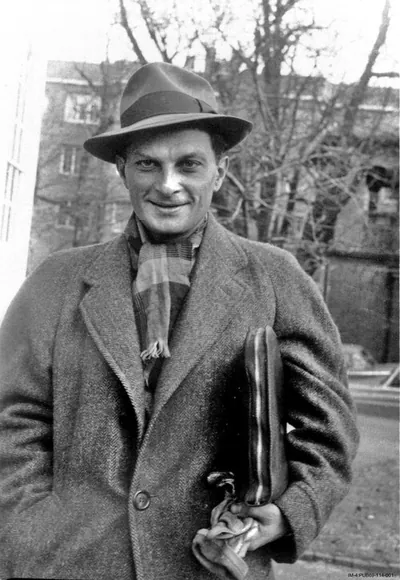 Stanisław Ulam1909–1984 · Mathematics
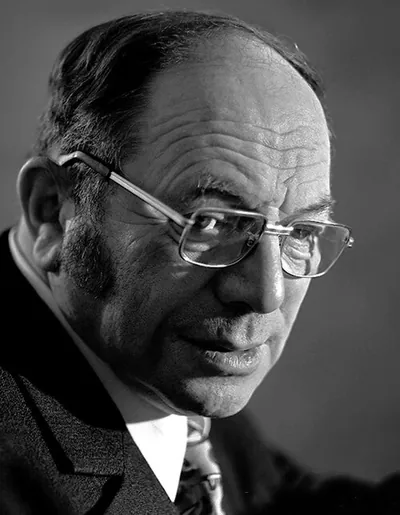 Leonid Kantorovich1912–1986 · Mathematics
 Paul Erdős1913–1996 · Mathematics
 Andrey Kolmogorov1903–1987 · Mathematics
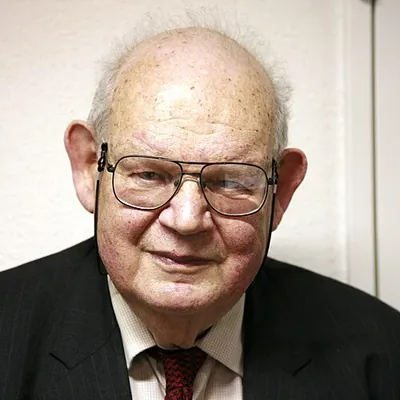 Benoit Mandelbrot1924–2010 · Mathematics
 John Tate1925–2019 · Mathematics