
Evgeny Velikhov
Soviet and Russian physicist, scientific director of the Kurchatov Institute and a leading figure in the ITER nuclear fusion project · 1935–2024
- Born
- February 2, 1935
- Died
- December 5, 2024
- Country
- Russia
- Section
- Physics
- Awards
- Abel Prize
Biography
Evgeny Velikhov (1935-2024) was a Russian physicist and one of the most influential scientific leaders of the Soviet Union and of post-Soviet Russia. His research covered plasma physics, lasers, controlled nuclear fusion, power engineering and magnetohydrodynamics, the study of electrically conducting fluids, such as ionized gases, moving under magnetic fields. His importance lies both in his own discoveries and in his role as an organizer of science during an era of large international programmes.
He graduated in physics from Moscow State University in 1958, specializing in theoretical physics, and studied as a graduate student from 1958 to 1961. He then joined the Institute of Atomic Energy, the forerunner of the Kurchatov Institute, where he spent almost his entire career as he rose to its leadership. His early work on instabilities in fluids and plasmas led him to describe the magnetorotational instability in 1959 and the electrothermal instability in 1962. An instability, in this sense, is a process in which a small disturbance grows until it fundamentally changes a system. He defended his thesis in 1964 and later received a doctorate in physics and mathematics.
In 1968 he became a professor of atomic physics, plasma physics and microelectronics at Moscow State University, and in 1973 he took charge of the department, a post he held until 1988. From 1971 to 1978 he directed the Magnetic Laboratory at Troitsk, near Moscow, which belonged first to the Academy of Sciences and later to the Kurchatov Institute, and he pushed research on high-energy plasmas there. In 1972 he founded a department for energy and space plasma research at the Moscow Institute of Physics and Technology, known as Phystech, and in 1976 he became the first dean of its Faculty of Physics for Energy, which worked on fusion together with quantum optics, lasers and space technology.
His public profile grew through the 1980s. In 1986 he advised the Soviet leader Mikhail Gorbachev and took part in the clean-up after the Chernobyl disaster. In 1988 he was named director of the Kurchatov Institute and chairman of the international programme to build ITER, an experimental fusion reactor of the tokamak type, a doughnut-shaped device that confines plasma with magnetic fields. He served as its president from 1992 until his death and in 2009 was elected chair of ITER's governing council. He also led Rosshelf, a Gazprom subsidiary developing seabed oil and gas production, and chaired the board of RELCOM.
Velikhov was elected to the Soviet Academy of Sciences in 1974, served as its vice-president from 1978 to 1991, and then held the same post in the Russian Academy of Sciences until 1996. He received many honours, including the Lenin Prize in 1984 and the USSR State Prize in 1977. He died in Moscow on 5 December 2024, aged 89. His legacy combines an extensive scientific output of more than 1500 publications with a lasting push for international cooperation on nuclear fusion, a goal that ITER still pursues.
Main contributions
- 1959Magnetorotational instability: a phenomenon in electrically conducting fluids under magnetic fields and rotation in which small disturbances grow.
- 1962Electrothermal instability: an instability in plasmas and fluids driven by electrical heating.
- 1976Founding of the Faculty of Physics for Energy at Phystech, focused on fusion, plasmas and lasers.
- 1988Appointment as director of the Kurchatov Institute and chairman of the international programme for the ITER fusion reactor.
- 2009Election as chair of the ITER Council, the governing body of the project.
Teachers and students
Studied under:
Taught:
Trivia and anecdotes
Adviser to Gorbachev
In 1986 he advised Soviet leader Mikhail Gorbachov, at a time of great tension after the Chernobyl accident.
Soviet Academy honour
He was elected corresponding member of the Soviet Academy of Sciences in 1968 and became a full member in 1974.
Their contemporaries
While Evgeny Velikhov was alive (1935–2024)…
Alive at the same time
Discovered or invented in those years
- 1945ComputerA programmable machine that takes in data, processes it by following stored instructions, and produces results, able to switch tasks simply by running different software.
- 1957Artificial satelliteAn artificial satellite is a human-made object placed in orbit around a celestial body, usually Earth, to collect information, relay signals, or carry out a specific task.
- 1969InternetA global network of interconnected computer networks that communicate using the TCP/IP protocol suite.
- 1971EmailA network service that lets users send and receive digital messages through addressed mailboxes, much like postal mail but electronic.
- 1973Mobile phoneA handheld wireless phone that lets people make and receive calls while moving across a cellular network area.
- 1989World Wide WebA system of linked documents and resources, connected by hyperlinks and accessed over the Internet with web browsers.
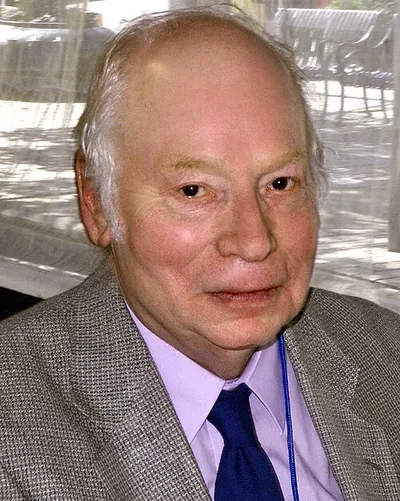 Steven Weinberg1933–2021 · Physics
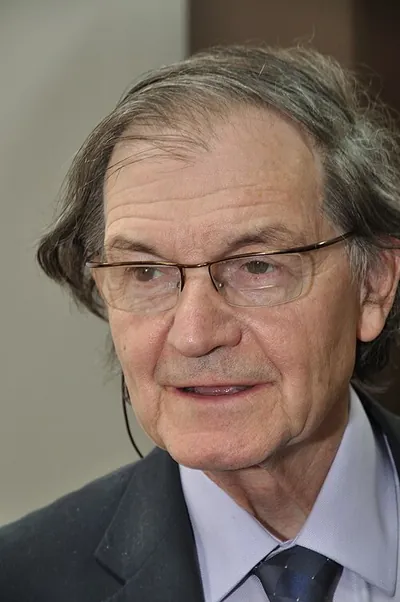 Roger Penrose1931 · Physics
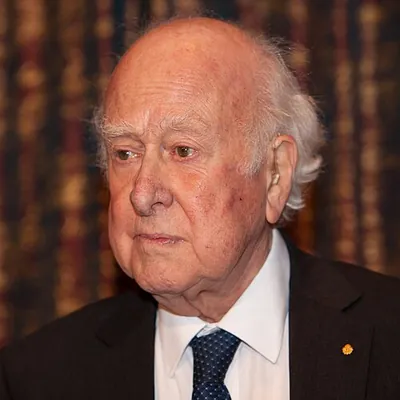 Peter Higgs1929–2024 · Physics
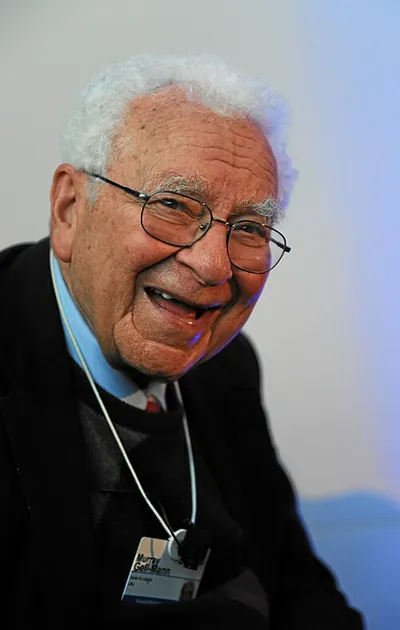 Murray Gell-Mann1929–2019 · Physics
 John Stewart Bell1928–1990 · Physics
 Stephen Hawking1942–2018 · Physics
