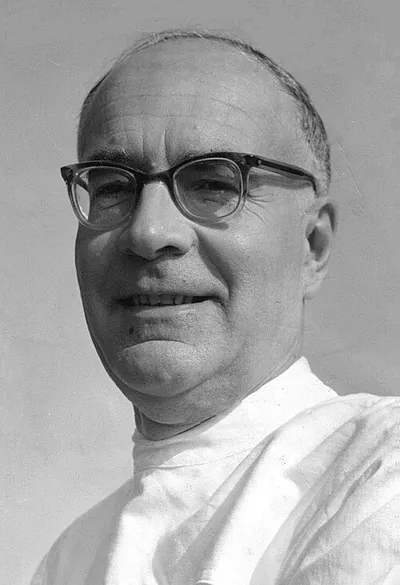
Francis Thomas Bacon
English engineer who built one of the first practical hydrogen–oxygen fuel cells · 1904–1992
- Born
- December 21, 1904
- Died
- May 24, 1992
- Country
- United Kingdom, United Kingdom of Great Britain and Ireland
- Section
- Energy
Biography
Francis Thomas "Tom" Bacon (1904–1992) was an English engineer who built one of the first practical hydrogen–oxygen fuel cells. His work matters because his design, known as the alkaline fuel cell, went on to supply electricity and drinking water aboard NASA spacecraft during the Apollo era.
Born on 21 December 1904 at Ramsden Hall in Billericay, Essex, Bacon was a descendant of the family of the philosopher Francis Bacon, who had no children. He was educated at Eton College and Trinity College, Cambridge. After university he became an apprentice at an engineering firm in Newcastle owned by Sir Charles Parsons, whose influence shaped his approach. Unlike many earlier fuel cell researchers, Bacon was a trained engineer who felt at ease with machinery running at high temperatures and pressures.
A fuel cell produces electricity through a controlled chemical reaction between a fuel gas and oxygen, without burning anything. Sir William Robert Grove had shown the principle in 1839, but the idea stayed largely dormant for more than a century. Bacon started from Grove's approach, which used platinum electrodes and sulphuric acid as the electrolyte, the liquid that carries electric charge between the electrodes. Soon he switched to activated nickel electrodes and a potassium hydroxide solution, which proved easier to work with.
In January 1940 he moved to a laboratory at King's College London, where he designed a double cell. One half produced hydrogen and oxygen through electrolysis, meaning the splitting of water by an electric current, while the other half acted as the fuel cell itself. Because the unit could run in reverse, it could serve both purposes. High operating temperatures, high pressures and corrosive chemicals caused serious trouble.
In 1946, with new funding, the work moved to the Department of Colloid Science at Cambridge University. There his team was shown a sample of porous nickel sheet whose origins were so secret that it fell under the British Official Secrets Act. They used it to make electrodes with large pores on the gas side and finer pores on the electrolyte side, creating a far more stable interface. When funding grew, the apparatus moved to the Department of Chemical Engineering, where the team reduced corrosion of the oxygen electrode by soaking the nickel electrodes in lithium hydroxide, then drying and heating them.
In 1959, with support from Marshall of Cambridge Ltd, later Marshall Aerospace, he publicly demonstrated a 5 kW unit made of forty cells, with an efficiency of 60 per cent. The patents were licensed to Pratt and Whitney, which used them in a winning bid to supply electrical power for NASA's Apollo programme. Fuel cells suited the mission because, unlike heat engines, their efficiency rises as the load falls. Hydrogen and oxygen were already carried on board for propulsion and life support, and the water produced by the reaction could be drunk or used to humidify the cabin air.
Late in life he worked as a consultant for Energy Conversion Limited and Johnson Matthey. He was a founder fellow of the Fellowship of Engineering, now the Royal Academy of Engineering, and was made an OBE in 1967. He died on 24 May 1992. His alkaline design still carries his name and is often called the Bacon fuel cell.
Main contributions
- 1940Reversible double cell: one unit generates hydrogen and oxygen while the other works as a fuel cell, so the set can operate in both directions.
- 1946Dual-porosity nickel electrodes, made from a porous nickel sheet, that stabilise the boundary between gas and electrolyte.
- 19595 kW alkaline fuel cell with forty cells and an efficiency of 60 per cent, publicly demonstrated.
- Fuel cells for NASA's Apollo programme, which generated electricity and drinkable water on board the spacecraft during the 1960s.
Trivia and anecdotes
A thank-you at the White House
It is said that US President Richard Nixon welcomed him to the White House and told him: "Without you Tom, we wouldn't have gotten to the moon."
Meeting the astronauts
After the Apollo 11 landing in July 1969, he and his wife Barbara met Neil Armstrong, Buzz Aldrin and Michael Collins at a reception hosted by British Prime Minister Harold Wilson at 10 Downing Street.
Their contemporaries
While Francis Thomas Bacon was alive (1904–1992)…
Alive at the same time
Discovered or invented in those years
- 1916Black holeA region of space where gravity is so strong that nothing, not even light, can escape once it crosses a certain boundary.
- 1925TelevisionA system that sends moving pictures and sound over distance and shows them on a receiver, the television set.
- 1925Quantum mechanicsPhysical theory describing how matter and light behave at atomic and subatomic scales, where energy is exchanged in minimal packets and results are expressed as probabilities.
- 1931Big BangA cosmological model describing how the universe expanded from an early state of extreme density and temperature, about 13.8 billion years ago.
- 1945ComputerA programmable machine that takes in data, processes it by following stored instructions, and produces results, able to switch tasks simply by running different software.
- 1969InternetA global network of interconnected computer networks that communicate using the TCP/IP protocol suite.
 Igor Kurchatov1903–1960 · Energy
 Felix Wankel1902–1988 · Energy
 Walter Zinn1906–2000 · Energy
 John R. Dunning1907–1975 · Energy
 Mária Telkes1900–1995 · Energy
 Nikolay Dollezhal1899–2000 · Energy