
Frank Conrad
American electrical engineer and pioneer of radio broadcasting and shortwave radio · 1874–1941
- Born
- May 4, 1874
- Died
- December 11, 1941
- Country
- United States
- Section
- Technology and communications
Biography
Frank Conrad (1874-1941) was an American electrical engineer who spent half a century at Westinghouse and is remembered as a pioneer of radio. He worked at a time when radio was still a hobby for amateurs. His importance lies in showing that a station could entertain the public and in opening the way to shortwave transmission.
He was born on May 4, 1874, in Pittsburgh, the son of a railroad mechanic. He left school after seventh grade, although in 1928 the University of Pittsburgh gave him an honorary doctorate in science. He joined Westinghouse at 16 and in 1897 created a circular watt-hour meter, a device that measures how much electricity a home uses. He was granted more than 200 patents in several countries.
His interest in radio began in 1913 with a bet over whose watch was more accurate. He won partly because he had secretly swapped the works of his cheap watch for those of a more expensive one. Doubting the time signals sent by the Western Union telegraph service, he built a receiver to pick up those of the Naval Observatory, broadcast from Arlington, Virginia. He then built a transmitter to talk with his neighbour John Coleman and other amateurs. In 1916 he obtained the experimental licence 8XK for a station in a Wilkinsburg garage, which at first could send only Morse code.
In 1917 the United States entered the First World War and civilian stations were silenced. Conrad worked on radio equipment for the Army, where voice transmission was tested. This was made possible by vacuum tubes, electronic valves that amplify signals.
After the war ended, in October 1919, Conrad began broadcasting again, playing records from his collection for local amateurs. The novelty proved popular, though some neighbours phoned to ask him to stop. To get fresh material he struck a deal with the Brunswick Shop: he received new records in exchange for mentioning the store on air. His sons and a niece performed live, and a telephone line carried the family piano from the house to the garage.
In late 1920 the Joseph Horne department store advertised in Pittsburgh papers that its staff had heard a concert from Conrad's station. Westinghouse vice president H. P. Davis then pushed for a company station that would help sell receivers. The company launched its service on election night, November 2, from station 8ZZ, later KDKA, while Conrad broadcast the victory of Warren G. Harding from his garage and stood ready to take over if it failed.
He stopped broadcasting music but kept experimenting. While studying harmonics, unwanted signals at higher frequencies than the main one, he found that they sometimes carried farther than the original signal, which was thought impossible. This led him to shortwave. In 1924 he showed RCA's David Sarnoff that weak signals from East Pittsburgh could be heard in London on a simple receiver with a curtain rod as its antenna, at a small fraction of the cost of RCA's transatlantic system.
He retired in 1940 and died in Miami in December 1941 after a heart attack. He received the 1930 Edison Medal for his work in broadcasting and shortwave radio. His legacy is in showing that radio could reach the public and in advancing shortwave. In 2001 the garage that housed 8XK was dismantled and placed in storage by the National Museum of Broadcasting, with the hope of rebuilding it one day.
Main contributions
- 1897Circular watt-hour meter, a device that records how much electricity is used.
- 1916Experimental licence for his station 8XK, which at first sent only Morse code.
- 1919Early entertainment broadcasts after the war, playing records for local amateurs.
- 1920Broadcast of Harding's election victory from his garage, on the night station 8ZZ, later KDKA, went on air.
- 1924Demonstration that low-power shortwave could cover long distances with simple equipment.
- 1928Converter that turned cinema film into a television signal.
Trivia and anecdotes
A bet over watches
His interest in radio started with a bet, which he won by a trick: he secretly swapped the innards of his cheap watch for those of an expensive one.
Calls at all hours
According to his wife, neighbours phoned him at all hours asking him to get off the air.
A garage in a museum
The garage that housed station 8XK was dismantled in 2001 and stored by a museum, with the idea of rebuilding it.
Their contemporaries
While Frank Conrad was alive (1874–1941)…
Alive at the same time
Discovered or invented in those years
- 1876TelephoneA device that carries the human voice over distance by turning sound into electrical signals and back into sound at the other end of the line.
- 1884CarA road vehicle with four wheels and its own engine, mainly built to carry people.
- 1903AirplaneA fixed-wing aircraft, heavier than air, powered by engines or rockets, that stays aloft because its wings generate lift.
- 1925TelevisionA system that sends moving pictures and sound over distance and shows them on a receiver, the television set.
- 1925Quantum mechanicsPhysical theory describing how matter and light behave at atomic and subatomic scales, where energy is exchanged in minimal packets and results are expressed as probabilities.
- 1931Big BangA cosmological model describing how the universe expanded from an early state of extreme density and temperature, about 13.8 billion years ago.
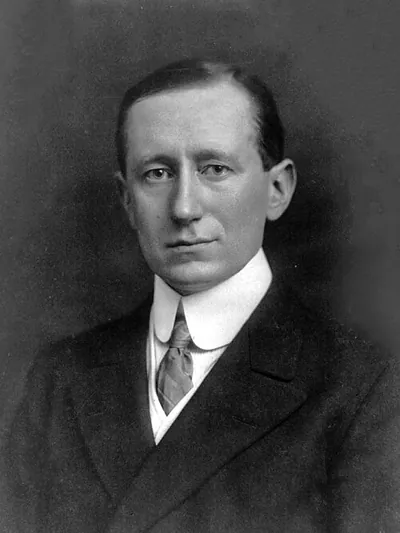 Guglielmo Marconi1874–1937 · Technology and communications
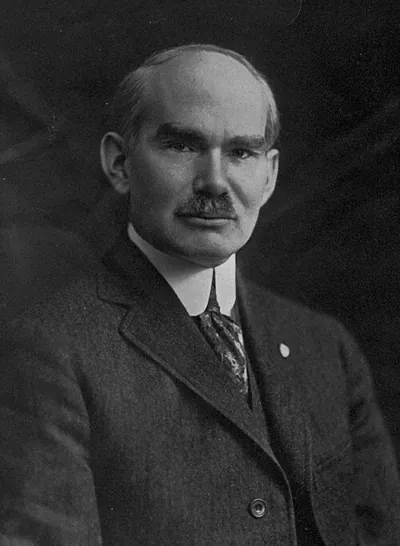 Lee de Forest1873–1961 · Technology and communications
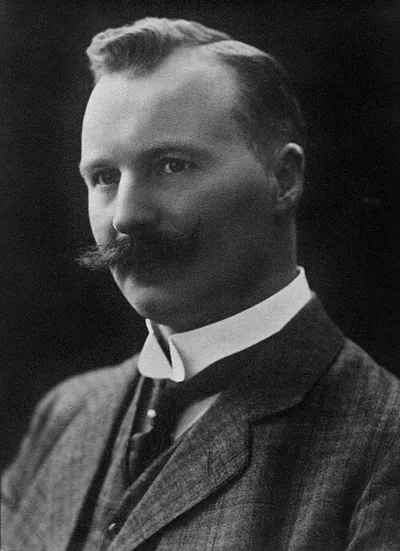 Nils Gustaf Dalén1869–1937 · Technology and communications
 Louis Lumière1864–1948 · Technology and communications
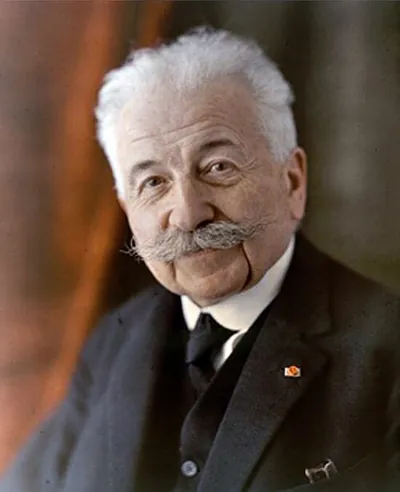 Auguste Lumière1862–1954 · Technology and communications
 John Logie Baird1888–1946 · Technology and communications
