
Georg Ernst Stahl
German physician and chemist, the leading advocate of the phlogiston theory · 1659–1734
- Born
- October 21, 1659
- Died
- May 14, 1734
- Country
- Principality of Ansbach
- Section
- Chemistry
Biography
Georg Ernst Stahl (Ansbach, 1659 – Berlin, 1734) was a German physician and chemist whose name is attached to the phlogiston theory, one of the most influential explanations of chemical change before Lavoisier. He worked in Protestant Germany at the close of the seventeenth century and the early eighteenth, when chemistry still shared much of its territory with alchemy. His importance lies in the fact that phlogiston was one of the first attempts to explain a broad range of chemical processes, from burning to the making of acids, within a single framework, and that it helped bridge alchemy and modern chemistry.
Stahl was born into a Lutheran family. His father was a pastor, and the devout atmosphere of the household shaped his outlook. He developed an early interest in chemistry. By the age of fifteen, he is said to have mastered a set of university lecture notes on the subject and later a demanding treatise by Johann Kunckel. Among his early influences were the medical professor Jacob Barner and Kunckel himself. He studied medicine at the University of Jena, where he earned his doctorate around 1683 and then taught. His reputation led to his appointment in 1687 as personal physician to Duke Johann Ernst of Saxe-Weimar.
In 1693 he joined his old college friend Friedrich Hoffmann at the University of Halle, and in 1694 he took up the chair of medicine there. Much of his chemical work was carried out during these years. From 1715 until his death he served as physician and counsellor to King Friedrich Wilhelm I of Prussia, and he also led Berlin's Medical Board.
His medical thinking centred on the difference between living and non-living matter. He rejected purely mechanical explanations of the body, though he accepted that living creatures work partly like machines. Non-living things, he argued, stay stable over time, whereas living things tend to decay. An agent, the anima or soul, delays that decay and directs the body's processes. For him, the circulation of the blood, excretion and secretion were the key movements of the organism. This animistic position set him against the materialism of Hermann Boerhaave and of Hoffmann. He held that physicians should treat the body as a whole rather than its separate parts. Gottfried Leibniz criticised these ideas, and the two men corresponded on the subject; the exchange was published later as Negotium otiosum.
His early chemical work concerned fermentation. Stahl built on Johann Joachim Becher's notion of a fatty earth that escaped when substances burned. He turned it into phlogiston, an inflammable principle that, in his account, left a combustible substance during burning and passed into another that could take it up. This release explained the light and heat that accompany a fire.
The theory also accounted for the calcination of metals. Heating iron or lead produced a earthy calx that lacked lustre and malleability. Stahl believed a metal was composed of this calx together with phlogiston, which escaped on heating. To recover the metal, the calx could be heated with charcoal, which was rich in phlogiston and returned it. Other chemists later used the idea to explain the formation of acids, such as sulphuric acid from burning sulphur or phosphoric acid from burning phosphorus. For this reason it is often described as the first unifying theory in chemistry.
Stahl was widely admired through much of the eighteenth century. In 1787 the philosopher Immanuel Kant listed him, alongside Galileo and Torricelli, among those who had turned a field of study into a true science. Yet phlogiston did not survive Lavoisier's experiments, which showed that burning involves combination with oxygen rather than the loss of a substance. His legacy lies in having helped prepare the ground for modern chemistry.
In his personal life, Stahl married three times and suffered painful family losses. His first two wives died of puerperal fever, in 1696 and 1706. He kept working and publishing after these deaths, although, according to the sources, he grew distant with students and fell into deep depression until his death in 1734.
Main contributions
- 1697Zymotechnia fundamentalis, a work on fermentation, in which he described carbon monoxide as a noxious vapour.
- 1707Theoria medica vera, a statement of his medical doctrine on the soul and tonic motion.
- Phlogiston theory, according to which combustible substances contain an inflammable principle released during burning or calcination.
Teachers and students
Trivia and anecdotes
An early start
According to the sources, by the age of fifteen he had already mastered university lecture notes on chemistry.
A friend and rival
Friedrich Hoffmann, his old college friend, joined him at Halle, though their medical ideas differed.
Related discoveries and inventions
- 1667Phlogiston theoryAn obsolete chemical theory that explained combustion and metal calcination through a weightless substance, phlogiston, said to escape from bodies when they burned.
- 1667PhlogistonAn obsolete scientific theory holding that combustible materials contain a weightless substance, phlogiston, released when they burn or rust.
Their contemporaries
While Georg Ernst Stahl was alive (1659–1734)…
Alive at the same time
Discovered or invented in those years
- 1665CellThe smallest unit of matter that can be considered alive: a compartment enclosed by a membrane that holds genetic material and carries out the functions of life on its own.
- 1676BacteriaSingle-celled prokaryotic microorganisms without a defined nucleus, forming one of the three great domains of life.
- 1687GravityThe attraction that every body with mass exerts on every other, responsible for objects falling and planets circling the Sun.
- 1687ForceA vector quantity that changes the motion of a body or deforms it, measured in newtons.
- 1687Newton's laws of motionThree principles linking the motion of a body to the forces acting on it, the foundation of classical mechanics.
- 1700PianoA keyboard instrument in which each key sets a felt-covered hammer moving to strike a tensioned string, letting the player control loudness through touch.
 Robert Boyle1627–1691 · Chemistry
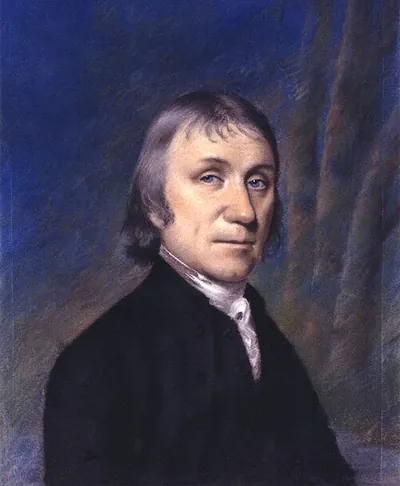 Joseph Priestley1733–1804 · Chemistry
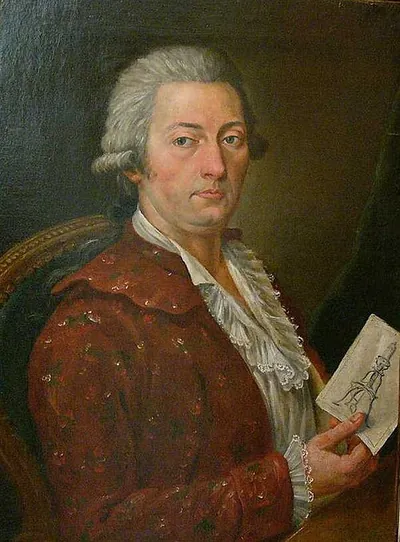 Carl Wilhelm Scheele1742–1786 · Chemistry
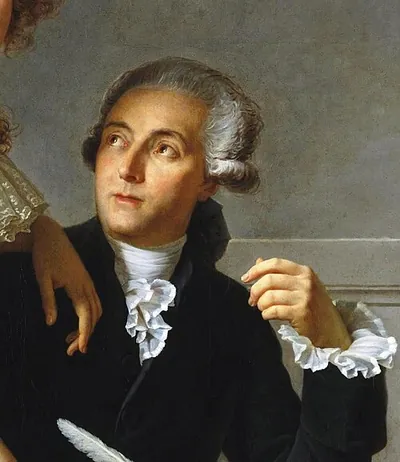 Antoine Lavoisier1743–1794 · Chemistry
 John Dalton1766–1844 · Chemistry
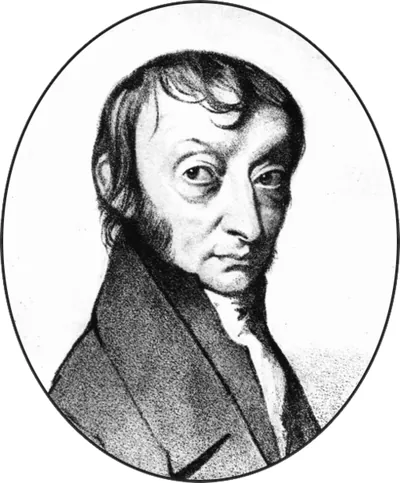 Amedeo Avogadro1776–1856 · Chemistry
