
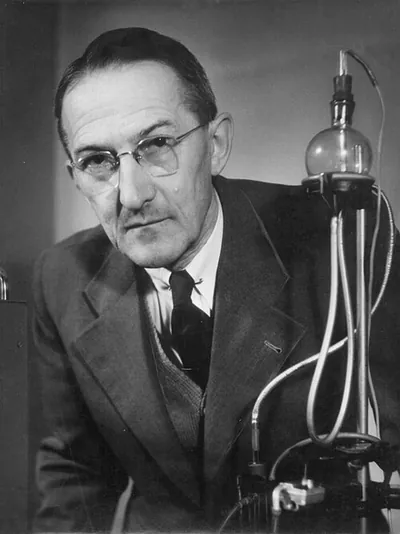
George de Hevesy
Hungarian radiochemist and 1943 Nobel Prize in Chemistry laureate for the use of radioactive tracers · 1885–1966
- Born
- August 1, 1885
- Died
- July 5, 1966
- Country
- Hungary, Sweden
- Section
- Chemistry
- Awards
- Nobel Prize in Chemistry
Biography
George de Hevesy (Budapest, 1885 - Freiburg, 1966) was a Hungarian-born chemist, later a Swedish resident, who developed the use of radioactive isotopes as markers to follow chemical processes in living things and in matter. His work, carried out in the first half of the twentieth century, earned him the Nobel Prize in Chemistry in 1943 and made him one of the founders of practical radiochemistry. He also took part in the discovery of the element hafnium, which places him in the history of the periodic table as well.
He was born in Budapest, then part of the Austro-Hungarian Empire, into a wealthy family of Hungarian-Jewish origin that had been ennobled. His father, Lajos, held a court title, and his mother, Eugénie, came from a noble family. The sources record that the family name was Bischitz and that it was later changed to Hevesy, a change that is documented but rarely explained in detail. He attended a Piarist school in Budapest and finished secondary education in 1903. He then studied chemistry for a year at the University of Budapest and for a few months at the Technical University in Charlottenburg, Berlin, before moving to the University of Freiburg, where he earned his doctorate in 1908 under Georg Meyer.
Having private means, Hevesy could choose his working environment freely. He declined a post at the ETH in Zurich and preferred to train with leading researchers. He first worked with Fritz Haber in Karlsruhe, whose work on the synthesis of ammonia interested him, and then with Ernest Rutherford in Manchester, where he also met Niels Bohr. With Rutherford he learned the techniques of radioactivity, a very new field at the time. In 1913, in Vienna, together with Friedrich Paneth, he carried out what is usually cited as the first experiment with radioactive tracers: they added to a sample a radioactive form of a substance already present in it, so that its path could be followed without changing the mixture. The basic idea was to mark atoms with a signal that could be easily detected, in this case radioactivity.
During the First World War he was called up into the Austro-Hungarian army. When the war ended he taught at the University of Budapest and in 1918 was appointed professor of physical chemistry. However, the political situation in postwar Hungary led him to look for another post. In 1920 he settled in Copenhagen, where he worked at Niels Bohr's institute, which offered an exceptional research environment, and where his best-known work took shape. He returned to Freiburg in 1924 as professor of physics and chemistry, and that same year he married Pia Riis; they had one son and three daughters.
His first research dealt with the chemical behaviour of molten salts, but his direction changed as he worked with radioactive elements. In 1922, together with the Dutch physicist Dirk Coster and with support from the Rockefeller Foundation, he studied with X-rays samples of a zirconium mineral from the mineralogical museum in Copenhagen, which held material from Norway and Greenland. They were looking for an element with 72 protons, a gap in Mendeleev's table that Bohr's atomic model made it possible to predict. The result was the discovery of hafnium, named after the Latin Hafnia, meaning Copenhagen. Some historians have disputed how credit is shared, pointing to the British chemist Charles Bury as the person who predicted that element 72 would be a transition metal, so the finding is best read as a joint effort.
The work that brought him worldwide fame concerned tracers. In 1923 he published the first study using lead-212, a naturally occurring radioactive isotope, to follow how substances were absorbed and moved through the roots, stems and leaves of the broad bean. The method works by mixing into a plant or an animal a small amount of a radioactive atom, which behaves chemically just like the ordinary one, and then following it with detectors. In this way one can learn where a substance accumulates or where it travels inside a body without destroying it. From 1934 he extended its use to animal and plant physiology, and in Freiburg he took part in the first clinical applications of radioactive isotopes. In 1936 he developed neutron activation analysis, a technique that identifies how much of an element is present by bombarding it with neutrons and measuring the radioactivity it acquires.
In 1943, during the Second World War, the situation in Denmark became dangerous for a scientist of Jewish origin. Before the German invasion, Max von Laue and James Franck had sent their gold Nobel medals to Copenhagen so that the Nazis would not confiscate them, since taking gold out of Germany was illegal. When Denmark was occupied, Hevesy dissolved the medals in aqua regia, a strong acid mixture able to dissolve gold, and left the solution on a shelf in his laboratory. After the war he found it undisturbed, precipitated the gold out of the liquid, and the Nobel Foundation recast the medals and returned them to their owners. The episode is often told, and the sources describe it as documented, although the details of the escape and the hiding place have been repeated in many versions.
He fled to Stockholm in 1943, where he joined the Institute of Organic Chemistry and worked at the university until 1961. In 1943 he also received the Nobel Prize in Chemistry for his work on isotopes as tracers of the chemical behaviour of substances. In Sweden he collaborated with Hans von Euler-Chelpin, who kept pro-German positions during the war, although the two published many papers together. Hevesy was a member of the Royal Society in London, the Royal Swedish Academy of Sciences and many other academies, and in 1949 he was named Franqui Professor at the University of Ghent. His studies on the effect of X-rays on tumours and healthy tissues, and on the transport of iron in healthy and cancerous organisms, received support from Swedish foundations. In 1958 he received the Atoms for Peace Award for the peaceful use of radioactive isotopes.
His legacy is twofold. On the one hand, the tracer method became a standard tool in medicine, agriculture, biochemistry and materials science, and it is still used in medical imaging and biological research. On the other, his work with X-rays and neutron activation widened the techniques of chemical analysis. He died in Freiburg in 1966, at the age of eighty. At his family's request his remains were moved to Budapest in 2001, and in his memory a lunar crater has borne his name since 2009, along with an asteroid that carries his designation. Hevesy is remembered as a researcher who turned a physical instrument into a way of understanding the chemistry of living things.
Main contributions
- 1913First experiment with radioactive tracers, carried out with Friedrich Paneth in Vienna: marking atoms with radioactivity to follow them without altering the mixture.
- 1922Discovery of hafnium, together with Dirk Coster, by X-ray analysis of a zirconium mineral; the element filled gap number 72 in the periodic table.
- 1923First study using lead-212 as a tracer in plants, to follow the uptake and transport of substances in the broad bean.
- 1927Publication of the monograph Das Element Hafnium, on the newly discovered element and its compounds.
- 1936Neutron activation analysis, a technique that measures the amount of an element by bombarding it with neutrons and recording the resulting radioactivity.
- 1943Nobel Prize in Chemistry for his work on isotopes as tracers in the study of the chemical properties of substances.
Teachers and students
Studied under:
Taught:
Trivia and anecdotes
The gold Nobel medals
To keep the Nazis from seizing the medals of Max von Laue and James Franck, Hevesy dissolved them in aqua regia. After the war he recovered the gold, and the Nobel Foundation recast the medals.
A medal he valued above the Nobel
Hevesy argued that the Nobel Prize in Chemistry was not the highest honour for a scientist, because only two people had received the Copley Medal, Niels Bohr being the other.
A crater on the Moon
Since 2009 a lunar crater has carried his name in his memory, and an asteroid also commemorates him.
Their contemporaries
While George de Hevesy was alive (1885–1966)…
Alive at the same time
Discovered or invented in those years
- 1897ElectronA negatively charged subatomic particle found in every atom, and key to electricity and chemical bonding.
- 1903AirplaneA fixed-wing aircraft, heavier than air, powered by engines or rockets, that stays aloft because its wings generate lift.
- 1925TelevisionA system that sends moving pictures and sound over distance and shows them on a receiver, the television set.
- 1925Quantum mechanicsPhysical theory describing how matter and light behave at atomic and subatomic scales, where energy is exchanged in minimal packets and results are expressed as probabilities.
- 1931Big BangA cosmological model describing how the universe expanded from an early state of extreme density and temperature, about 13.8 billion years ago.
- 1945ComputerA programmable machine that takes in data, processes it by following stored instructions, and produces results, able to switch tasks simply by running different software.
 Peter Debye1884–1966 · Chemistry
 Jaroslav Heyrovský1890–1967 · Chemistry
 Otto Hahn1879–1968 · Chemistry
 Johannes Nicolaus Brønsted1879–1947 · Chemistry
 Harold Urey1893–1981 · Chemistry
 Wallace Carothers1896–1937 · Chemistry
