
George Everest
British geographer and surveyor who led the Great Trigonometrical Survey of India and gave his name to Mount Everest · 1790–1866
- Born
- July 4, 1790
- Died
- December 1, 1866
- Country
- United Kingdom
- Section
- Earth sciences
Biography
George Everest (1790-1866) was a British geographer and surveyor who led the mapping of India from 1830 to 1843. He lived at a time when British power over the subcontinent was expanding, and the East India Company needed accurate maps to govern and exploit the territory. Today he is remembered mainly because Mount Everest bears his name, although he never saw the mountain.
He was born on 4 July 1790, but the exact place of his birth is uncertain, since it was not recorded on his baptismal certificate. Some sources place it in Greenwich, then in Kent, and others in Crickhowell, in south Wales, where his family owned the estate of Gwernvale Manor. He was the eldest son of a solicitor and justice of the peace from a family long established in Greenwich. He studied at the Royal Military College in Marlow and then at the Royal Military Academy in Woolwich, where he excelled in mathematics. In 1806, before he had reached the required age, he joined the East India Company as a cadet and was posted to the Bengal Artillery.
His first work in India brought him recognition. In 1814 he was sent to Java by the lieutenant-governor, Stamford Raffles, to survey the island. He later returned to Bengal, where he improved British knowledge of the Ganges and the Hooghly River. His work caught the attention of William Lambton, who led the Great Trigonometrical Survey. This method measures a chain of triangles along a line of meridian. By accurately measuring one baseline and the angles between points, surveyors can calculate the distances between far-off places without walking the whole terrain. In 1818 Everest joined Lambton at Hyderabad as his chief assistant and took on much of the fieldwork.
In 1820 he contracted malaria and had to recover at the Cape of Good Hope. According to the historian John Keay, his interest in meridians may have come from growing up near the Royal Observatory in Greenwich, the historical starting point of the Prime Meridian. He returned to India in 1821 and succeeded Lambton as head of the survey when Lambton died in 1823, extending the arc further north. However, fever and rheumatism left him half paralysed, and in 1825 he went back to England, where he spent five years recovering. In 1827 he was elected a Fellow of the Royal Society.
From England he pressed the East India Company for better instruments, built to his own designs, and persuaded it to extend the survey northwards towards the Himalayas. By reviewing his own measurements and Lambton's, he published new estimates of the ellipsoidal axes of the Earth, that is, of the slightly flattened shape of the planet. He corresponded regularly with Thomas Frederick Colby of the Ordnance Survey to keep up with the latest methods. His niece Mary Boole later recalled that he had likely introduced Indian thought to others as well.
In June 1830 he returned to India as Surveyor General. The arc from Cape Comorin to the northern border of British India was completed in 1841 under the supervision of his protégé, Andrew Scott Waugh. Everest spent much of those years on administration and on defending his work against criticism from London. Thomas Jervis, provisionally named as his successor, gave a series of lectures to the Royal Society on the supposed flaws in Everest's methods. Everest replied with open letters to the Duke of Sussex, the society's president, in which he scolded the scientists for meddling in matters they knew little about. Jervis withdrew, and Everest secured the appointment of Waugh as his successor. He resigned in November 1842, and his commission was formally revoked in December 1843, when he returned to England for good.
In November 1846 he married Emma Wing, aged 23, in London, and they had six children. The following year he published an account of the measurement of two sections of the Indian meridian arc, which earned him a medal from the Royal Astronomical Society. He was promoted to colonel in 1854 and knighted in 1861. He died at his home in Hyde Park Gardens on 1 December 1866 and was buried at Hove, near Brighton.
Mount Everest, first known as Peak B and later as Peak XV, was recognised as the highest mountain in the world thanks to observations by Waugh and calculations by Radhanath Sikdar. In 1856 Waugh proposed naming it after his predecessor, since no local name could be confirmed by the British, who had no access to Nepal or Tibet. Everest objected, arguing that people in India could neither pronounce nor easily write the name in Hindi. Nonetheless, in 1865 the Royal Geographical Society officially adopted the name Mount Everest. His legacy is that of a meticulous surveyor whose method helped fix the shape and height of a vast subcontinent.
Main contributions
- 1830Account of measuring a stretch of the Indian meridian arc, extending the work begun by Lambton.
- 1841Completion of the meridian arc from Cape Comorin northwards, about 2400 kilometres long.
- 1847Publication on measuring two sections of the meridian arc, which earned a medal.
- 1865Adoption of the name Mount Everest for the world's highest mountain, proposed in his honour.
- New estimates of the ellipsoidal axes of the Earth, obtained by revising the arc measurements.
Trivia and anecdotes
A name he did not want
Everest objected to the mountain being named after him, arguing that it was hard to pronounce and to write in Hindi. The society adopted it anyway in 1865.
An uncertain birthplace
Nobody knows for sure where he was born, because his baptismal certificate did not record it. Some sources give Greenwich and others Crickhowell, in Wales.
A mathematical niece
His niece Mary Everest married the mathematician George Boole, and their daughter Alicia Boole Stott also became a mathematician.
Their contemporaries
While George Everest was alive (1790–1866)…
Alive at the same time
Discovered or invented in those years
- 1803AtomThe basic unit of a chemical element: a nucleus of protons and usually neutrons surrounded by a cloud of electrons.
- 1811MoleculeAn electrically neutral group of at least two atoms held together by chemical bonds in a defined arrangement.
- 1821ElectricityThe set of physical phenomena linked to the presence and movement of electric charge, and one of the most versatile forms of energy in modern life.
- 1839PhotographyA technique for creating lasting images by recording light, either on a light-sensitive material or with an electronic sensor.
- 1846NeptuneThe eighth and most distant planet of the Solar System, an ice giant found through mathematical prediction before any direct sighting.
- 1859EvolutionThe process by which the heritable traits of living populations change over generations, explaining the diversity of life from common ancestors.
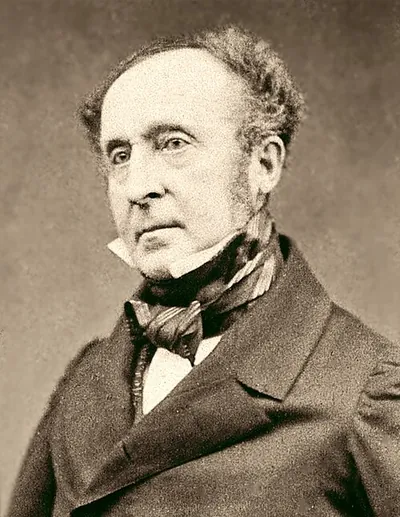 Roderick Murchison, 1st Baronet1792–1871 · Earth sciences
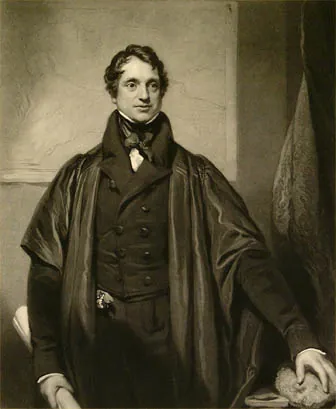 Adam Sedgwick1785–1873 · Earth sciences
 William Buckland1784–1856 · Earth sciences
 Charles Lyell1797–1875 · Earth sciences
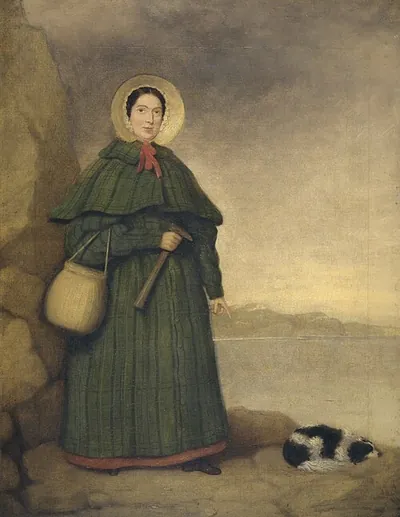 Mary Anning1799–1847 · Earth sciences
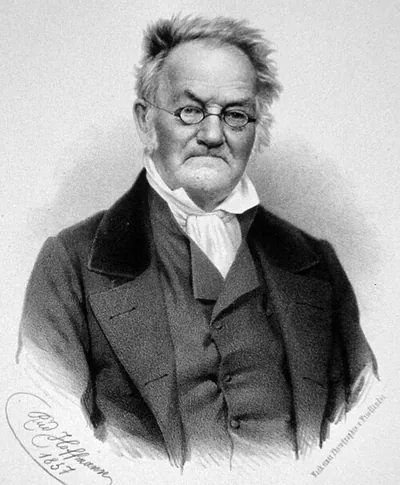 Carl Ritter1779–1859 · Earth sciences
