
George Porter
British chemist, Nobel Prize in Chemistry in 1967 for studying extremely fast chemical reactions · 1920–2002
- Born
- December 6, 1920
- Died
- August 31, 2002
- Country
- United Kingdom
- Section
- Chemistry
- Awards
- Nobel Prize in Chemistry
Biography
George Porter (Stainforth, England, 1920 – Canterbury, England, 2002) was a British chemist who shared the 1967 Nobel Prize in Chemistry with Ronald Norrish and Manfred Eigen. His name is tied to the development of experimental methods that made it possible to observe chemical processes lasting fractions of a second. His work turned into a laboratory tool what had barely been measurable before, and it remains a key reference in chemical kinetics, the branch of chemistry that studies how fast reactions take place.
He was born on 6 December 1920 in Stainforth, in the West Riding of Yorkshire in northern England. He attended local primary and grammar schools and, in 1938, won an Ackroyd Scholarship to the University of Leeds. There he developed an interest in physical chemistry, which applies the laws of physics to explain how substances behave, and in chemical kinetics. He later said that his teacher Meredith Gwynne Evans was the most brilliant chemist he had ever met, and Evans's teaching steered him toward these subjects. In his final year he took a special course in radiophysics, which would prove useful later.
The war soon shaped his path. During the Second World War he served as a volunteer in the Royal Naval Volunteer Reserve, in a section that worked on radar. That experience gave him training in electronics and pulse techniques, which he later said helped him suggest new approaches to chemical problems. In 1945 he moved to the University of Cambridge to work as a research student under Ronald George Wreyford Norrish, a chemist who studied reactions triggered by light in gases.
His first task was to study free radicals, short-lived and highly reactive fragments of molecules with unpaired electrons, produced by light-driven reactions in gases, using flow techniques. About a year later he had the key idea: rather than observing these species continuously, he could light the sample with flashes shorter than the lifetime of the radicals. This works much like a snapshot of a single instant. In early summer 1947 he began building an apparatus for this purpose, and together with Norrish applied it to gaseous free radicals and to combustion. This method, known as flash photolysis, became the core of his work. Their collaboration lasted until 1954, when Porter left Cambridge. According to the sources, this research gave the first evidence of free radicals obtained in this way.
He received his PhD from Cambridge in 1949 for research on free radicals produced by photochemical means, and later became a Fellow of Emmanuel College. From 1953 to 1954 he was Assistant Director of the British Rayon Research Association, where he studied how sunlight weakens dyed cellulose fabrics. From 1954 to 1965 he was a professor of chemistry at the University of Sheffield. There he started his flash photolysis work with equipment designed and built in the department's own workshop, a detail that reflects his hands-on approach. During this time he also appeared in a television programme in the Eye on Research series describing his work. In 1966 he became Fullerian Professor of Chemistry at the Royal Institution in London and its Director. During his directorship he helped set up Applied Photophysics, a company that supplied instruments based on his group's methods. That same year he was also a visiting professor at University College London.
Porter's research also reached photosynthesis, the process by which plants use light to make their own compounds. He used flash photolysis to examine in detail the light-dependent reactions in this process. He also had a lasting interest in the possible uses of a hydrogen economy, in which hydrogen would serve as a main energy carrier, and was a firm advocate of it. His contribution was recognised in 1967, when the Nobel committee awarded him the prize for research on extremely fast chemical reactions, triggered by a short energy pulse that disturbs a chemical equilibrium. He shared it with Norrish and with the German Manfred Eigen, who had worked on related problems independently.
Porter was also an active public communicator. He championed what he called not-yet-applied science, meaning basic research that has no practical use yet but may have one later. He became president of the British Association in 1985 and was the founding chair of the Committee on the Public Understanding of Science. He gave the Romanes Lecture at the University of Oxford in 1978, titled Science and the human purpose, and the Dimbleby Lecture in 1988. In 1976 he gave the Royal Institution Christmas Lectures, titled The Natural History of a Sunbeam. He was elected a Fellow of the Royal Society in 1960 and served as its president from 1985 to 1990. Queen Elizabeth II made him a knight in 1972, and he was appointed to the Order of Merit in 1989. In 1990 he became a life peer, with the title Baron Porter of Luddenham. He was Chancellor of the University of Leicester from 1984 to 1995, and in 2001 the university named its chemistry building after him. He married Stella Jean Brooke in 1949. He died in Canterbury in 2002.
Porter's legacy lies mainly in the technique he developed. Flash photolysis made it possible to study chemical species with very short lives and became a basic tool of modern chemistry. His popular books, such as Chemistry for the Modern World from 1962 and Chemistry in Microtime from 1996, show the same commitment to making chemistry understandable to a general audience.
Main contributions
- 1947Development of flash photolysis, a method that uses short light pulses to observe chemical species with a very brief lifetime.
- 1949PhD thesis on free radicals produced by photochemical processes, at the University of Cambridge.
- 1960Election as a Fellow of the Royal Society in London.
- 1967Nobel Prize in Chemistry, shared with Norrish and Eigen, for studying very fast chemical reactions.
- 1978Romanes Lecture at Oxford, titled Science and the human purpose.
Teachers and students
Trivia and anecdotes
An unforgettable teacher
Porter said that Meredith Gwynne Evans was the most brilliant chemist he had ever met.
Equipment built by hand
At Sheffield, his flash photolysis instruments were designed and built in the department's own workshop.
Their contemporaries
While George Porter was alive (1920–2002)…
Alive at the same time
Discovered or invented in those years
- 1925TelevisionA system that sends moving pictures and sound over distance and shows them on a receiver, the television set.
- 1925Quantum mechanicsPhysical theory describing how matter and light behave at atomic and subatomic scales, where energy is exchanged in minimal packets and results are expressed as probabilities.
- 1931Big BangA cosmological model describing how the universe expanded from an early state of extreme density and temperature, about 13.8 billion years ago.
- 1945ComputerA programmable machine that takes in data, processes it by following stored instructions, and produces results, able to switch tasks simply by running different software.
- 1969InternetA global network of interconnected computer networks that communicate using the TCP/IP protocol suite.
- 1989World Wide WebA system of linked documents and resources, connected by hyperlinks and accessed over the Internet with web browsers.
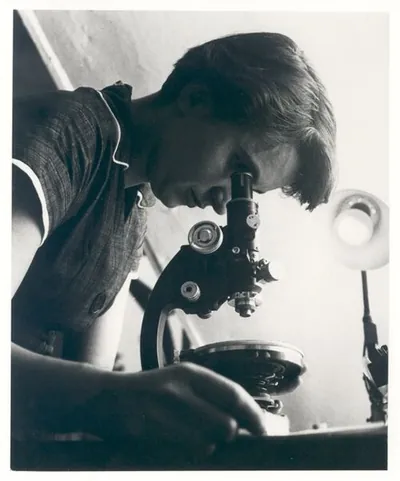 Rosalind Franklin1920–1958 · Chemistry
 Derek Barton1918–1998 · Chemistry
 Robert Burns Woodward1917–1979 · Chemistry
 Ilya Prigogine1917–2003 · Chemistry
 John Pople1925–2004 · Chemistry
