
George Zweig
American physicist of Russian-Jewish origin who independently proposed the quark model · 1937
- Born
- May 30, 1937
- Country
- United States
- Section
- Physics
Biography
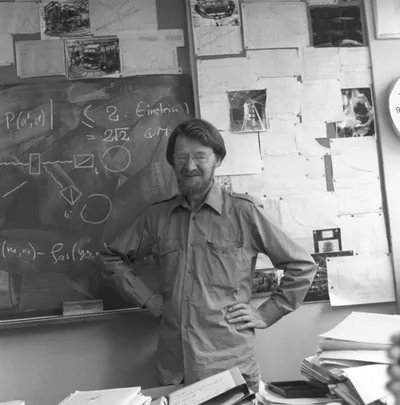
George Zweig is a physicist born in Moscow in 1937 who became an American. He is best known for proposing, independently and at almost the same time as Murray Gell-Mann, the existence of quarks, the particles now understood as the basic building blocks of protons and neutrons. His work belongs to particle physics in the 1960s, when researchers were trying to bring order to a growing list of subatomic particles, and it helped shape a model that still underpins modern physics.
Zweig was born in Moscow into a Jewish family. His father was a structural engineer, a specialist in designing buildings and bridges. He graduated from the University of Michigan in 1959 with a bachelor's degree in mathematics, having taken many physics courses as electives. He then earned a PhD in theoretical physics at the California Institute of Technology in 1964. During his training he was a student of Richard Feynman, one of the most influential physicists of the twentieth century, whose approach to problems left a clear mark on him.
At the time, physicists noticed that many particles, such as baryons (the family that includes protons and neutrons), showed properties that repeated in orderly patterns. Zweig and Gell-Mann realised that these regularities could be explained if the particles were made of three smaller constituents carrying fractional electric charges. Zweig called them "aces", after the playing cards, because he assumed there were four of them, based on the four leptons known at the time. Gell-Mann's name, quarks, is the one that stuck.
Zweig was partly led to his picture by a different clue from Gell-Mann's: the unusually suppressed way a particular meson, the phi meson, decayed. That behaviour was later codified as the OZI rule, named after the initials of Okubo, Zweig and Iizuka, which signalled a deeper pattern behind such decays. Over time Gell-Mann's quarks came to be called current quarks, while Zweig's ideas moved closer to what are called constituent quarks, two complementary notions within the same theory.
The proposal met resistance. In 1969 Gell-Mann received the Nobel Prize in Physics for his work on classifying elementary particles, but quark theory was not yet fully accepted and was not mentioned in the official citation. Once the model became the standard framework, the Nobel committee did not honour Zweig. In 1977 Feynman nominated both physicists, but the nomination did not succeed, and Zweig has still not received the prize, an omission many historians regard as unfortunate.
Later Zweig turned to hearing and neurobiology. He studied how the cochlea, the spiral structure of the inner ear, converts sound vibrations into nerve impulses, and how the brain maps sounds across the cerebral cortex according to their characteristics. In 1975, while investigating the ear, he introduced a version of the continuous wavelet transform, a mathematical tool for analysing signals that change over time, which he called the cochlear transform.
His career took him to Los Alamos National Laboratory, to MIT and later to the financial sector. In 2003 he joined Renaissance Technologies, a quantitative hedge fund founded by James Simons, where he applied mathematical methods to markets. He left the firm in 2010, and after his confidentiality agreement expired he co-founded another quantitative fund, Signition, which began trading in 2015.
His legacy links particle physics, the neuroscience of hearing and the use of mathematical tools across very different fields. His recognitions include a MacArthur Fellowship in 1981, membership of the US National Academy of Sciences in 1996 and the Sakurai Prize in 2015.
Main contributions
- 1964PhD in theoretical physics at Caltech, the starting point of his work on particles.
- 1964Proposal of quarks, which he called "aces", as constituents of baryons and mesons, independently of Gell-Mann.
- 1964OZI rule, which explains the suppressed decay of the phi meson and carries his initial in its name.
- 1975Cochlear transform, a version of the continuous wavelet transform inspired by his study of the ear.
- 1981MacArthur Fellowship, recognising his scientific career.
- 2015Sakurai Prize, one of the most important awards in particle physics.
Teachers and students
Trivia and anecdotes
The "aces"
Zweig called his particles aces, after the four suits he assumed existed. In the end Gell-Mann's name, quarks, prevailed.
A change of sector
After his scientific career he worked at Renaissance Technologies, a quantitative fund, and later co-founded another fund with two younger partners.
Their contemporaries
While George Zweig was alive (1937–)…
Alive at the same time
Discovered or invented in those years
- 1945ComputerA programmable machine that takes in data, processes it by following stored instructions, and produces results, able to switch tasks simply by running different software.
- 1957Artificial satelliteAn artificial satellite is a human-made object placed in orbit around a celestial body, usually Earth, to collect information, relay signals, or carry out a specific task.
- 1969InternetA global network of interconnected computer networks that communicate using the TCP/IP protocol suite.
- 1971EmailA network service that lets users send and receive digital messages through addressed mailboxes, much like postal mail but electronic.
- 1973Mobile phoneA handheld wireless phone that lets people make and receive calls while moving across a cellular network area.
- 1989World Wide WebA system of linked documents and resources, connected by hyperlinks and accessed over the Internet with web browsers.
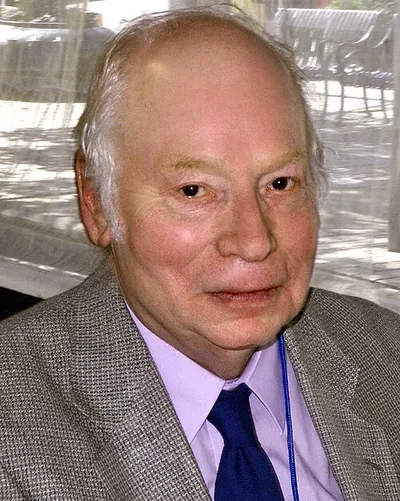 Steven Weinberg1933–2021 · Physics
 Stephen Hawking1942–2018 · Physics
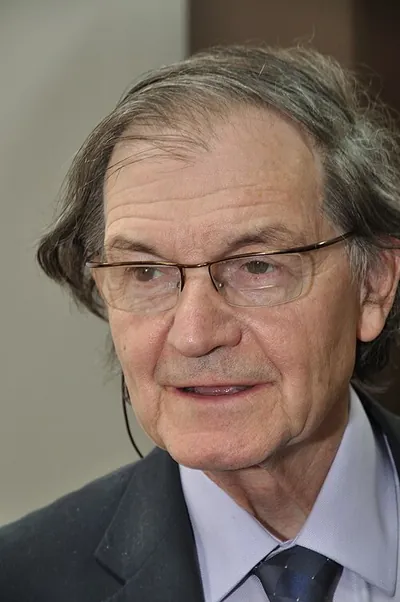 Roger Penrose1931 · Physics
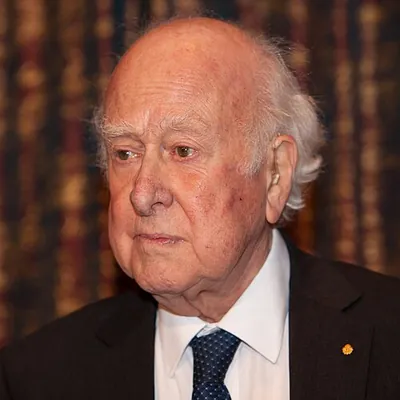 Peter Higgs1929–2024 · Physics
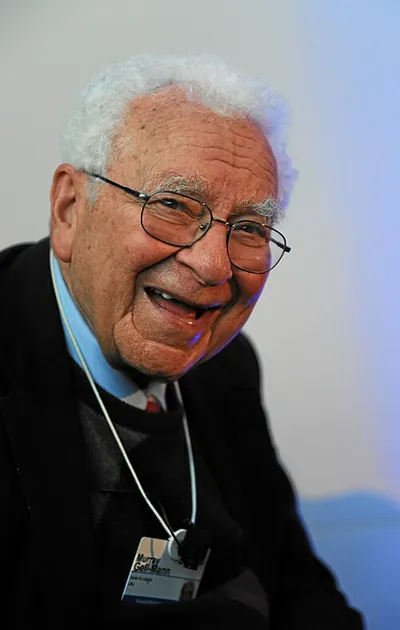 Murray Gell-Mann1929–2019 · Physics
 John Stewart Bell1928–1990 · Physics
