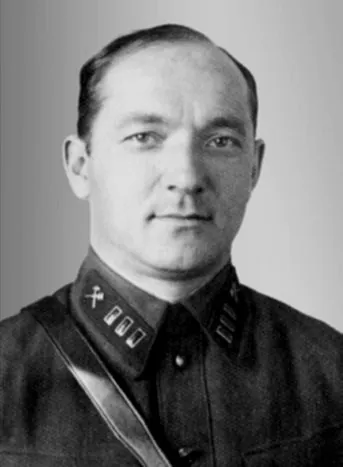
Georgy Langemak
Soviet rocket engineer who co-designed the unguided artillery rockets used in Katyusha launchers · 1898–1938
- Born
- July 20, 1898
- Died
- January 11, 1938
- Country
- Soviet Union
- Section
- Transport
- Awards
- Abel Prize
Biography
Georgy Langemak, also spelled Gueorgui Languemak, was a Soviet engineer who worked on rocket design. He lived through the Russian Revolution and the Stalin era, and he is remembered because his artillery rockets became the basis of the Katyusha launchers used in the Second World War. His life ended in an execution during the Great Purge.
He was born in Starobilsk, in the Russian Empire, on 20 July 1898 by the Gregorian calendar, which is 8 July by the Julian calendar still used in Russia at the time. His father, of German origin, had studied at the University of Berlin and died in 1905. His Swiss-born mother took Russian citizenship. Langemak spoke French and German from childhood and graduated with honours from a school in Elisabethgrad in 1916. That same year he enrolled to study Japanese philology in Petrograd.
War and revolution disrupted his plans. He was conscripted in 1916, served with the Baltic Fleet and became an officer in 1917. He was not in the city during the October Revolution, as he was away at an artillery academy. He was demobilised in 1918, and in 1919 the Red Army recalled him as a military specialist. He joined the Communist Party in 1920. During the Kronstadt uprising of 1921, a revolt by disillusioned communists against Lenin, the rebels imprisoned him and sentenced him to death, but he was freed once the revolt was crushed.
In 1922 he was expelled from the party after a church wedding to Elena Kamneva. From 1928 he worked at the Gas Dynamics Laboratory alongside other Soviet pioneers, developing projectiles propelled by smokeless powder. That group merged with another rocketry team to form the Reactive Scientific Research Institute, where Langemak became deputy director. In 1935 he co-authored with Valentin Glushko a book on the missile, its design and its use, and in 1936 the group completed the specifications for a rocket-glider.
In 1937, during the Great Purge, he was dismissed and arrested together with the institute's director, Ivan Kleymyonov, and Glushko, on fabricated charges that followed a denunciation accusing him of sabotage. According to historical accounts, he was tortured. He was tried in a closed military session, sentenced to death and executed on 11 January 1938. He was fully rehabilitated in 1955. His name lives on in the Langemak crater on the Moon, and his daughter Maya Belyanina devoted much of her life to restoring his reputation.
Main contributions
- 1928Rocket projectiles propelled by smokeless powder, developed at the Gas Dynamics Laboratory as forerunners of later Soviet rockets.
- 1935A book on the missile, its design and its use, written with Valentin Glushko.
- 1936Technical specifications completed for a rocket-glider, an unpowered aircraft launched into the air.
- Unguided artillery rockets, such as the RS-82 and RS-132, adapted for the Katyusha launcher.
- Co-design and direction of the development of the artillery rockets used in Katyusha launchers during the Second World War.
Trivia and anecdotes
Two birth dates
He was born on 8 July by the Julian calendar used in Russia then, which is 20 July by the Gregorian calendar.
A crater on the Moon
The lunar crater Langemak bears his name in his memory.
A daughter who fought for his name
His daughter Maya Belyanina worked to restore her father's name.
Their contemporaries
While Georgy Langemak was alive (1898–1938)…
Alive at the same time
Discovered or invented in those years
- 1900GeneticsIt is the branch of biology that studies how hereditary traits pass from one generation to the next, through genes carried in DNA.
- 1903AirplaneA fixed-wing aircraft, heavier than air, powered by engines or rockets, that stays aloft because its wings generate lift.
- 1916Black holeA region of space where gravity is so strong that nothing, not even light, can escape once it crosses a certain boundary.
- 1925TelevisionA system that sends moving pictures and sound over distance and shows them on a receiver, the television set.
- 1925Quantum mechanicsPhysical theory describing how matter and light behave at atomic and subatomic scales, where energy is exchanged in minimal packets and results are expressed as probabilities.
- 1931Big BangA cosmological model describing how the universe expanded from an early state of extreme density and temperature, about 13.8 billion years ago.
 Sergey Ilyushin1894–1977 · Transport
 Charles Lindbergh1902–1974 · Transport
 Hermann Oberth1894–1989 · Transport
 Jiro Horikoshi1903–1982 · Transport
 Sydney Camm1893–1966 · Transport
 Donald Wills Douglas, Sr.1892–1981 · Transport
