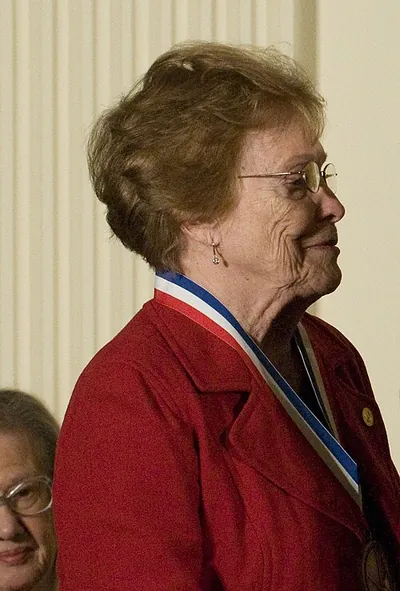
Helen Murray Free
American chemist and educator, pioneer of urine test strips · 1923–2021
- Born
- February 20, 1923
- Died
- May 1, 2021
- Country
- United States
- Section
- Chemistry
Biography
Helen Murray Free (Pittsburgh, 1923 - Elkhart, 2021) was an American chemist and educator best known for developing simple diagnostic tests that let people analyze urine without complicated equipment. Her work, carried out in the second half of the twentieth century, led to the test strips that are still used to monitor diabetes.
She was born in 1923, and her mother died during an influenza epidemic when Free was six. She attended public schools in Youngstown, Ohio, and graduated in 1941 as the top student of Poland Seminary High School. She first planned to study English and Latin to become a teacher, but after Pearl Harbor was bombed in December 1941, many young men joined the army and universities encouraged women to enter science. She switched to chemistry and graduated from the College of Wooster in 1944. She later called the change the most terrific thing that had ever happened to her, a phrase that in English means something wonderful.
After graduating she worked as a quality control chemist at Miles Laboratories, the maker of Alka-Seltzer, but she wanted to do research. When a position opened in the biochemistry group led by Alfred Free, she took it. They married in 1947 and became lifelong research partners, a partnership she had not expected when she was hired. They first studied antibiotics and then moved on to dry reagent systems, chemicals fixed onto a support that change color when they meet a specific substance.
Their first task was to improve Clinitest, a tablet that measured glucose in the urine of diabetic patients: a diluted urine sample was applied to the tablet, and the resulting color showed the level. They then created Acetest, another diabetes tablet, and Ictotest, which detected bilirubin in urine as a sign of hepatitis A. The decisive step came in 1956 with Clinistix, the first dip-and-read test strip for glucose in urine. Later came Multistix, which combined several tests on one strip by separating the reagents with an impermeable barrier.
By 1975 Free held seven patents for improvements in urine testing, and that year she and her husband co-wrote Urinalysis in Laboratory Practice, which remains a standard work in the field. In 1978 she earned a master's degree in health care administration and became an adjunct professor at Indiana University South Bend. That same year Bayer Diagnostics acquired Miles. She retired in 1982 but kept working as a consultant.
After retiring she became an active promoter of science education, focusing on women and disadvantaged students through programs such as Kids & Chemistry and Expanding Your Horizons. In 1993 she was elected president of the American Chemical Society, and she wanted the public to see the positive role chemistry plays in everyday life. The society named a public outreach award in her honor.
She and Alfred Free had six children, and she helped raise three stepchildren. Free died in 2021 at a hospice in Elkhart, aged 98, from complications of a stroke. Her honors include the Garvan-Olin Medal (1980), the Kilby Award (1996), the National Medal of Technology and Innovation (2010), and induction into the National Inventors Hall of Fame (2000). The couple's work on diagnostic test strips was designated a National Historic Chemical Landmark in 2010.
Main contributions
- 1956Clinistix: the first test strip for measuring glucose in urine by dipping it and reading the color.
- 1975Urinalysis in Laboratory Practice: a book co-written with Alfred Free that remains a reference work on urine analysis.
- Clinitest: an improved tablet for detecting glucose in the urine of diabetic patients.
- Acetest: a tablet test for monitoring diabetes.
- Ictotest: a tablet test that detects bilirubin in urine as a sign of hepatitis A.
- Multistix: a strip combining several urine tests in one, with the reagents separated by an impermeable barrier.
Trivia and anecdotes
A word with a double meaning
Free described her switch to chemistry as the most terrific thing that had happened to her. In English the word means wonderful, which is the opposite of the frightening sense the Spanish version suggests.
A hiring that changed her life
Free took the lab job under Alfred Free without knowing that she would become his research partner for decades and, in 1947, his wife.
Their contemporaries
While Helen Murray Free was alive (1923–2021)…
Alive at the same time
Discovered or invented in those years
- 1925TelevisionA system that sends moving pictures and sound over distance and shows them on a receiver, the television set.
- 1925Quantum mechanicsPhysical theory describing how matter and light behave at atomic and subatomic scales, where energy is exchanged in minimal packets and results are expressed as probabilities.
- 1931Big BangA cosmological model describing how the universe expanded from an early state of extreme density and temperature, about 13.8 billion years ago.
- 1945ComputerA programmable machine that takes in data, processes it by following stored instructions, and produces results, able to switch tasks simply by running different software.
- 1969InternetA global network of interconnected computer networks that communicate using the TCP/IP protocol suite.
- 1989World Wide WebA system of linked documents and resources, connected by hyperlinks and accessed over the Internet with web browsers.
 John Pople1925–2004 · Chemistry
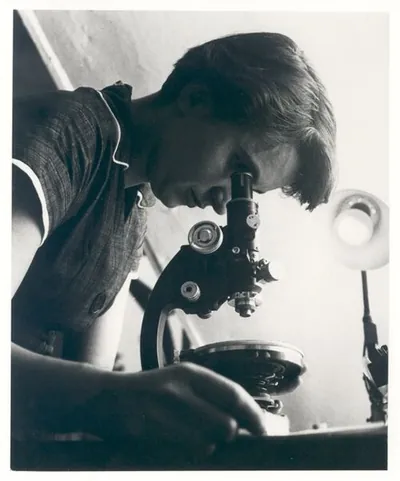 Rosalind Franklin1920–1958 · Chemistry
 Manfred Eigen1927–2019 · Chemistry
 Derek Barton1918–1998 · Chemistry
 Elias James Corey1928 · Chemistry
