
Hermann von Fehling
German chemist, creator of Fehling's solution for measuring sugars · 1812–1885
- Born
- June 9, 1812
- Died
- July 1, 1885
- Country
- Lübeck
- Section
- Chemistry
Biography
Hermann von Fehling was a nineteenth-century German chemist whose name survives mainly through a laboratory reagent still used to detect and measure sugars. He worked at a time when organic chemistry was becoming an established discipline and university laboratories were producing more precise methods of analysis.
He was born in Lübeck, in northern Germany, on 9 June 1812. He first intended to train as a pharmacist and entered Heidelberg University around 1835. After graduating he moved to Gießen to work as an assistant to Justus von Liebig, one of the most influential chemists of the period, whose laboratory there was very busy. Together with Liebig he clarified the composition of paraldehyde and metaldehyde, two related substances formed when acetaldehyde molecules link into larger repeating structures.
In 1839, on Liebig's recommendation, he was appointed to lead the chemistry chair at the polytechnic in Stuttgart, a post he held for more than forty-five years. Before settling there he studied succinic acid, an organic acid found in various living things, and prepared phenyl cyanide, better known as benzonitrile, the simplest nitrile in the aromatic series, a family of compounds built on the benzene ring.
In later life his interests shifted towards technology and public health rather than pure chemistry. Within that shift, his best-known achievement was a method for estimating the sugar content of a sample. The reagent, known as Fehling's solution, mixes copper sulfate with an alkali and with potassium sodium tartrate, also called Rochelle salt. When heated with a sugar that can reduce copper, the blue solution forms a reddish precipitate of copper oxide, and the extent of this change allows the concentration to be estimated. The test spread quickly through food chemistry and medicine, for example for checking glucose in urine.
Fehling contributed to major reference works of his day, including Liebig's Handwörterbuch, a dictionary edited with Wöhler and Poggendorff, and the Graham-Otto textbook of chemistry. For many years he sat on the revision committee of the Pharmacopoeia Germanica, the German pharmacopoeia that set standards for medicines. He died in Stuttgart on 1 July 1885. He is also remembered as the father of the gynaecologist Hermann Fehling. His main legacy is the reagent bearing his name, which still appears in laboratory manuals as a simple test for reducing sugars.
Main contributions
- 1839Chemistry chair at the Stuttgart polytechnic: led chemistry teaching there for more than forty-five years.
- Clarification of the composition of paraldehyde and metaldehyde, with Liebig: explained the makeup of two compounds related to acetaldehyde.
- Preparation of benzonitrile: obtained the simplest aromatic nitrile, a compound derived from benzene.
- Fehling's solution: a copper sulfate solution with alkali and Rochelle salt for estimating reducing sugars.
Teachers and students
Their contemporaries
While Hermann von Fehling was alive (1812–1885)…
Alive at the same time
Discovered or invented in those years
- 1846NeptuneThe eighth and most distant planet of the Solar System, an ice giant found through mathematical prediction before any direct sighting.
- 1859EvolutionThe process by which the heritable traits of living populations change over generations, explaining the diversity of life from common ancestors.
- 1869Periodic tableAn arrangement of the chemical elements into rows (periods) and columns (groups), ordered by atomic number, that reveals recurring chemical behaviour and lets scientists predict properties.
- 1869Deoxyribonucleic acidA double-stranded molecule that carries the genetic instructions of nearly all living things and many viruses.
- 1876TelephoneA device that carries the human voice over distance by turning sound into electrical signals and back into sound at the other end of the line.
- 1884CarA road vehicle with four wheels and its own engine, mainly built to carry people.
 Robert Bunsen1811–1899 · Chemistry
 Thomas Graham1805–1869 · Chemistry
 Justus von Liebig1803–1873 · Chemistry
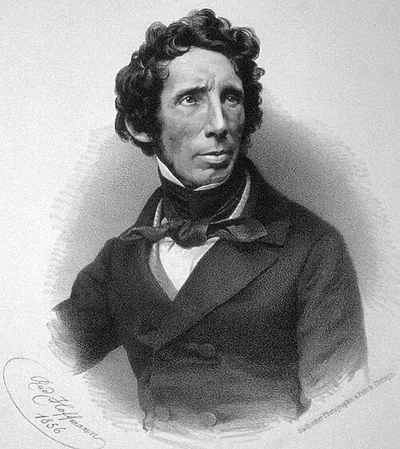 Friedrich Wöhler1800–1882 · Chemistry
 Jean-Baptiste Dumas1800–1884 · Chemistry
 Stanislao Cannizzaro1826–1910 · Chemistry
