
Hubert Cecil Booth
English engineer, inventor of one of the first powered vacuum cleaners · 1871–1955
- Born
- July 4, 1871
- Died
- January 14, 1955
- Country
- United Kingdom
- Section
- Technology and communications
Biography
Hubert Cecil Booth was an English engineer active from the late nineteenth century into the mid-twentieth. He is best remembered for designing one of the first powered vacuum cleaners, although he also worked on suspension bridges, Ferris wheels and factories. His invention changed the way buildings were cleaned and laid the groundwork for the vacuum cleaners used today.
Booth was born in Gloucester in 1871 and was schooled there. In 1889 he entered the Central Technical College in London, where he completed a three-year course in civil and mechanical engineering under Professor William Cawthorne Unwin. He earned the ACGI diploma, coming second in his department, and became a student of the Institution of Civil Engineers.
In December 1892 he joined the drawing office of Maudslay, Sons & Field in Lambeth as a civil engineer, working under Charles Sells. There he designed bridges and large Ferris wheels for amusement parks in London, Blackpool, Paris and Vienna, and he also worked on engines for Royal Navy battleships.
According to Booth's own account, written decades later, the idea came to him in 1901 at the Empire Music Hall in London, where he watched a demonstration of an American machine that blew dust away rather than collecting it. He reasoned that reversing the system, pulling air through a filter that trapped the dirt, would be far more hygienic. To test this, he later recalled, he laid a handkerchief on a restaurant chair, sucked air through it and saw the dust collect on the cloth.
His first machine, nicknamed the "Puffing Billy", was a large petrol-powered unit pulled by horses. It had no brushes; all the cleaning happened through suction along long hoses. It was too bulky to enter buildings, so the British Vacuum Cleaner Company sold cleaning services from its vans rather than selling the machines. Booth received his first British patents on 18 February and 30 August 1901.
His machines were used at Westminster Abbey before the coronation of Edward VII, by the Royal Navy, and in theatres and shops. In the home market, competition from Hoover proved decisive, and the company, later known as Goblin, concentrated on industrial customers with ever larger models.
In 1903 Booth married Charlotte Mary Pearce, the daughter of a London company director. He turned down an offer of a knighthood. He died in Croydon on 14 January 1955. His legacy is the principle of drawing dust in and trapping it, which every modern vacuum cleaner still relies on.
Main contributions
- 1901British patents for his vacuum cleaner, which pulls dust through a filter instead of blowing it away.
- 1901"Puffing Billy", one of the first motorised suction cleaners, too bulky to enter buildings.
- 1901First appearance of the term "vacuum cleaner" in the prospectus of the company that marketed his invention.
- Design of Ferris wheels and suspension bridges for fairgrounds and amusement parks, as a civil engineer.
Trivia and anecdotes
Arrested at the Royal Mint
After cleaning the Royal Mint he forgot to empty his machine, which had collected a large amount of silver dust from the coins. He was arrested as he left, but was released quickly.
Fined for frightening horses
His noisy machines, pulled by horses, drew constant complaints, and he was even fined for frightening the animals.
A Google tribute
On 4 July 2018 Google marked his 147th birthday with a Google Doodle.
Related discoveries and inventions
- 1901Vacuum cleanerA machine that removes dust and small debris from floors and carpets by pulling air through a nozzle, using a motor-driven fan.
Their contemporaries
While Hubert Cecil Booth was alive (1871–1955)…
Alive at the same time
Discovered or invented in those years
- 1876TelephoneA device that carries the human voice over distance by turning sound into electrical signals and back into sound at the other end of the line.
- 1884CarA road vehicle with four wheels and its own engine, mainly built to carry people.
- 1903AirplaneA fixed-wing aircraft, heavier than air, powered by engines or rockets, that stays aloft because its wings generate lift.
- 1925TelevisionA system that sends moving pictures and sound over distance and shows them on a receiver, the television set.
- 1931Big BangA cosmological model describing how the universe expanded from an early state of extreme density and temperature, about 13.8 billion years ago.
- 1945ComputerA programmable machine that takes in data, processes it by following stored instructions, and produces results, able to switch tasks simply by running different software.
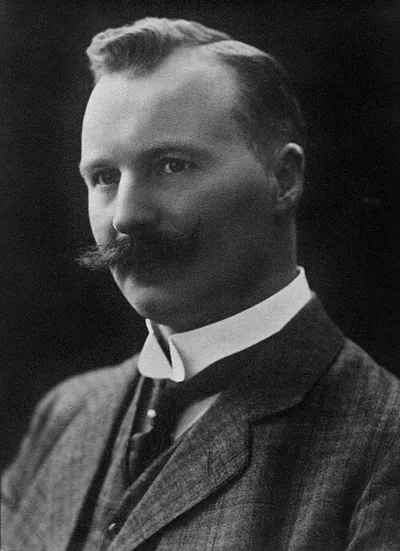 Nils Gustaf Dalén1869–1937 · Technology and communications
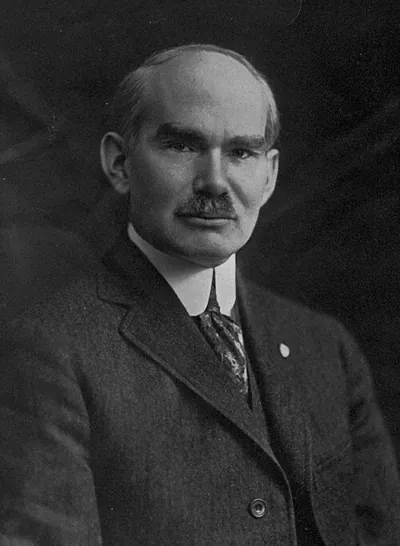 Lee de Forest1873–1961 · Technology and communications
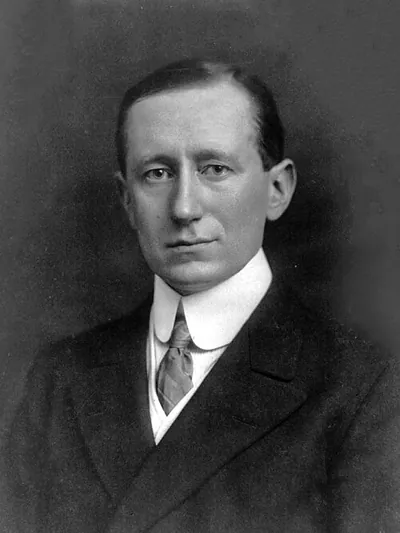 Guglielmo Marconi1874–1937 · Technology and communications
 Louis Lumière1864–1948 · Technology and communications
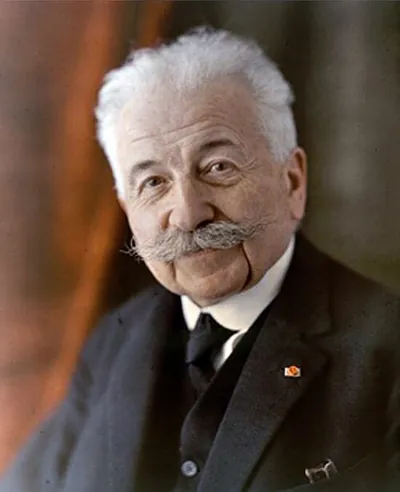 Auguste Lumière1862–1954 · Technology and communications
 Aleksandr Popov1859–1906 · Technology and communications
