Hugh Everett III
American physicist who proposed the many-worlds interpretation of quantum mechanics · 1930–1982
- Born
- November 11, 1930
- Died
- July 19, 1982
- Country
- United States
- Section
- Physics
Biography
Hugh Everett III (Washington, 1930 - McLean, Virginia, 1982) was an American physicist who proposed a new way of understanding quantum mechanics, the branch of physics that describes the behaviour of atoms and particles. His idea, known as the many-worlds interpretation, holds that every possible outcome of a measurement occurs in a separate branch of reality. For decades it was largely ignored, and today it is one of the most debated interpretations of the field.
He was born in 1930 and grew up in the Washington, D.C. area. His parents separated when he was young, and from the age of seven he lived with his father and stepmother. At twelve he wrote to Albert Einstein asking whether what holds the universe together is something random or something unifying, and he received a reply. During the Second World War his father served in Europe, and afterwards the family settled in West Germany. Everett joined him there in 1949, taking a year off from university, and the two of them photographed the country's reconstruction with keen interest.
He graduated in 1953 from the Catholic University of America with a degree in chemical engineering, having also completed enough mathematics courses for a degree in that subject. With a National Science Foundation fellowship he entered Princeton University, starting in the mathematics department, where he worked on game theory, the mathematical study of strategic decisions. Gradually he drifted towards physics. He attended classes with Robert Dicke and Eugene Wigner, and in 1955 he switched his thesis adviser to John Archibald Wheeler.
His work began with an awkward problem. Quantum mechanics describes a system with a wave function that evolves smoothly, yet when something is measured the result seems to jump to a single value. The standard view, associated with Niels Bohr, simply accepted that jump. Everett proposed dropping it: the observer is also described by the wave function, and after a measurement every possible result coexists in branches that no longer interact. On this account, probabilities measure how the universe branches. He completed the long paper, first titled 'Wave Mechanics Without Probability', in 1956, and earned his doctorate in 1957. The short version in Reviews of Modern Physics was a compromise with Wheeler, who wrote a favourable review, but Everett was never satisfied with it.
To avoid losing his draft deferment, he took a research job at the Pentagon's Weapons Systems Evaluation Group in 1956, and he largely stopped theoretical physics there. He worked on missile studies and on the spread of radioactive fallout, and in 1957 became director of the group's department of physical and mathematical sciences. In 1959 he went to Copenhagen to meet Bohr, but the visit was a failure. Bohr rejected his approach, and one of Bohr's close colleagues criticised him harshly. Everett later called the experience hell. In 1963 he published a theorem on Lagrange multipliers, mathematical tools for finding the best outcome within given constraints, widely used in operations research.
In 1962 he presented his formulation at a conference, stating that observers in every branch are equally real. Boris Podolsky remarked that this would produce an infinite number of worlds, and Everett agreed. In 1964 he co-founded Lambda Corp. with colleagues, to apply military modelling to civilian problems. In 1973 he and a colleague left it to found DBS Corporation in Arlington, Virginia, which studied the socioeconomic effects of affirmative action programmes for federal agencies. Everett also contributed algorithms to American Management Systems, a business consulting firm.
Recognition came late. In 1970 Bryce DeWitt wrote an article in Physics Today about the theory, which he dubbed many-worlds, and in 1973 he edited an anthology that included Everett's 1956 paper, previously unpublished. In 1977 Everett gave a talk at the University of Texas at Austin that impressed David Deutsch, who later helped popularise the idea. Even so, Everett did little to promote his work, saying he had washed his hands of the affair in 1956. Wheeler, in 1980, judged the theory to carry too much metaphysical baggage.
He died of a heart attack at home on 19 July 1982, aged 51. A committed atheist, he had asked that his remains be thrown in the trash, and his wife kept his ashes in an urn for a few years before complying. His legacy is twofold. The many-worlds interpretation gained strength after the discovery of quantum decoherence in the 1970s, meaning the loss of coherence a system suffers when it interacts with its surroundings. His optimisation techniques also found their way into business. His son, Mark Oliver Everett, known as Mr. E and leader of the band Eels, directed the documentary Parallel Worlds, Parallel Lives about his father.
Main contributions
- 1956Doctoral thesis proposing that measurement involves no collapse, but coexisting branches of the universe.
- 1957Relative-state formulation, published in Reviews of Modern Physics, the basis of the many-worlds interpretation.
- 1963Theorem on Lagrange multipliers, tools for optimising outcomes under constraints.
- 1964Co-founding of Lambda Corp., a firm applying military models to civilian problems.
- 1973Founding of DBS Corporation, which carried out studies for US government agencies.
Teachers and students
Trivia and anecdotes
A letter to Einstein
At the age of twelve he wrote to Albert Einstein asking about the order of the universe, and he received a reply.
An unceremonious end
A committed atheist, he asked that his remains be thrown in the trash, a wish his wife eventually carried out.
Their contemporaries
While Hugh Everett III was alive (1930–1982)…
Alive at the same time
Discovered or invented in those years
- 1931Big BangA cosmological model describing how the universe expanded from an early state of extreme density and temperature, about 13.8 billion years ago.
- 1932NeutronA subatomic particle with no net electric charge, found in the nucleus of almost every atom alongside protons.
- 1945ComputerA programmable machine that takes in data, processes it by following stored instructions, and produces results, able to switch tasks simply by running different software.
- 1969InternetA global network of interconnected computer networks that communicate using the TCP/IP protocol suite.
- 1971EmailA network service that lets users send and receive digital messages through addressed mailboxes, much like postal mail but electronic.
- 1973Mobile phoneA handheld wireless phone that lets people make and receive calls while moving across a cellular network area.
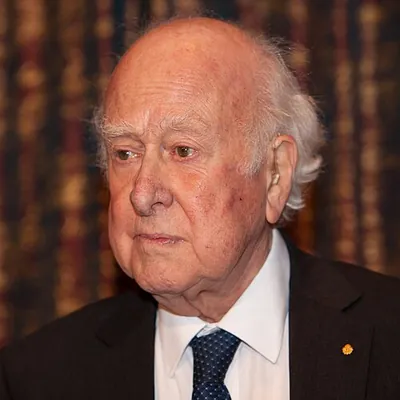 Peter Higgs1929–2024 · Physics
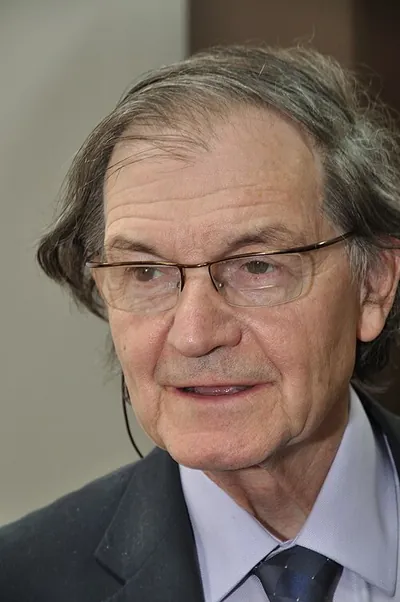 Roger Penrose1931 · Physics
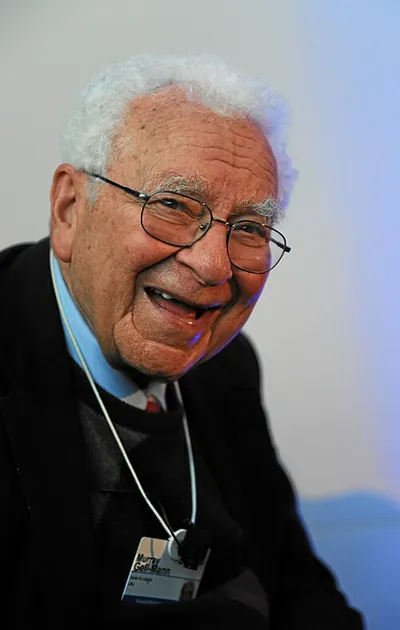 Murray Gell-Mann1929–2019 · Physics
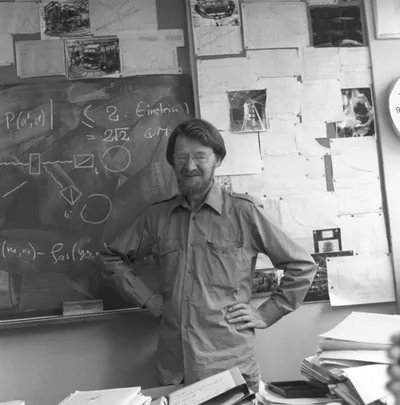 John Stewart Bell1928–1990 · Physics
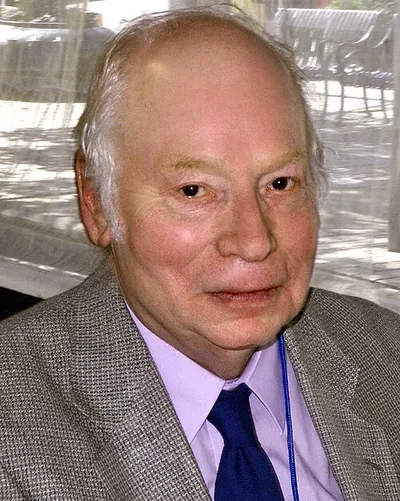 Steven Weinberg1933–2021 · Physics
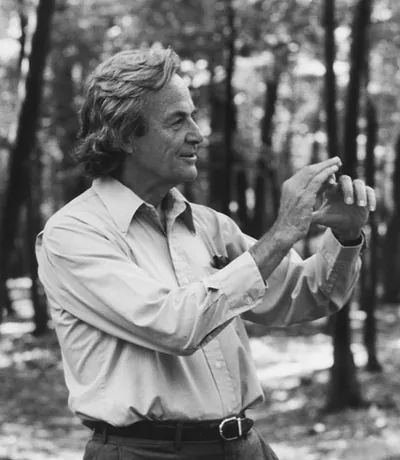 Richard Feynman1918–1988 · Physics