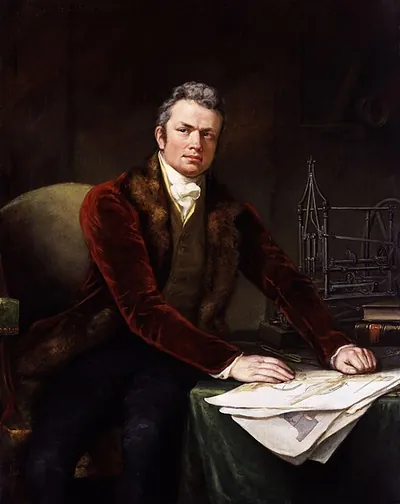
Marc Isambard Brunel
French-British engineer, builder of the Thames Tunnel · 1769–1849
- Born
- April 25, 1769
- Died
- December 12, 1849
- Country
- France, Kingdom of Great Britain, United Kingdom of Great Britain and Ireland
- Section
- Engineering and construction
Biography
Marc Isambard Brunel (born in Hacqueville, Normandy, 1769; died in London, 1849) was a French-born engineer who spent most of his career in Britain. He is best remembered for building the Thames Tunnel, one of the first tunnels under a river, and for being the father of the engineer Isambard Kingdom Brunel. His working life, which spanned the French Revolution and the rise of British industry, combined practical training with large-scale machinery and construction.
He was the second son of Jean Charles Brunel and Marie-Victoire Lefebvre, prosperous farmers in Normandy. By custom the eldest son inherited the land and the second was expected to join the priesthood, so Marc received a classical schooling that held little appeal for him. He showed a gift for drawing, mathematics and music instead. After a spell at a seminary in Rouen, where he learned carpentry and cabinetmaking, he was sent to relatives in the same city, where a family friend introduced him to naval matters. In 1786 he became a cadet on a French frigate, and he made himself an octant of brass and ivory to navigate by on his voyages.
The Revolution forced a change of course. A monarchist sympathiser, he rashly predicted in Paris in 1793 that Robespierre would fall, and he had to flee France. He reached New York in September of that year. There he took part in a canal scheme and submitted a design for the Capitol in Washington, which was not chosen. In 1796, having become an American citizen, he was named chief engineer of New York City, where he designed houses, docks and an arsenal, though few records of this work survive.
In 1798, over dinner, he learned that the Royal Navy needed around a hundred thousand pulley blocks a year, all made by hand. He designed a set of machines to automate their manufacture and travelled to England to put them before the Admiralty. There he met Henry Maudslay, who built the working models, and in London he was reunited with Sophia Kingdom, whom he had left behind in Rouen and married in November 1799. His machines, installed at Portsmouth, let unskilled workers produce ten times as many blocks as before. Still, the Admiralty dragged its feet over payment, and Brunel had to cover considerable costs himself.
He later worked on sawmill machinery and on equipment for mass-producing army boots, though the boot project was dropped when the Napoleonic Wars ended. His reputation earned him election to the Royal Society in 1814. Business ventures that failed to pay off, however, left him heavily in debt, and in 1821 he was committed to the King's Bench debtors' prison. During the 88 days he spent there he corresponded with Tsar Alexander I about moving to St Petersburg, until the British government, under pressure from influential figures such as the Duke of Wellington, cleared his debts on condition that he give up the idea.
His great project was the tunnel under the Thames between Rotherhithe and Limehouse. The Thames Archway Company, formed in 1805, began the work with Richard Trevithick, but in 1807 the digging hit quicksand and the scheme was abandoned after a little over a thousand feet had been dug. In 1818 Brunel patented a cast-iron shield that protected the miners as they dug, pushed forward by large jacks while brick lining was laid behind it. The shield is said to have been inspired by the shipworm, a creature that bores through ships' timbers with a hard-shelled head, though that account is traditional and not firmly documented.
His legacy is twofold: the shield technique laid the groundwork for modern tunnelling, and the Thames Tunnel, completed after years of effort, is regarded as the world's first underwater tunnel. He was knighted in 1841, as the work neared completion.
Main contributions
- 1798Design of a set of machines to mass-produce the pulley blocks used by the Royal Navy, which had until then been made by hand.
- 1808Installation of his machines at the Portsmouth Block Mills, where blocks were made at high speed by unskilled labour.
- 1818Patent for a cast-iron tunnelling shield that protected miners as they dug and was pushed forward by jacks.
- 1828Election as a foreign member of the Royal Swedish Academy of Sciences.
- 1841Knighted by Queen Victoria in anticipation of the completion of the Thames Tunnel.
Trivia and anecdotes
A preferred name
He preferred to be called Isambard, but history knows him as Marc to avoid confusion with his son.
A rash prediction
In Paris during the Revolution he publicly predicted Robespierre's fall, an act that forced him to flee France.
Their contemporaries
While Marc Isambard Brunel was alive (1769–1849)…
Alive at the same time
Discovered or invented in those years
- 1774OxygenA colorless, odorless gas, symbol O and atomic number 8, that forms the dioxygen in air and is essential for respiration in most living things.
- 1781UranusThe seventh planet from the Sun, an ice giant discovered by William Herschel in 1781, the first planet found with a telescope.
- 1803AtomThe basic unit of a chemical element: a nucleus of protons and usually neutrons surrounded by a cloud of electrons.
- 1821ElectricityThe set of physical phenomena linked to the presence and movement of electric charge, and one of the most versatile forms of energy in modern life.
- 1839PhotographyA technique for creating lasting images by recording light, either on a light-sensitive material or with an electronic sensor.
- 1846NeptuneThe eighth and most distant planet of the Solar System, an ice giant found through mathematical prediction before any direct sighting.
 Thomas Telford1757–1834 · Engineering and construction
 Lazare Carnot1753–1823 · Engineering and construction
 Samuel Crompton1753–1827 · Engineering and construction
 Claude-Louis Navier1785–1836 · Engineering and construction
 Marc Seguin1786–1875 · Engineering and construction
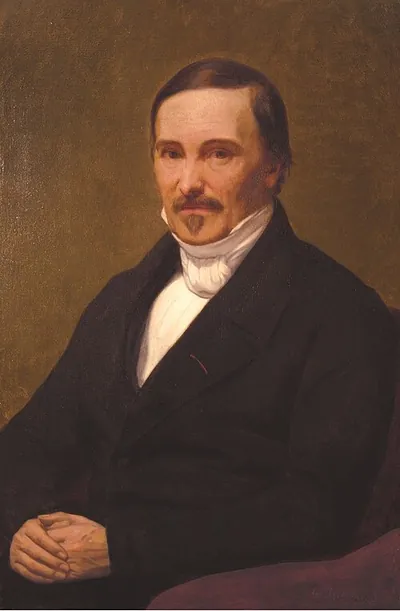 Jean-Victor Poncelet1788–1867 · Engineering and construction
