
James Cronin
American physicist, 1980 Nobel laureate for discovering CP violation · 1931–2016
- Born
- September 29, 1931
- Died
- August 25, 2016
- Country
- United States
- Section
- Physics
- Awards
- Nobel Prize in Physics
Biography
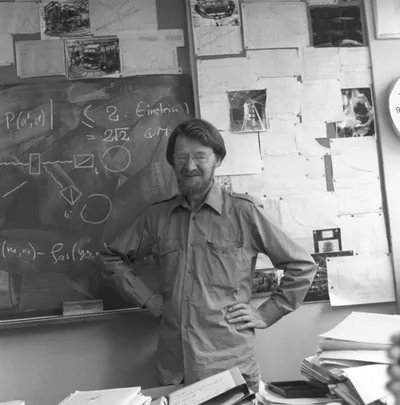
James Watson Cronin (Chicago, 1931 – Saint Paul, 2016) was an American physicist who shared the 1980 Nobel Prize in Physics with Val Fitch. Their experiment showed that certain subatomic reactions do not behave the same way when they run in reverse, a finding that overturned a principle many physicists had assumed was exact. Working in particle physics, the field that studies the smallest building blocks of matter, Cronin helped reshape how scientists understand the basic symmetries governing the universe.
Cronin was born in Chicago on September 29, 1931. His father, James Farley Cronin, was a graduate student in classical languages at the University of Chicago. After he earned his doctorate, the family moved first to Alabama and then, in 1939, to Dallas, Texas, where the elder Cronin became a professor of Latin and Greek at Southern Methodist University. Cronin stayed in Dallas after high school and earned his undergraduate degree in physics and mathematics there in 1951. His family had Irish roots, with ancestors who emigrated from County Cork.
He returned to Chicago for graduate study, where his teachers included several future Nobel laureates: Enrico Fermi, Maria Mayer, Murray Gell-Mann and Subrahmanyan Chandrasekhar. His thesis, supervised by Samuel K. Allison, dealt with experimental nuclear physics, the laboratory study of atomic nuclei and how they change. He completed his doctorate in 1955.
That year he joined the group of Rodney L. Cool and Oreste Piccioni at Brookhaven National Laboratory, which had just completed the Cosmotron, a particle accelerator. An accelerator drives particles to very high speeds and smashes them together so physicists can study what emerges. There he began studying parity violation in the decay of particles called hyperons, and he met Val Fitch, who later brought him to Princeton University. After a magnet failure at the Cosmotron, the Brookhaven group moved its work to the Bevatron at the University of California, Berkeley.
The starting assumption was simple: if the laws of physics are symmetrical, a process and the same process run backwards should behave in similar ways. Cronin and Fitch studied the decay of neutral K mesons, unstable particles that transform into lighter ones. In 1964 they found that, in a share of the cases, the reversed reaction did not retrace the original path. This showed that the interactions of subatomic particles are not unchanged when time is reversed. The effect is called CP violation, because it involves both charge conjugation (C) and parity (P), a spatial symmetry that amounts to viewing an event in a mirror.
After the discovery, Cronin spent a year in France at the Centre d'Études Nucléaires in Saclay, then returned to Princeton to keep studying the CP-violating decay modes of the long-lived neutral K meson. In 1971 he moved back to the University of Chicago as a full professor, drawn by a new 400 GeV accelerator under construction at nearby Fermilab. There he began a long series of experiments on particle production at high transverse momentum, meaning particles flung out with considerable force at right angles to the collision direction.
During 1982 and 1983 he took a sabbatical at CERN, near Geneva, where he measured the lifetime of the neutral pion. By the late 1990s he had shifted to ultra-high-energy cosmic rays, particles that arrive from space with energies far beyond anything a laboratory accelerator can produce. His first line of work was a search for point sources of these rays. His measurements, published in 1997, found none.
In 1998 he joined the University of Utah on a half-time basis to help launch the Pierre Auger Observatory in Malargüe, Argentina, a large array of detectors spread across the plains to capture the showers of particles these rays create when they strike the atmosphere. His appointment was meant to last five years, but he left after one to keep building international support for the project with Alan Watson and Murat Boratav. Later, the collaboration published in 2008 an observed suppression in the cosmic ray flux above a certain energy, a paper on which Cronin is a co-author.
His personal life was shaped by family losses. He met his first wife, Annette Martin, while in graduate school, and they married in 1954. She directed special events at the University of Chicago and died in 2005 of complications from Parkinson's disease. They had three children: daughters Cathryn and Emily, and a son, Daniel. In 2006 he married Carol Champlin. In 2011 his daughter Cathryn died of leukemia at the age of 54.
Cronin also spoke publicly in defence of basic science. In 2008 he was one of twenty American Nobel laureates who signed a letter to President George W. Bush asking him to reverse the damage done to basic research in that year's budget bill. He had received the National Medal of Science in 1999. He was Professor Emeritus at the University of Chicago and a member of the Board of Sponsors of the Bulletin of the Atomic Scientists. He died in Saint Paul, Minnesota, on August 25, 2016, at the age of 84.
His legacy is a demonstration, in the laboratory, that time-reversal symmetry does not hold in every case. The result is part of the foundation of particle physics, and it earned him a share of the Nobel Prize alongside Fitch.
Main contributions
- 1964CP violation: demonstration that certain decays of K mesons do not respect symmetry under time reversal.
- 1976Ernest Orlando Lawrence Award for experimental contributions to particle physics, including work on weak interactions.
- 1977Series of experiments on particle production at high transverse momentum, summarized in Physical Review D.
- 1985Measurement of the lifetime of the neutral pion, carried out at CERN during his sabbatical.
- 1997Search for point sources of cosmic rays, which found none.
- 2008Observation of the suppression of the cosmic ray flux above a certain energy, published by the Pierre Auger Observatory collaboration.
Teachers and students
Trivia and anecdotes
Irish roots
His family descended from Irish immigrants who came from County Cork.
Top-tier teachers
During his graduate years in Chicago he learned from professors who later won the Nobel, including Enrico Fermi.
A letter to the White House
In 2008 he signed, alongside other American Nobel laureates, a letter to President Bush defending funding for basic science.
Their contemporaries
While James Cronin was alive (1931–2016)…
Alive at the same time
Discovered or invented in those years
- 1931Big BangA cosmological model describing how the universe expanded from an early state of extreme density and temperature, about 13.8 billion years ago.
- 1932NeutronA subatomic particle with no net electric charge, found in the nucleus of almost every atom alongside protons.
- 1945ComputerA programmable machine that takes in data, processes it by following stored instructions, and produces results, able to switch tasks simply by running different software.
- 1969InternetA global network of interconnected computer networks that communicate using the TCP/IP protocol suite.
- 1973Mobile phoneA handheld wireless phone that lets people make and receive calls while moving across a cellular network area.
- 1989World Wide WebA system of linked documents and resources, connected by hyperlinks and accessed over the Internet with web browsers.
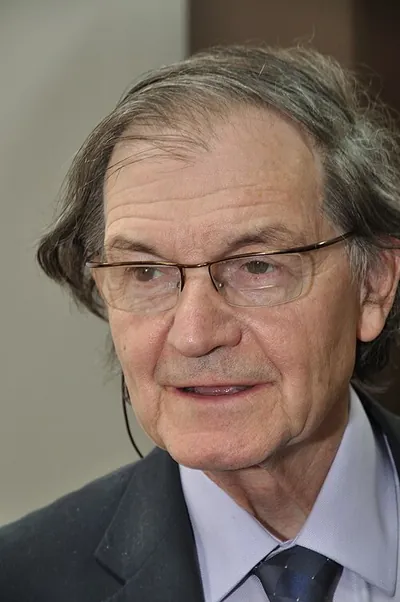 Roger Penrose1931 · Physics
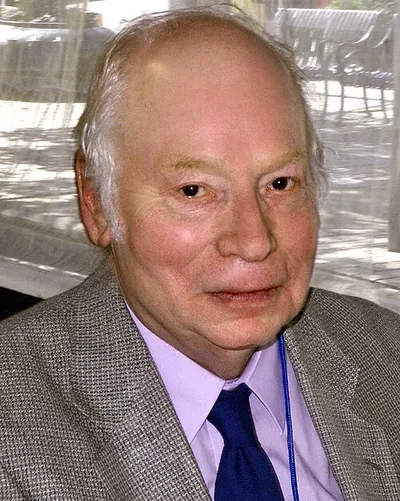 Steven Weinberg1933–2021 · Physics
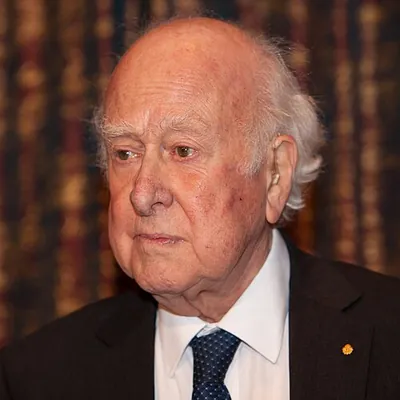 Peter Higgs1929–2024 · Physics
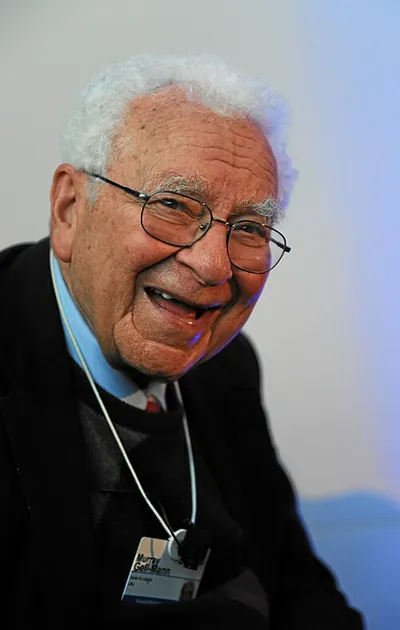 Murray Gell-Mann1929–2019 · Physics
 John Stewart Bell1928–1990 · Physics
 Stephen Hawking1942–2018 · Physics
