
Jean-André Deluc
Swiss geologist and meteorologist who studied heat, water and the atmosphere and devised measuring instruments · 1727–1817
- Born
- February 8, 1727
- Died
- November 7, 1817
- Country
- Switzerland, France, Republic of Geneva
- Section
- Earth sciences
Biography
Jean-André Deluc, also written de Luc, was a Swiss geologist and meteorologist from the Republic of Geneva, active between the late eighteenth and early nineteenth centuries. He matters because he combined the study of mountains, ice and air with the invention of measuring instruments, and because his defence of an Earth history shaped by the Scriptures placed him at the centre of the debates about geological time of his day.
He was born in Geneva on 8 February 1727. His family had come to the city from Lucca in Italy; the English source dates this to the fifteenth century, although the Spanish source leaves the date unclear. His mother was Françoise Huaut. His father, Jacques-François Deluc, had written against Bernard Mandeville and other rationalist writers, yet he also openly admired Jean-Jacques Rousseau. As a pupil of Georges-Louis Le Sage, the young Deluc received a grounding in mathematics and natural philosophy.
His first years as an adult were taken up largely by business, although he used his journeys into the Alps for scientific observation. With his brother Guillaume-Antoine he assembled a fine collection of minerals and fossils. He was also drawn into public life. In 1768 he was sent on a mission to the duc de Choiseul in Paris and won the duke's friendship. In 1770 he joined the Council of Two Hundred in Geneva. Financial setbacks forced him to leave his home town in 1773, and he returned to it only once, for a short visit.
That same year he moved to Britain, where he became reader to Queen Charlotte, a post he held for forty-four years. It gave him leisure and a steady income, which freed him for science. He was elected a fellow of the Royal Society and became a correspondent of the French Academy of Sciences. He toured Switzerland, France, the Netherlands and Germany. During his German period (1798 to 1804) he was made an honorary professor of philosophy and geology at Göttingen, and after his return he surveyed the geology of Britain (1804 to 1807). He died at Windsor in 1817, after nearly seventy years of research.
Geology was his chief concern. His major work, Lettres physiques et morales sur les montagnes et sur l'histoire de la terre et de l'homme, appeared in six volumes between 1778 and 1780 and was dedicated to the queen. He noticed that ice absorbs heat as it melts, an observation made at the same time as Joseph Black's work on latent heat, the energy a substance takes in without a rise in temperature while changing state. He found that water is densest at about 4 °C rather than at freezing point, and he argued that the amount of water vapour in a space does not depend on the air filling it, an idea John Dalton later revived.
Much of his effort went into instruments. He designed a portable barometer for field expeditions and applied the barometer to measuring heights. His Recherches sur les modifications de l'atmosphère reports experiments on moisture and evaporation. He built a hygrometer with an ivory bulb that swelled with humidity, and another based on whalebone, which set off a bitter quarrel with Horace-Bénédict de Saussure, the inventor of the hair hygrometer. He favoured mercury over alcohol in thermometers. In 1809 he sent the Royal Society a long paper on the dry pile, a form of Voltaic battery, but its views clashed with recent discoveries and it was not admitted to the Transactions. The dry column he described was built by other scientists, and although he was not its inventor, his improvement of the dry pile is still considered important.
He greatly admired Francis Bacon and published two works on him. His Traité élémentaire de géologie (1809) set out to refute James Hutton and John Playfair, whose theory of internal heat and erosion needed far more time than his own biblically based neptunism allowed. He never called Hutton an atheist, though he faulted him for not opposing atheism firmly enough. In his writings he sought to reconcile observation with Genesis, reading the six days as successive epochs and attributing the flood to the filling of cavities within the earth.
His legacy is twofold. As an investigator, his observations on water, the atmosphere and the history of the Earth were cited by authorities such as Georges Cuvier. As an instrument maker, his name survives in a lunar crater. His views on geological time, however, were overtaken by those of Hutton and Playfair.
Main contributions
- 1772Recherches sur les modifications de l'atmosphère: experimental study of humidity, evaporation and the use of hygrometers and thermometers.
- 1778Lettres physiques et morales sur les montagnes et sur l'histoire de la terre et de l'homme: a geological work in six volumes, published up to 1780.
- 1798Lettres sur l'histoire physique de la terre: a work proposing an Earth history divided into six periods, paralleling the six days of Creation.
- 1809Traité élémentaire de géologie: a textbook refuting Hutton and Playfair and defending a Neptunist account of rock origins based on Scripture.
- 1809Improved dry pile: refinement of the Voltaic battery without liquid, though the dry column was built by others.
- Portable barometer: an instrument designed for geological expeditions and also used to calculate heights.
- Whalebone hygrometer: an instrument for measuring air humidity, which led to a controversy with Saussure.
Trivia and anecdotes
A crater bearing his name
An impact crater on the Moon carries Deluc's name, an unusual honour for a scientist of his time.
A quarrel over humidity
His whalebone hygrometer sparked a bitter dispute with Horace-Bénédict de Saussure, who had invented the hair hygrometer.
Mentor to Francis Ronalds
He was a valued mentor to the young Francis Ronalds, who published several papers on dry piles in 1814 and 1815.
Their contemporaries
While Jean-André Deluc was alive (1727–1817)…
Alive at the same time
Discovered or invented in those years
- 1766HydrogenThe lightest and most abundant chemical element in the universe, atomic number 1, which under normal conditions is a colourless, odourless and highly flammable gas.
- 1772NitrogenChemical element with atomic number 7, a colourless, odourless gas that makes up about 78% of Earth's air and is an essential part of proteins and nucleic acids.
- 1774OxygenA colorless, odorless gas, symbol O and atomic number 8, that forms the dioxygen in air and is essential for respiration in most living things.
- 1781UranusThe seventh planet from the Sun, an ice giant discovered by William Herschel in 1781, the first planet found with a telescope.
- 1803AtomThe basic unit of a chemical element: a nucleus of protons and usually neutrons surrounded by a cloud of electrons.
- 1811MoleculeAn electrically neutral group of at least two atoms held together by chemical bonds in a defined arrangement.
 James Hutton1726–1797 · Earth sciences
 Horace Bénédict de Saussure1740–1799 · Earth sciences
 Déodat Gratet de Dolomieu1750–1801 · Earth sciences
 Jean Baptiste Bourguignon d'Anville1697–1782 · Earth sciences
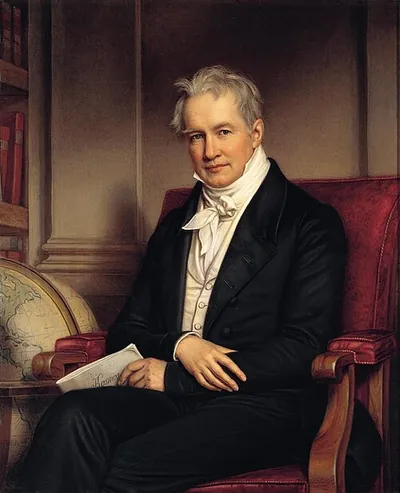 Alexander von Humboldt1769–1859 · Earth sciences
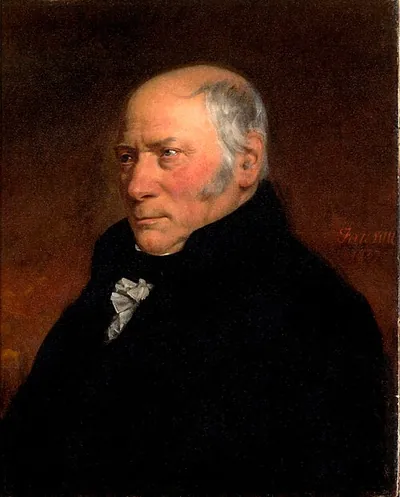 William Smith1769–1839 · Earth sciences
