
Jeannette Wing
American computer scientist, theorist and promoter of computational thinking · 1956
- Born
- December 4, 1956
- Country
- United States
- Section
- Computing
Biography
Jeannette Marie Wing (United States, born 1956) is a computer scientist whose work on formal methods and on computational thinking has shaped how computing is taught and understood well beyond the field itself. Her career spans university research, the leadership of scientific programmes and the management of industrial research laboratories, which makes her a prominent voice for bringing the rigour of computer science into other areas.
Wing studied at the Massachusetts Institute of Technology (MIT), where she earned her bachelor's and master's degrees in electrical engineering and computer science in June 1979. Her master's advisers were Ronald Rivest and John Reiser. Rivest is known as one of the creators of the RSA encryption method, which protects messages using pairs of mathematical keys. In 1983 she completed her doctorate at the same institution under John Guttag, a specialist in abstract data types, that is, in describing data structures by their behaviour rather than their concrete implementation.
After her doctorate, Wing taught at the University of Southern California from 1982 to 1985. She then joined Carnegie Mellon University in Pittsburgh, where she stayed from 1985 to 2012. There she headed the Computer Science Department in two periods, from 2004 to 2007 and from 2010 to 2012. Her best-known research area is formal methods, a set of techniques that use mathematical logic to specify what a program should do and to check that it does it. Within this field she was a leading figure in the Larch family of specification languages, which describe the expected behaviour of software components. She led many projects and published widely.
One of her most cited results is the Liskov substitution principle, which she developed with Barbara Liskov and published in 1993. Put simply, it states that an object of a subclass should be usable wherever an object of its parent class is expected, without the program behaving incorrectly. The rule is now taught in object-oriented programming courses and helps engineers design software that is more reliable and easier to maintain.
From the early 2000s, Wing became a persistent advocate of computational thinking. By this she means the problem-solving skills of decomposition and abstraction that computer scientists use routinely, and she argues that these techniques are valuable in biology, economics, history and many other disciplines. Her popular writing on the subject became a reference point for computing education in schools and universities in many countries.
From 2007 to 2010 she served as assistant director for Computer and Information Science and Engineering at the United States National Science Foundation. In January 2013 she left Carnegie Mellon to join Microsoft Research, where she became corporate vice president with oversight of the company's core research laboratories around the world. She left that post on 30 June 2017. She then led the Data Science Institute at Columbia University, and in 2021 she was appointed the university's executive vice president for research, while remaining a professor of computer science there.
Her professional recognition includes being named an ACM Fellow in 1998, for her contributions to formal methods and programming languages, and an IEEE Fellow in 2003. In 2024 she was elected to the United States National Academy of Engineering, for her formulation and promotion of computational thinking and her contributions to formal methods and trustworthy computing. Her legacy lies in the theory that helped formalise software correctness and in her sustained argument that learning to think like a computer scientist is useful to everyone.
Main contributions
- 1993Liskov substitution principle: a rule for designing classes and subclasses so that a child object can replace its parent without changing how the program works.
- Work on formal methods and the Larch specification language, used to describe precisely the expected behaviour of software.
- Promotion of computational thinking, the set of decomposition, abstraction and problem-solving techniques that can also be applied outside computing.
Teachers and students
Studied under:
Taught:
Trivia and anecdotes
Black belt
According to her biographical record, she holds a fourth-degree black belt in Tang Soo Do, a Korean martial art.
Related discoveries and inventions
- 2006Computational thinkingA way of framing and solving problems using reasoning borrowed from computer programming: breaking them down, spotting patterns, abstracting and ordering steps.
Their contemporaries
While Jeannette Wing was alive (1956–)…
Alive at the same time
Discovered or invented in those years
- 1957Artificial satelliteAn artificial satellite is a human-made object placed in orbit around a celestial body, usually Earth, to collect information, relay signals, or carry out a specific task.
- 1969InternetA global network of interconnected computer networks that communicate using the TCP/IP protocol suite.
- 1971EmailA network service that lets users send and receive digital messages through addressed mailboxes, much like postal mail but electronic.
- 1973Mobile phoneA handheld wireless phone that lets people make and receive calls while moving across a cellular network area.
- 1989World Wide WebA system of linked documents and resources, connected by hyperlinks and accessed over the Internet with web browsers.
- 1990Web browserA program that lets people access the web by fetching a page's files from a server and displaying them on screen as an interactive page.
 Guido van Rossum1956 · Computing
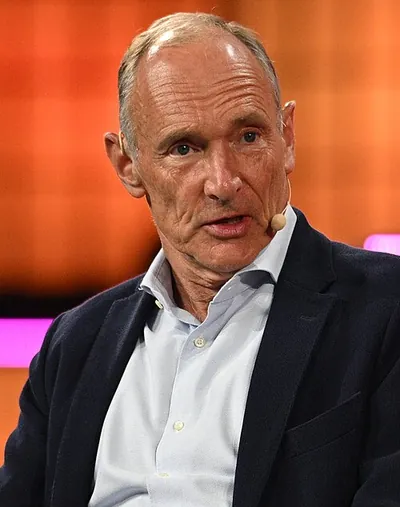 Tim Berners-Lee1955 · Computing
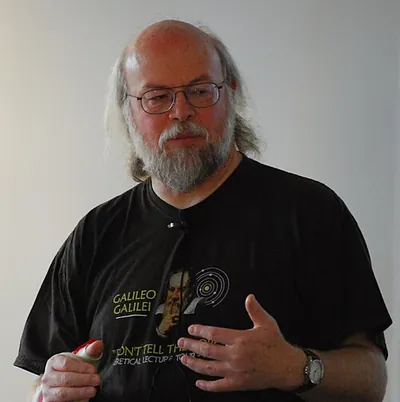 James Gosling1955 · Computing
 Shafrira Goldwasser1958 · Computing
 Yann LeCun1959 · Computing
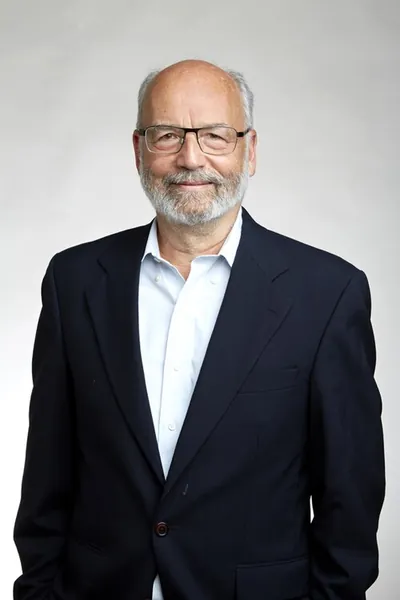 Adi Shamir1952 · Computing
