
John L. Hall
American physicist, 2005 Nobel Prize in Physics for laser-based precision spectroscopy and the optical frequency comb technique · 1934
- Born
- August 21, 1934
- Country
- United States
- Section
- Physics
- Awards
- Nobel Prize in Physics
Biography
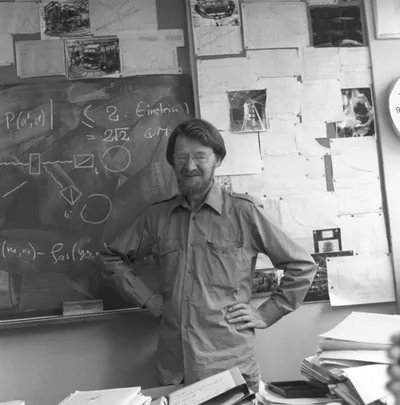
John Lewis Hall, known as Jan, is an American physicist born in Denver in 1934 whose work made it possible to measure light with extraordinary precision. He shared the 2005 Nobel Prize in Physics with Theodor W. Hänsch, while the other half of the award went to Roy J. Glauber. His contribution transformed metrology, the science of making precise measurements, and opened paths both in fundamental physics and in everyday technology.
Hall was born in Denver, Colorado, on August 21, 1934. He studied at the Carnegie Institute of Technology, now part of Carnegie Mellon University, where he earned a bachelor's degree in 1956, a master's in 1958 and a doctorate in 1961. During those years he held a fellowship in physics from the National Carbon Company, which gave him room to pursue optics and lasers at a time when this kind of artificial light was still a young technology.
After his doctorate he did postdoctoral work at the National Bureau of Standards in the United States, the agency that later became the National Institute of Standards and Technology (NIST). He remained there from 1962 until his retirement in 2004, and most of his career unfolded in that setting. From 1967 he also taught at the University of Colorado Boulder, and he maintained close ties with the Joint Institute for Laboratory Astrophysics (JILA), a research institute run jointly by the university and NIST.
The core of his work was the control of laser light. A laser emits light of one very specific colour, but that frequency, meaning the number of oscillations per second that defines the colour, can drift slightly. Hall and his team developed methods to stabilise these frequencies so that the laser oscillated in a predictable and repeatable way. This allowed frequencies to be compared with an accuracy previously out of reach, and it underpinned work in fundamental physics, such as testing whether the constants of nature stay the same over time.
In the late 1990s, Hall and Hänsch refined the optical frequency comb technique. This device generates a series of evenly spaced lines of light, like the teeth of a comb, which serve as a ruler for measuring any other frequency of light. Thanks to it, frequencies could be measured to fifteen digits of precision. The tool made it possible to build extremely accurate clocks and to improve satellite positioning technology such as GPS.
The 2005 Nobel Prize recognised this line of work. The committee highlighted the contribution of both scientists to precision spectroscopy, the study of how light interacts with matter in fine detail, and to the comb technique. Hall received many other honours over his career, among them the Max Born Award of the Optical Society of America, given for his work on stable lasers and the stabilisation of femtosecond lasers, which emit pulses lasting a few quadrillionths of a second.
Hall has also taken part in public debates. In 2008 he signed, together with other Nobel laureates in physics, a letter to President George W. Bush asking him to reverse cuts to basic science research, and in 2015 he signed the Mainau Declaration on Climate Change, which was handed over during the COP21 summit in Paris. In 2018 he donated his Nobel medal to the University of Colorado Boulder.
Hall's legacy lies in how the measurement of light has become a tool of extreme precision. His work on stable lasers and the frequency comb has shaped modern metrology, the search for possible variations in fundamental constants, and increasingly exact time standards. After retiring, he remained connected to the university and to JILA as an emeritus researcher.
Main contributions
- 1961Doctorate from the Carnegie Institute of Technology, the starting point of his work in optics and lasers.
- 1990Frequency stabilisation of lasers, which keeps the colour of laser light constant and predictable.
- 1999Optical frequency comb technique, developed with Theodor W. Hänsch, which acts as a precise ruler for measuring light frequencies.
- 2005Nobel Prize in Physics, shared with Theodor W. Hänsch for laser-based precision spectroscopy.
Teachers and students
Trivia and anecdotes
Donation of the medal
In 2018 he donated his Nobel medal to the University of Colorado Boulder, where he has carried out much of his teaching.
Letter to the White House
In 2008 he signed, along with nineteen other American Nobel laureates in physics, a letter to President Bush defending basic research.
Their contemporaries
While John L. Hall was alive (1934–)…
Alive at the same time
Discovered or invented in those years
- 1945ComputerA programmable machine that takes in data, processes it by following stored instructions, and produces results, able to switch tasks simply by running different software.
- 1957Artificial satelliteAn artificial satellite is a human-made object placed in orbit around a celestial body, usually Earth, to collect information, relay signals, or carry out a specific task.
- 1969InternetA global network of interconnected computer networks that communicate using the TCP/IP protocol suite.
- 1971EmailA network service that lets users send and receive digital messages through addressed mailboxes, much like postal mail but electronic.
- 1973Mobile phoneA handheld wireless phone that lets people make and receive calls while moving across a cellular network area.
- 1989World Wide WebA system of linked documents and resources, connected by hyperlinks and accessed over the Internet with web browsers.
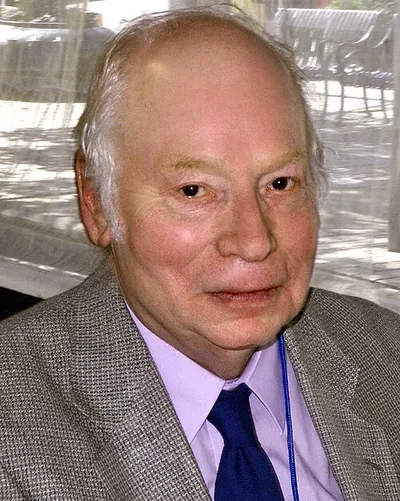 Steven Weinberg1933–2021 · Physics
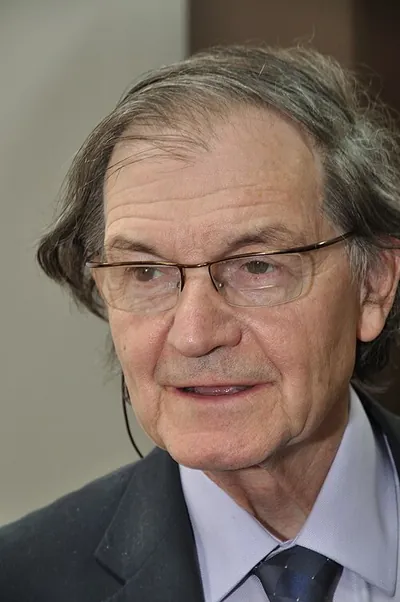 Roger Penrose1931 · Physics
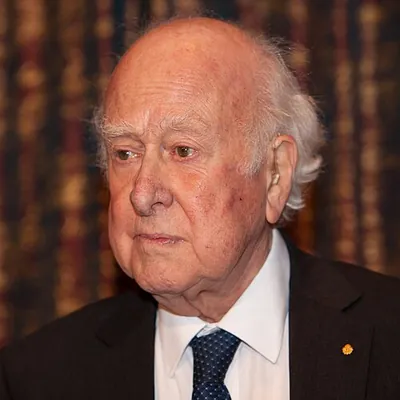 Peter Higgs1929–2024 · Physics
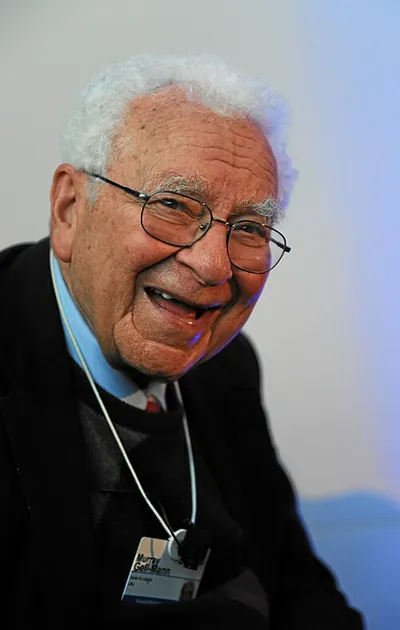 Murray Gell-Mann1929–2019 · Physics
 John Stewart Bell1928–1990 · Physics
 Stephen Hawking1942–2018 · Physics
