
John Polkinghorne
British physicist and Anglican priest, a leading voice on the dialogue between science and religion · 1930–2021
- Born
- October 16, 1930
- Died
- March 9, 2021
- Country
- United Kingdom
- Section
- Physics
Biography
John Polkinghorne (Weston-super-Mare, 1930 - Cambridge, 2021) was a British theoretical physicist who, after a career in particle physics, trained as an Anglican priest and became one of the most widely read voices on the relationship between science and religion. His life spans much of the second half of the twentieth century and shows that the two fields can coexist without giving up the pursuit of truth.
He was born on 16 October 1930 in Weston-super-Mare, Somerset, to a family with modest means: his father worked for the post office. Although born in Somerset, he regarded himself as Cornish rather than English, part of the Celtic fringe of Britain. He was schooled locally in Street and, after his father's promotion to head postmaster in Ely, he moved to The Perse School in Cambridge. After two years of National Service with the Royal Army Educational Corps, he read mathematics at Trinity College, Cambridge, graduating in 1952 as Senior Wrangler, the top student of his year. He then completed a PhD in physics in 1955, supervised by the Nobel laureate Abdus Salam in the group led by Paul Dirac.
That year he married Ruth Martin, a fellow mathematics student he had met in the Christian Union, and the couple sailed to New York. He held a Harkness Fellowship at the California Institute of Technology, working with Murray Gell-Mann, and then took a lectureship at the University of Edinburgh in 1956. He returned to Cambridge in 1958 and became professor of mathematical physics in 1968, a post he held until 1979. For about twenty-five years he studied elementary particles, the smallest building blocks of matter, and played a part in the discovery of the quark. He also worked on the S-matrix, a mathematical tool that describes what happens when particles collide and what they can turn into. His students included Brian Josephson and Martin Rees. He was elected a Fellow of the Royal Society in 1974.
In 1977 he decided to train for the priesthood. He later explained that he felt he had given his best to science and that his most productive mathematical years were behind him, while Christianity had always been central to his life. He resigned his chair in 1979 to study at Westcott House, an Anglican theological college in Cambridge, and was ordained priest on 6 June 1982 at Trinity College. He served five years as a curate in south Bristol and then as vicar in Blean, Kent. In 1986 he returned to Cambridge as dean of chapel at Trinity Hall and became president of Queens' College that year, a post he held until he retired in 1996. From 1994 to 2005 he was canon theologian of Liverpool Cathedral.
His thinking rests on what he called critical realism: science and religion explore different aspects of one and the same reality. He argued that the mechanical picture of the world, from Laplace onward, should give way to a view in which much of nature is cloud-like rather than clock-like, unpredictable in its details. About mind and body he defended dual aspect monism, the idea that a single underlying stuff can appear in two states, material and mental. He also proposed the notion of active information, suggesting that when several outcomes are possible, higher levels of causation may decide which one happens. His arguments for the existence of God, drawing on the intelligibility of the universe and its fine tuning for life, were offered as reasons for thinking theism makes better sense of things, not as logical proofs.
He was made a Knight Commander of the Order of the British Empire in 1997, though as a priest he did not use the title Sir. In 2002 he received the Templeton Prize, worth one million pounds, for his work at the interface of science and religion, and that same year he founded the International Society for Science and Religion, becoming its first president. His Gifford Lectures of 1993 to 1994 were later published as The Faith of a Physicist. His legacy lies in a large body of writing, five books on physics and twenty-six on science and religion, and in his influence on academic dialogue between the two fields. He died in Cambridge on 9 March 2021, at the age of ninety.
Main contributions
- 1966The Analytic S-Matrix. A technical book, written with collaborators, on the S-matrix, the mathematical tool describing collisions between particles.
- 1980Models of High Energy Processes. A technical book on models explaining what happens when particles collide at very high energies.
- 1989The Quantum World. A popular book on quantum physics, the theory describing how matter and energy behave at the atomic scale.
- 1994The Faith of a Physicist. A book based on his 1993 to 1994 Gifford Lectures, on the relationship between scientific inquiry and faith.
- Role in the discovery of the quark. He contributed to the work that helped identify the quark, one of the particles that make up protons and neutrons.
Teachers and students
Studied under:
Taught:
Trivia and anecdotes
Cornish, not English
Although born in Somerset, Polkinghorne saw himself as Cornish rather than English, stressing his ties to the Celtic tradition of south-west Britain.
Binocular vision
He said that moving from science to religion had given him binocular vision, while admitting that the claim invited the kind of suspicion one might direct at a vegetarian butcher.
Their contemporaries
While John Polkinghorne was alive (1930–2021)…
Alive at the same time
Discovered or invented in those years
- 1931Big BangA cosmological model describing how the universe expanded from an early state of extreme density and temperature, about 13.8 billion years ago.
- 1932NeutronA subatomic particle with no net electric charge, found in the nucleus of almost every atom alongside protons.
- 1945ComputerA programmable machine that takes in data, processes it by following stored instructions, and produces results, able to switch tasks simply by running different software.
- 1969InternetA global network of interconnected computer networks that communicate using the TCP/IP protocol suite.
- 1973Mobile phoneA handheld wireless phone that lets people make and receive calls while moving across a cellular network area.
- 1989World Wide WebA system of linked documents and resources, connected by hyperlinks and accessed over the Internet with web browsers.
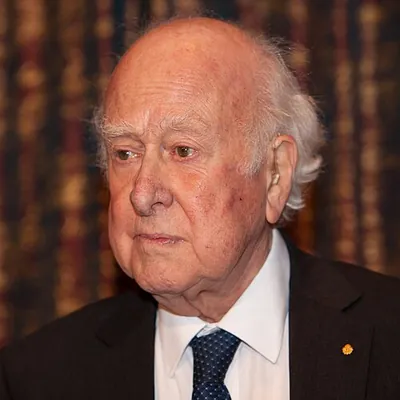 Peter Higgs1929–2024 · Physics
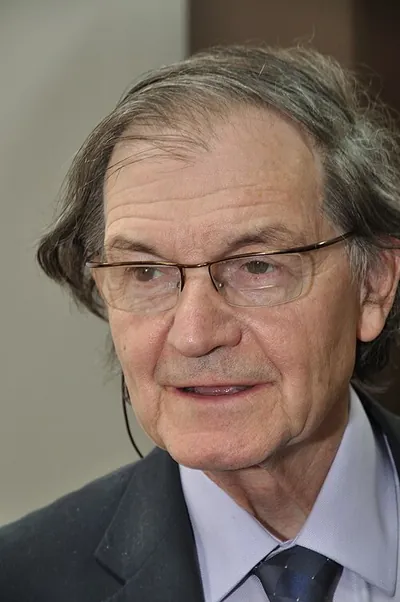 Roger Penrose1931 · Physics
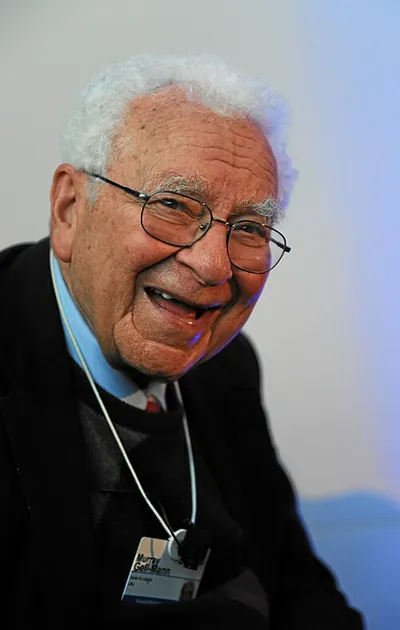 Murray Gell-Mann1929–2019 · Physics
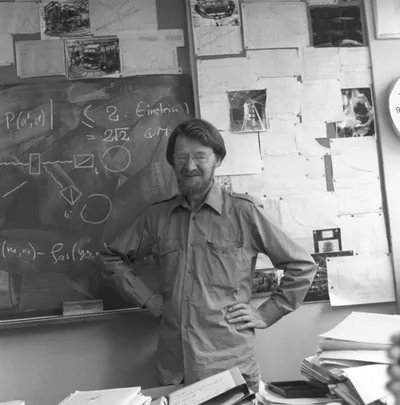 John Stewart Bell1928–1990 · Physics
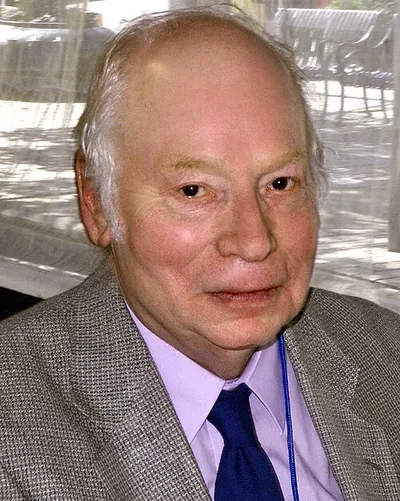 Steven Weinberg1933–2021 · Physics
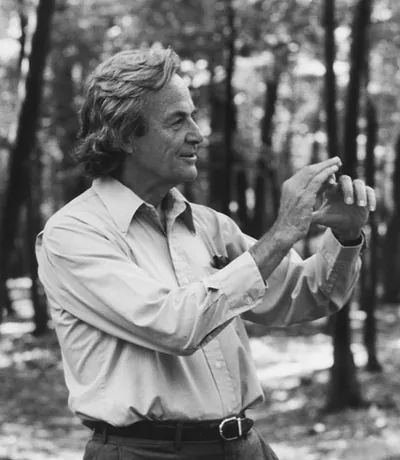 Richard Feynman1918–1988 · Physics
