
John Robert Schrieffer
American physicist, co-author of the BCS theory of superconductivity and 1972 Nobel Prize laureate in Physics · 1931–2019
- Born
- May 31, 1931
- Died
- July 27, 2019
- Country
- United States
- Section
- Physics
- Awards
- Nobel Prize in Physics
Biography
John Robert Schrieffer (Oak Park, Illinois, May 31, 1931 - Tallahassee, Florida, July 27, 2019) was an American physicist who shared the 1972 Nobel Prize in Physics with John Bardeen and Leon Cooper for the BCS theory, the first successful quantum description of superconductivity. His work, carried out in the late 1950s, solved a puzzle that had baffled physicists for more than thirty years. His career linked an education on the East Coast with academic posts that took him to Europe and to several American campuses.
He was born on May 31, 1931, in Oak Park, Illinois, to Louise Anderson and John Henry Schrieffer. In 1940 the family moved to Manhasset, New York, and in 1947 to Eustis, Florida, where his father, a former pharmaceutical salesman, took up work in the citrus industry. In Florida the young Schrieffer built homemade rockets and enjoyed amateur radio, a hobby that sparked his interest in electrical engineering. After finishing high school in 1949 he entered the Massachusetts Institute of Technology, where he studied electrical engineering for two years before switching to physics in his junior year. In 1953 he completed a bachelor's thesis on multiplets in heavy atoms under the supervision of John C. Slater.
His interest then turned to condensed-matter physics, the branch that studies solids and liquids made of enormous numbers of closely packed atoms. He began graduate work at the University of Illinois at Urbana-Champaign, where he was immediately hired as a research assistant to John Bardeen, who became his most important mentor and collaborator. Under Bardeen's guidance, Schrieffer tackled a theoretical question about how electricity moves across the surfaces of semiconductors, materials that conduct current only under certain conditions. He then spent a year in the laboratory applying that theory to several surface problems, which gave him a practical feel for the phenomena he was studying.
The breakthrough came around 1957, when Bardeen, Cooper and Schrieffer were working on superconductivity. Some materials lose all electrical resistance when cooled below a certain temperature. Cooper had shown that electrons in a superconductor group into pairs, now called Cooper pairs, and that these pairs move in a coordinated way thanks to vibrations of the material's atomic lattice. Schrieffer later recalled that in January 1957, riding a subway train in New York City, he came up with a way to describe mathematically the lowest-energy state of these electrons. His key insight was to treat all the pairs together rather than one at a time. The day after he returned to Illinois he showed his equations to Bardeen, who immediately recognized that they solved the problem. The theory, now known as BCS, accounted for experimental results of more than thirty years that had resisted the efforts of some of the most capable theorists in physics.
After defending his doctoral thesis on superconductivity, Schrieffer spent the 1957-1958 academic year as a National Science Foundation fellow at the University of Birmingham in England and at the Niels Bohr Institute in Denmark, where he kept working on the subject. He then served as an assistant professor at the University of Chicago and returned to the University of Illinois in 1959 as a faculty member. In 1960 he made a summer visit to the Bohr Institute, where he became engaged to Anne Grete Thomsen, and they married that Christmas. They had three children: Bolette, Paul and Regina. In 1961 he joined the University of Pennsylvania in Philadelphia. In 1964 he published Theory of Superconductivity, a detailed account of the BCS theory that served for years as a reference for students and researchers.
He shared the 1972 Nobel Prize with Bardeen and Cooper. In 1980 he moved to the University of California, Santa Barbara, where he became a chancellor's professor in 1984 and directed the university's Kavli Institute for Theoretical Physics. In 1992 Florida State University appointed him university eminent scholar and chief scientist of the National High Magnetic Field Laboratory, where he continued to pursue one of the field's great goals, superconductivity at room temperature, which has not yet been achieved.
His final years were overshadowed by a traffic accident. On September 24, 2004, while driving with a suspended license, he was involved in a crash that killed one person and injured seven others. He was reported to have fallen asleep at the wheel. On November 6, 2005, he was sentenced to two years in prison for vehicular manslaughter, and he was incarcerated at the Richard J. Donovan Correctional Facility near San Diego, California. Schrieffer died on July 27, 2019, at a nursing facility in Florida, while asleep, at the age of 88. He was a Christian.
His legacy is twofold. The BCS theory was the first complete quantum explanation of conventional superconductivity and remains the basic framework for understanding these materials. His ideas about how electrons behave collectively also opened paths in condensed-matter physics that later generations of researchers have continued to explore.
Main contributions
- 1957BCS theory of superconductivity, developed with Bardeen and Cooper, explaining how electrons paired together move without resistance at very low temperatures.
- 1964The book Theory of Superconductivity, a detailed account of the BCS theory that served as a reference for years.
- A mathematical description of all Cooper pairs acting together, the key step that solved the superconductivity problem.
Teachers and students
Trivia and anecdotes
An idea on the subway
He later recalled that the solution came to him in January 1957 while he was riding a subway train in New York City.
Rockets and ham radio
As a teenager in Florida he built homemade rockets and enjoyed ham radio, a hobby that drew him toward electrical engineering.
Their contemporaries
While John Robert Schrieffer was alive (1931–2019)…
Alive at the same time
Discovered or invented in those years
- 1931Big BangA cosmological model describing how the universe expanded from an early state of extreme density and temperature, about 13.8 billion years ago.
- 1932NeutronA subatomic particle with no net electric charge, found in the nucleus of almost every atom alongside protons.
- 1945ComputerA programmable machine that takes in data, processes it by following stored instructions, and produces results, able to switch tasks simply by running different software.
- 1969InternetA global network of interconnected computer networks that communicate using the TCP/IP protocol suite.
- 1973Mobile phoneA handheld wireless phone that lets people make and receive calls while moving across a cellular network area.
- 1989World Wide WebA system of linked documents and resources, connected by hyperlinks and accessed over the Internet with web browsers.
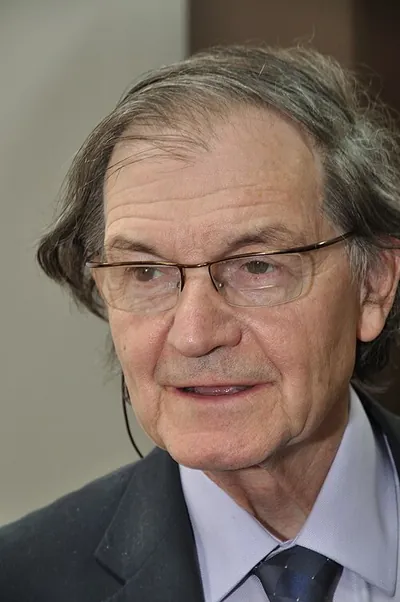 Roger Penrose1931 · Physics
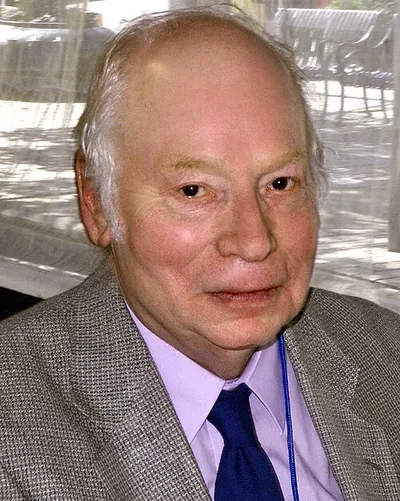 Steven Weinberg1933–2021 · Physics
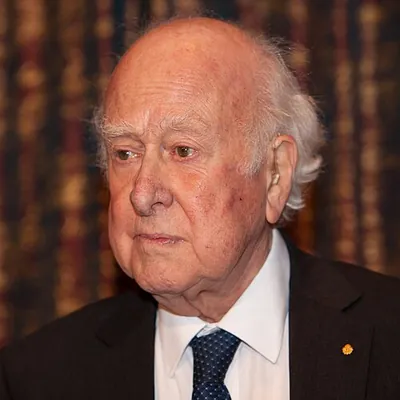 Peter Higgs1929–2024 · Physics
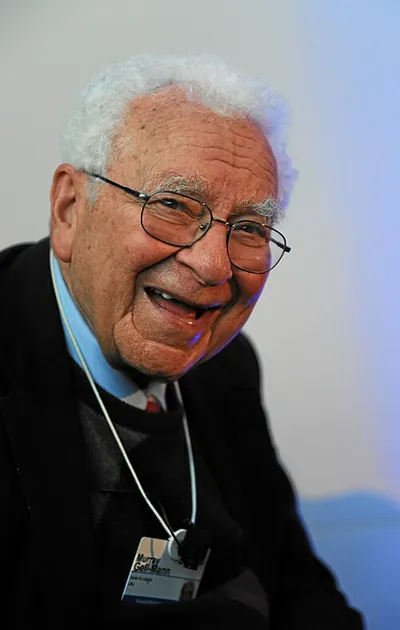 Murray Gell-Mann1929–2019 · Physics
 John Stewart Bell1928–1990 · Physics
 Stephen Hawking1942–2018 · Physics
