
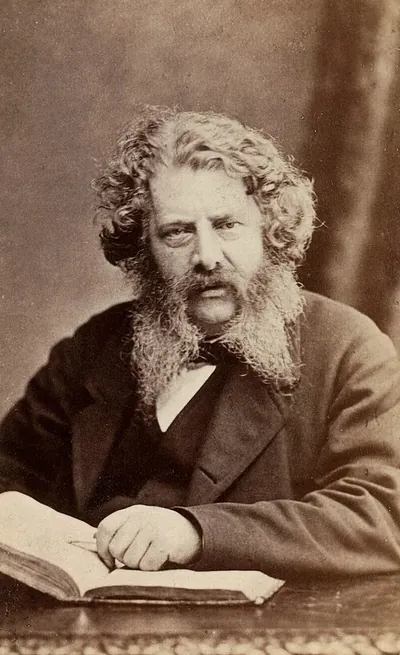
John Wolfe-Barry
British civil engineer, responsible for building Tower Bridge in London · 1836–1918
- Born
- December 7, 1836
- Died
- January 22, 1918
- Country
- United Kingdom of Great Britain and Ireland
- Section
- Engineering and construction
Biography
John Wolfe-Barry (London, 1836–1918) was a British civil engineer, best known for leading the construction of Tower Bridge over the River Thames. He worked in an age when railways and large iron and steel bridges were reshaping cities, and his name is tied both to those structures and to the standardisation of building materials.
He was the youngest of five sons of the architect Charles Barry. He was named after his godfather, the artist John Lewis Wolfe, who left him an inheritance; later he added that name to his own. He was educated at Glenalmond and King's College London, then trained as a pupil of the leading civil engineer John Hawkshaw, where he met Henry Marc Brunel, son of the famous Isambard Kingdom Brunel and later his business partner.
In 1867 he set up his own practice, at first concentrating on railway projects. Over time his work centred on bridges, railways and docks. He formed partnerships with Brunel in 1878, with his nephew Arthur John Barry in 1891, and with Edward Cruttwell in 1901, who had been resident engineer on the Blackfriars and Tower bridges.
Tower Bridge brought him fame. In 1878 the architect Horace Jones had proposed a bascule bridge, a design whose leaves lift to let ships pass. After an Act of Parliament in 1885 allowed the project, Jones prepared the initial scheme but died within a month of work starting. Wolfe-Barry, who already had experience of bridges across the Thames, was appointed engineer and, with Brunel, redesigned the lifting mechanisms, which changed the original plan. The two men completed the bridge in 1894, and he later received a CBE for the work.
His other bridges included the Cannon Street Railway Bridge of 1866, the Blackfriars Railway Bridge of 1886 and Kew Bridge in west London, of 1903. As consulting engineer he advised on lines including the Metropolitan District Railway and the Callander and Oban Railway, and on dock work such as the Immingham Dock of 1912 and the expansion of Greenland Dock in London.
His less visible contribution was standardisation. He urged the Institution of Civil Engineers to set up a committee on standard sections of iron and steel. The group first met on 26 April 1901 and, once other institutions joined, became the founding body of today's British Standards Institution. He also designed the Kitemark, and in 1917 he noted that at least 85 per cent of rolled steel sections already followed standard specifications.
He was elected a Fellow of the Royal Society in 1895 and made a Knight Commander of the Order of the Bath in 1897. He presided over the Institution of Civil Engineers in 1896–97 and represented the British Government on the International Consultative Committee of the Suez Canal from 1892 to 1906. He helped establish the National Physical Laboratory and chaired Cable and Wireless from 1900 to 1917.
He married Rosalind Grace, and they had four sons and three daughters. He died on 22 January 1918, aged 82, and was buried at Brookwood Cemetery near Woking. His legacy lies in the bridges and docks built under his direction and in the standards that still shape manufacturing. A memorial window in Westminster Abbey, dedicated in 1922, honours him.
Main contributions
- 1866Cannon Street Railway Bridge, also called the Alexandra Bridge, over the Thames in London.
- 1886Blackfriars Railway Bridge, known as St Paul's Bridge until 1937, in London.
- 1894Tower Bridge, a bascule bridge over the Thames whose leaves lift to let ships pass.
- 1901First meeting of the committee that laid the groundwork for industrial standardisation and today's BSI.
- 1903Kew Bridge, in west London.
- 1912Immingham Dock, a port project on the east coast of England.
Trivia and anecdotes
A name with two layers
He took the name Wolfe from his godfather and, after being knighted in 1897, used Wolfe-Barry, though his full legal name was Sir John Wolfe Wolfe-Barry.
A port with a borrowed name
Barry Docks, near Cardiff, does not take its name from Wolfe-Barry. He worked on its projects, but the name has no connection to him.
An occasional genealogist
In 1906 he published the results of an investigation into his family's genealogy.
Their contemporaries
While John Wolfe-Barry was alive (1836–1918)…
Alive at the same time
Discovered or invented in those years
- 1846NeptuneThe eighth and most distant planet of the Solar System, an ice giant found through mathematical prediction before any direct sighting.
- 1859EvolutionThe process by which the heritable traits of living populations change over generations, explaining the diversity of life from common ancestors.
- 1869Periodic tableAn arrangement of the chemical elements into rows (periods) and columns (groups), ordered by atomic number, that reveals recurring chemical behaviour and lets scientists predict properties.
- 1876TelephoneA device that carries the human voice over distance by turning sound into electrical signals and back into sound at the other end of the line.
- 1884CarA road vehicle with four wheels and its own engine, mainly built to carry people.
- 1903AirplaneA fixed-wing aircraft, heavier than air, powered by engines or rockets, that stays aloft because its wings generate lift.
 Gustave Eiffel1832–1923 · Engineering and construction
 William Le Baron Jenney1832–1907 · Engineering and construction
 Emily Warren Roebling1843–1903 · Engineering and construction
 Leonardo Torres Quevedo1852–1936 · Engineering and construction
 William John Macquorn Rankine1820–1872 · Engineering and construction
 Cornelis Lely1854–1929 · Engineering and construction
