
Karl Alexander Müller
Swiss physicist, Nobel Prize in Physics in 1987 for discovering superconductivity in ceramic materials at relatively high temperatures · 1927–2023
- Born
- April 20, 1927
- Died
- January 9, 2023
- Country
- Switzerland
- Section
- Physics
- Awards
- Nobel Prize in Physics
Biography
Karl Alexander Müller (Basel, 20 April 1927 - Zurich, 9 January 2023) was a Swiss physicist who, together with the German researcher Johannes Georg Bednorz, discovered in 1986 a form of superconductivity in ceramic materials at temperatures far higher than anyone had considered realistic. The finding opened an entire field of research and earned the two men the 1987 Nobel Prize in Physics, only a year after their discovery, the shortest gap between a scientific discovery and a Nobel award on record.
Müller was born in Basel, but his family soon moved to Salzburg, in Austria, where his father was studying music. They then settled in Dornach, near Basel, at the house of his maternal grandparents, and later in Lugano, in the Italian-speaking part of Switzerland, where the boy became fluent in Italian. His mother died in 1938, when he was eleven. After that loss he was sent to the Evangelical college in Schiers, in eastern Switzerland, where he studied from 1938 to 1945 and earned his school-leaving certificate. He grew up, in other words, as a student in a neutral country during the Second World War. He took part in classes and discussion groups about the state of the world at that time, an experience that he later suggested shaped his outlook on both science and life.
In 1945 he enrolled at the Swiss Federal Institute of Technology in Zurich, the country's major technical university. There he attended lectures by Wolfgang Pauli, a Nobel laureate and one of the most influential physicists of the twentieth century, who left a deep impression on him. After completing his diploma in 1952, he spent a year working on the Eidophor, a large-scale projection system for images, in an industrial research department at the same institute. He then returned to complete a doctorate, submitted at the end of 1957. His diploma work had been done under G. Busch, studying the Hall effect in grey tin, a semimetal. The Hall effect is the appearance of a small voltage across a conductor when it is placed in a magnetic field, and it reveals how electric charges move through a material.
His first professional post was at the Battelle Memorial Institute in Geneva, where he led a group working on magnetic resonance, a technique that reveals how atoms respond to magnetic fields. He also lectured at the University of Zurich. In 1963 he joined the IBM research laboratory at Rüschlikon, near Zurich, where he would remain until his retirement. For almost fifteen years his work centred on strontium titanate and related perovskite compounds, crystals with a highly ordered structure. He examined how they change colour under light when doped, meaning when small amounts of other elements are added, and studied their structural phase transitions, the points at which a crystal rearranges itself. Key results from this period were gathered in a book he wrote with Tom Kool of the University of Amsterdam. He became a professor at the University of Zurich in 1970 and an IBM Fellow in 1982, an internal distinction for outstanding researchers.
In the early 1980s Müller set out to find materials that would become superconducting at higher temperatures. Superconductivity is a state in which a material carries electricity with no resistance, something that had only been achieved by cooling materials to temperatures close to absolute zero. The highest critical temperature reached up to then was about 23 kelvin, roughly minus 250 degrees Celsius. Müller planned to test oxides systematically, and in 1983 he brought Bednorz into IBM to help. Some colleagues found the idea far-fetched, and one expert reportedly called it crazy, although a few recent studies had hinted that certain oxides might superconduct. In 1986 the pair produced superconductivity in a lanthanum barium copper oxide at around 35 kelvin. That was remarkably high. Over the previous 75 years the critical temperature had climbed from 11 kelvin to 23 kelvin, and it had stayed there for thirteen years.
They published their result in the June 1986 issue of Zeitschrift für Physik B. Before the year ended, Shoji Tanaka at the University of Tokyo and Paul Chu at the University of Houston had each confirmed it independently. A few months later Chu reached superconductivity at 93 kelvin in a yttrium barium copper oxide, which set off a rush of scientific interest. That rush was epitomised by the 1987 gathering often called the 'Woodstock of physics', where Müller was one of the featured speakers. Soon more effective compounds appeared, including bismuth-based materials that passed 100 kelvin. The field remains active, since understanding these materials could lead to applications such as lossless power cables or magnetic levitation trains.
In 1987 Müller and Bednorz shared the Nobel Prize in Physics. In his private life Müller kept a low profile. He married Ingeborg Marie Louise Winkler in 1956, and they had a son, Eric, in 1957 and a daughter, Sylvia, in the late 1950s; sources differ on her exact year of birth. Müller died in Zurich on 9 January 2023 at the age of 95.
His legacy is twofold. The discovery of high-temperature cuprate superconductors transformed materials physics and created a family of substances that scientists still study with the aim of improving energy transmission. His career also shows how an idea that initially seemed risky can reshape an entire field when it is tested patiently and methodically.
Main contributions
- 1952Study of the Hall effect in grey tin, his diploma work on how electric charges move through a semimetal.
- 1986Discovery of superconductivity at about 35 kelvin in a lanthanum barium copper oxide, far above anything previously known.
- 1987Nobel Prize in Physics, shared with Johannes Georg Bednorz, for their work on superconductivity in ceramics.
- Research on strontium titanate and perovskite compounds at IBM, including their photochromic properties and structural phase transitions.
Teachers and students
Trivia and anecdotes
The 'Woodstock of physics'
In 1987 a large meeting on superconductivity earned this nickname, and Müller was one of its featured speakers.
An idea called crazy
According to some accounts, experts who knew of Müller's plan considered it unreasonable, which makes the result all the more striking.
A record-fast Nobel
Only about a year passed between the discovery and the prize, the shortest such gap for any scientific Nobel.
Their contemporaries
While Karl Alexander Müller was alive (1927–2023)…
Alive at the same time
Discovered or invented in those years
- 1931Big BangA cosmological model describing how the universe expanded from an early state of extreme density and temperature, about 13.8 billion years ago.
- 1932NeutronA subatomic particle with no net electric charge, found in the nucleus of almost every atom alongside protons.
- 1945ComputerA programmable machine that takes in data, processes it by following stored instructions, and produces results, able to switch tasks simply by running different software.
- 1969InternetA global network of interconnected computer networks that communicate using the TCP/IP protocol suite.
- 1973Mobile phoneA handheld wireless phone that lets people make and receive calls while moving across a cellular network area.
- 1989World Wide WebA system of linked documents and resources, connected by hyperlinks and accessed over the Internet with web browsers.
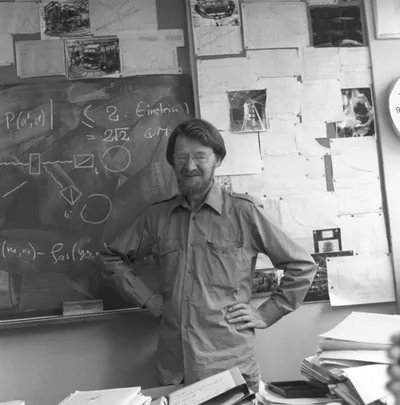 John Stewart Bell1928–1990 · Physics
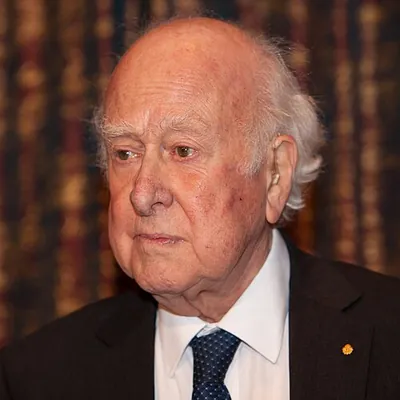 Peter Higgs1929–2024 · Physics
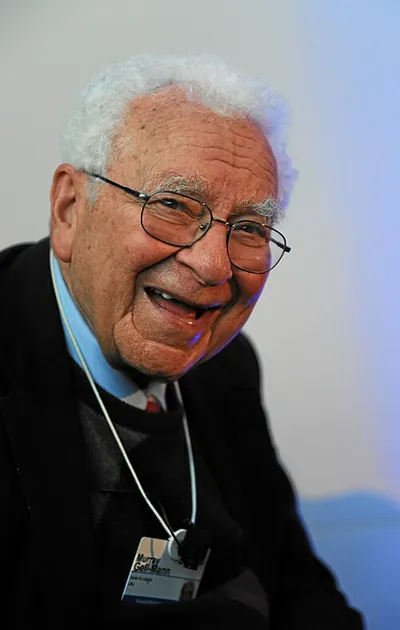 Murray Gell-Mann1929–2019 · Physics
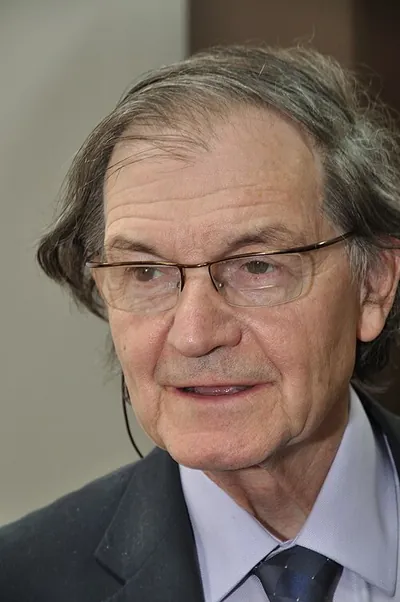 Roger Penrose1931 · Physics
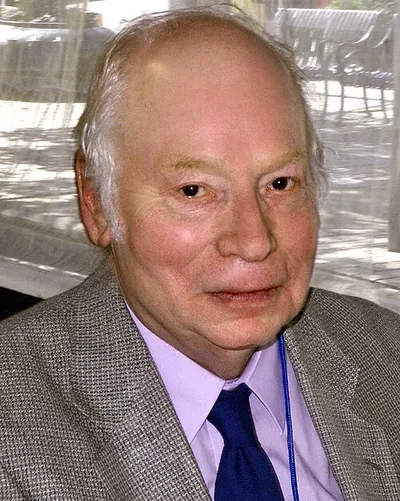 Steven Weinberg1933–2021 · Physics
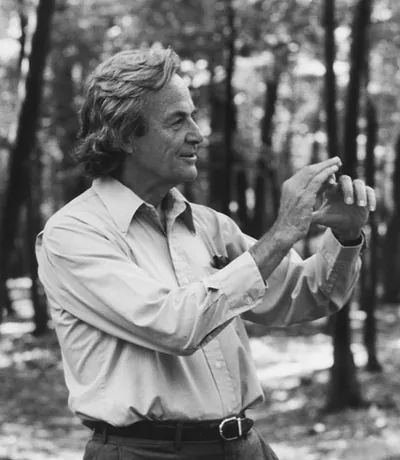 Richard Feynman1918–1988 · Physics
