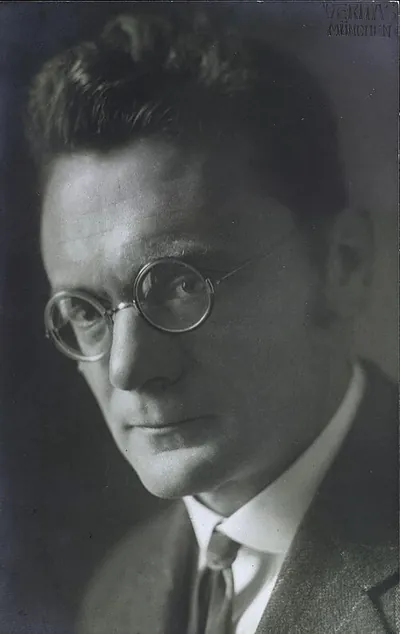
Karl von Frisch
Austrian ethologist known for decoding the honeybee waggle dance, who shared the 1973 Nobel Prize in Physiology or Medicine · 1886–1982
- Born
- November 20, 1886
- Died
- June 12, 1982
- Country
- Austria
- Section
- Biology
- Awards
- Nobel Prize in Physiology or Medicine
Biography
Karl Ritter von Frisch (Vienna, 1886 – Munich, 1982) was an ethologist, a biologist who studies animal behaviour in natural settings. Born in Austria and trained mostly in Germany, he is remembered for working out how honeybees communicate through dance. That work earned him the 1973 Nobel Prize in Physiology or Medicine, which he shared with Konrad Lorenz and Nikolaas Tinbergen. He is widely regarded as one of the founders of modern ethology.
He was the son of the surgeon and urologist Anton von Frisch and Marie Exner, and the youngest of four sons who all became university professors. Karl began studying medicine at the University of Vienna, where he worked under Hans Leo Przibram, but soon turned to the natural sciences. He went on to study zoology in Munich and Vienna, earning his doctorate in Vienna in 1910. That same year he became an assistant at the zoology institute of the Ludwig-Maximilians-Universität in Munich, under Richard von Hertwig, with whom he maintained a close working relationship. He became a lecturer in zoology and comparative anatomy there in 1912 and was promoted to professor in 1919.
His first research subject was fish. In 1910 he showed that they could distinguish colours and brightness, and he also tested their hearing, which he judged in some respects more sensitive than human hearing. In 1919 he turned to bees, which would make him famous. Using training with sugar-water rewards, he showed that bees could tell tastes and smells apart; their sense of smell, he found, resembled ours, while their sense of taste worked differently. The central discovery followed. Frisch noticed that returning foragers dance in ways that tell their hivemates the direction and distance of a food source. He separated two forms of dance: the round dance, which signals food nearby without giving a direction, and the waggle dance, in which the bee shakes her abdomen along a straight run. The angle of that run relative to vertical gives the direction relative to the sun, and the length of time spent on it gives the distance. His interpretation of the full code was refined over the following decades, but the basic insight held.
His work on orientation was equally original. In 1949 he showed, using polarised light, that bees use the sun as their main compass. Light scattered by the blue sky forms a pattern of polarisation that depends on where the sun is, and that the human eye cannot see. Bees detect it through ultraviolet receptors, and even a small patch of sky lets them work out the time of day. In cloudy weather or inside a dark hive they fall back on other cues, including the earth's magnetic field. His studies of colour vision were also important. He was the second researcher, after Charles Henry Turner, to show that bees see colour, and he found they can perceive ultraviolet, which we cannot. This brought him into a sharp dispute with Carl von Hess, who had argued that insects and fish were colour-blind.
His relationship with the Nazi regime was difficult. Frisch was criticised for employing Jewish assistants, many of them women, and was eventually forced into retirement, though the decision was reversed because his research on nosema, a bee disease, was judged valuable. It should be noted that in the first edition of his book Du und das Leben he wrote in support of the Nazi law on preventing hereditarily diseased offspring, a episode his biographers have debated. After the zoology institute was destroyed in the Second World War, he worked at the University of Graz from 1946 to 1950, then returned to Munich when the institute reopened. He retired in 1958 but kept researching. He was married to Margarete Mohr, who died in 1964, and their son Otto von Frisch directed the State Natural History Museum in Brunswick.
His legacy reaches well beyond the Nobel. His 1927 book Aus dem Leben der Bienen, published in English as The Dancing Bees, laid out his ideas, which took decades to be fully appreciated by the scientific community. He is now recognised as a pioneer in the study of animal behaviour, insect communication and navigation. The German Zoological Society awards a medal in his name every two years for zoological research.
Main contributions
- 1910Studies of fish senses, in which he showed they could distinguish colours and brightness.
- 1914Study of colour vision in bees, showing that these insects perceive colour.
- 1923Description of the bee dance as a way of communicating the direction and distance of a food source.
- 1927The book Aus dem Leben der Bienen, in which he set out his ideas on bee life and communication.
- 1949Demonstration that bees use the sun as a compass, guided by the polarisation pattern of skylight.
- 1973Nobel Prize in Physiology or Medicine, shared with Konrad Lorenz and Nikolaas Tinbergen, for discoveries on behavioural patterns.
Teachers and students
Trivia and anecdotes
A dance with an audience
In Frisch's own description, the round dance draws nearby bees, which follow the dancer with their antennae touching her abdomen.
Ultraviolet
Bees cannot tell red from black, but they see ultraviolet, so some flowers that look uniformly yellow to us show patterns to them.
Their contemporaries
While Karl von Frisch was alive (1886–1982)…
Alive at the same time
Discovered or invented in those years
- 1903AirplaneA fixed-wing aircraft, heavier than air, powered by engines or rockets, that stays aloft because its wings generate lift.
- 1925TelevisionA system that sends moving pictures and sound over distance and shows them on a receiver, the television set.
- 1925Quantum mechanicsPhysical theory describing how matter and light behave at atomic and subatomic scales, where energy is exchanged in minimal packets and results are expressed as probabilities.
- 1931Big BangA cosmological model describing how the universe expanded from an early state of extreme density and temperature, about 13.8 billion years ago.
- 1945ComputerA programmable machine that takes in data, processes it by following stored instructions, and produces results, able to switch tasks simply by running different software.
- 1969InternetA global network of interconnected computer networks that communicate using the TCP/IP protocol suite.
 Hermann Joseph Muller1890–1967 · Biology
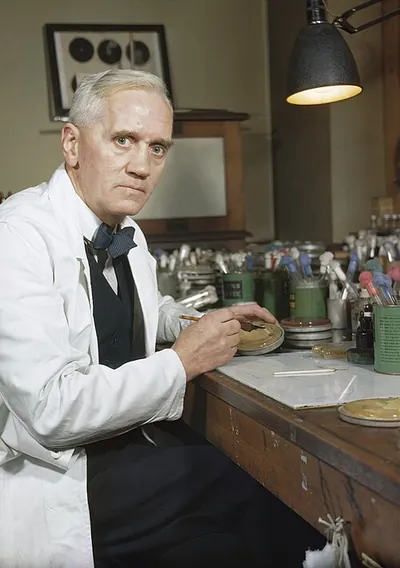 Alexander Fleming1881–1955 · Biology
 J.B.S. Haldane1892–1964 · Biology
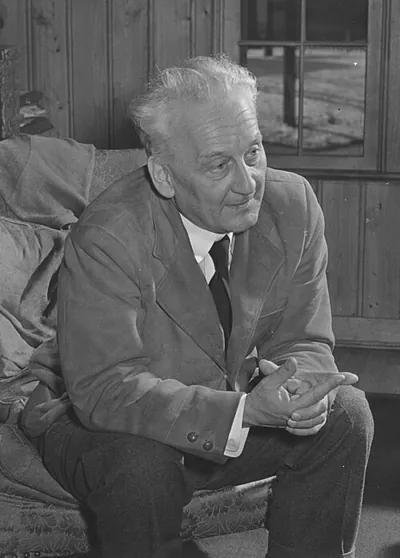 Albert Szent-Györgyi1893–1986 · Biology
 Gerty Cori1896–1957 · Biology
 Hans Krebs1900–1981 · Biology
