
Leo Kadanoff
American physicist, pioneer of renormalization group theory and of the physics of phase transitions · 1937–2015
- Born
- January 14, 1937
- Died
- October 26, 2015
- Country
- United States
- Section
- Physics
Biography
Leo Philip Kadanoff (January 14, 1937 - October 26, 2015) was an American physicist whose work on the sudden changes that matter undergoes reshaped statistical physics and theoretical condensed matter physics. He lived at a time when physicists were trying to explain collective phenomena, such as magnetism or boiling, from the behavior of the particles that make up materials. His importance lies in the fact that his ideas ended up being applied to fields as distant from physics as urban planning, biology and computer science.
He was raised in New York City and earned both his undergraduate degree and his doctorate in physics at Harvard University, the doctorate in 1960. After a postdoctoral stay at the Niels Bohr Institute in Copenhagen, he joined the physics faculty of the University of Illinois in 1965. His early research focused on superconductivity, the phenomenon in which certain materials carry electricity with no resistance when cooled to very low temperatures. In the late 1960s he turned to phase transitions, the abrupt changes a material goes through, such as a magnet losing its magnetism when heated or a liquid starting to boil.
Kadanoff showed that these transitions could be understood through two ideas. The first was scaling, the observation that certain quantities follow similar patterns when viewed at different sizes. The second was universality, the principle that very different systems behave in the same way at the critical point, the exact moment when the change happens. Together with his collaborators, he showed that the experimental data then available for so-called second-order phase transitions fit these two ideas. In 1966 he published a study of the Ising model, a simple picture of a magnet built from tiny spins arranged on a grid, which laid the groundwork for renormalization group theory, a method for tracking how a system changes as it is examined at different scales. In 1969 he published a paper on operator algebra that is regarded as the seed of conformal field theory.
That same year he moved to Brown University. He drew on mathematical analogies between solid state physics and the growth of cities, using them to shed light on urban development, and he contributed substantially to the statewide planning program in Rhode Island. In 1978 he moved to the University of Chicago, where he became the John D. and Catherine T. MacArthur Distinguished Service Professor of Physics and Mathematics. In the second half of his career much of his work addressed chaos theory, in both mechanical and fluid systems, where the behavior is extremely sensitive to starting conditions.
His honors included the Buckley Prize of the American Physical Society in 1977, the Wolf Prize in Physics in 1980, the Boltzmann Medal of the IUPAP in 1989 and the Lorentz Medal in 2006. He received the National Medal of Science in 1999 from President Clinton and was a member of the National Academy of Sciences. With Gordon Baym he wrote Quantum Statistical Mechanics, a prominent textbook that has been widely translated. With Leo Irakliotis he established the Center for Presentation of Science at the University of Chicago. He died after complications from an illness on October 26, 2015.
His legacy lives on in statistical physics and in the uses of his ideas well beyond physics. In 2018 the American Physical Society established the Leo P. Kadanoff Prize in his honor.
Main contributions
- 1966Work on the Ising model, the foundation of renormalization group theory, a method for studying systems at different scales.
- 1969Paper on operator algebra, regarded as the seed of conformal field theory.
- Scaling and universality as keys to understanding phase transitions, with experimental data fitted to these two ideas.
- Contributions to chaos theory in mechanical and fluid systems during the second half of his career.
- The textbook Quantum Statistical Mechanics, written with Gordon Baym, widely used and translated into several languages.
Teachers and students
Studied under:
Taught:
Trivia and anecdotes
An anonymous gift
In June 2013 it was reported that anonymous donors had given 3.5 million dollars to establish the Leo Kadanoff Center for Theoretical Physics at the University of Chicago.
From magnets to cities
Kadanoff applied the analogies he had used with magnetic solids to urban growth, going so far as to contribute to the planning of an entire state, Rhode Island.
Their contemporaries
While Leo Kadanoff was alive (1937–2015)…
Alive at the same time
Discovered or invented in those years
- 1945ComputerA programmable machine that takes in data, processes it by following stored instructions, and produces results, able to switch tasks simply by running different software.
- 1957Artificial satelliteAn artificial satellite is a human-made object placed in orbit around a celestial body, usually Earth, to collect information, relay signals, or carry out a specific task.
- 1969InternetA global network of interconnected computer networks that communicate using the TCP/IP protocol suite.
- 1971EmailA network service that lets users send and receive digital messages through addressed mailboxes, much like postal mail but electronic.
- 1973Mobile phoneA handheld wireless phone that lets people make and receive calls while moving across a cellular network area.
- 1989World Wide WebA system of linked documents and resources, connected by hyperlinks and accessed over the Internet with web browsers.
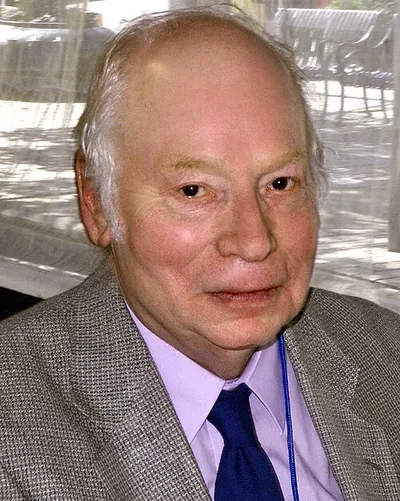 Steven Weinberg1933–2021 · Physics
 Stephen Hawking1942–2018 · Physics
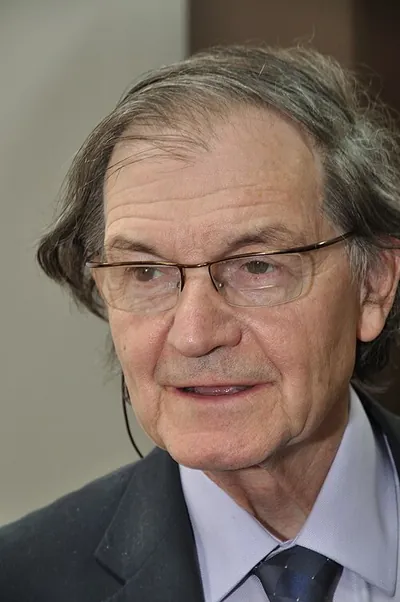 Roger Penrose1931 · Physics
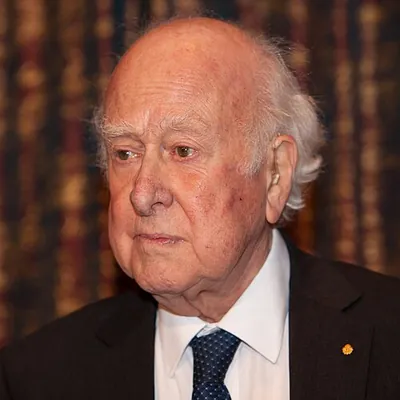 Peter Higgs1929–2024 · Physics
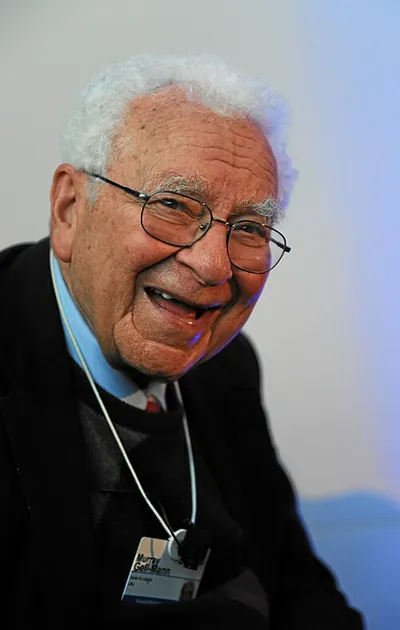 Murray Gell-Mann1929–2019 · Physics
 John Stewart Bell1928–1990 · Physics
