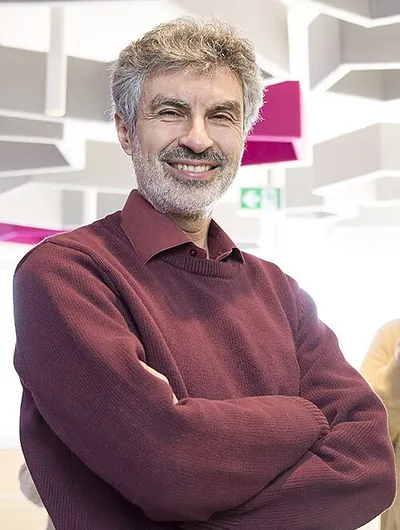
Yoshua Bengio
Canadian computer scientist and pioneer of artificial neural networks and deep learning · 1964
- Born
- March 5, 1964
- Country
- Canada, France
- Section
- Computing
- Awards
- Turing Award
Biography
Yoshua Bengio (born 1964 in France) is a Canadian computer scientist whose work on artificial neural networks and deep learning helped move artificial intelligence from a marginal research direction to a technology used every day. His name is linked with those of Geoffrey Hinton and Yann LeCun, with whom he received the 2018 ACM A.M. Turing Award, the most prestigious honour in computing, often compared to a Nobel Prize for the field. His career spans the 1990s and 2000s, when deep learning was viewed with skepticism by much of the scientific community, and his importance lies in helping turn it into the foundation of much of today's AI.
Bengio was born in France to a Jewish family that had emigrated from Morocco. The family soon moved to Canada, where he grew up and was educated. His household was unusual for a future scientist: his father, Carlo Bengio, was a pharmacist and playwright who ran a Sephardic theatre company in Montreal that performed works in Judeo-Arabic. His mother, Célia Moreno, had acted in the Moroccan theatre scene of the 1970s and in 1980 co-founded in Montreal, with the artist Paul St-Jean, a multimedia theatre troupe called l'Écran humain. The Bengio brothers lived in Morocco for a year during their father's military service there. His brother Samy Bengio is also a well-known researcher on neural networks and now works as senior director of AI and machine learning research at Apple.
He studied at McGill University, where he earned a bachelor's degree in electrical engineering, a master's degree in computer science and a doctorate in computer science. After his PhD he worked as a postdoctoral fellow at MIT, supervised by Michael I. Jordan, and then at AT&T Bell Labs. He has been a faculty member at the Université de Montréal since 1993, and most of his career has been built there.
To understand his work it helps to know what an artificial neural network is: a program that loosely imitates the connections between neurons. It is organised in layers of calculating units that adjust the strength of their connections based on examples, so the system learns from data rather than following rules written by hand. For much of the history of computing these networks had a reputation for being hard to train and for modest results, and many researchers abandoned them for other methods. Deep learning revives the idea with many more layers of processing, so that each layer builds increasingly abstract representations of the data. With images, for instance, the first layers detect edges, the next ones shapes, and the last ones whole objects.
One of the most influential contributions by Bengio and his colleagues was a probabilistic model of language that learned distributed representations of words, known as word embeddings. These are numerical vectors in which words with similar meanings sit close together in a mathematical space. The approach aimed to overcome the so-called curse of dimensionality, the problem that the possible combinations of words grow so fast that no collection of text can cover them all. These ideas had a lasting effect on natural language processing, the field that tries to make computers understand and generate text.
Bengio also worked on recurrent networks, designed to handle sequences such as a sentence or a speech signal, in which information from earlier steps shapes the next one. With Ian Goodfellow and Aaron Courville he wrote the textbook Deep Learning, published by MIT Press in 2016, which became a standard reference for students and researchers around the world. His work also reached practical applications. In 1998, together with Léon Bottou, Patrick Haffner, Paul Howard, Patrice Simard and Yann LeCun, he published a study on DjVu, a format for compressing scanned document images while keeping high quality and small files.
His weight in the field is also visible in academic measures. The journalist Cade Metz considers Bengio, alongside Hinton and LeCun, one of the three people most responsible for the advance of deep learning in the 1990s and 2000s. According to MILA, among computer scientists with an h-index of at least 100, meaning at least a hundred papers each cited at least a hundred times, he was in 2018 the one receiving the most recent citations per day. By August 2024 he also had the highest D-index of any computer scientist, a measure that combines the number of citations a researcher receives with how they are spread across his or her work.
In 2016 he co-founded Element AI, a Montreal-based artificial intelligence incubator that aimed to turn research into commercial products. The company sold its operations to ServiceNow in November 2020, and Bengio stayed on as an adviser. He now serves as scientific and technical adviser to Recursion Pharmaceuticals, a drug discovery company that uses AI, and as scientific adviser to Valence Discovery. For years he led MILA, the Montreal institute for machine learning that he founded and whose scientific direction he held until 2025.
From 2023 his public role changed noticeably. In November 2023, at the first international summit on AI safety, British Prime Minister Rishi Sunak announced that Bengio would lead an international scientific report on the safety of advanced AI. An interim version came out in May 2024, covering issues such as cyber attacks and scenarios in which people lose control of AI systems, and the full report was published in January 2025 as the International AI Safety Report, which he continues to chair. In June 2025 he launched LawZero, a non-profit organisation working on 'honest' AI systems that can detect and block harmful behaviour by autonomous agents. Its main project, called Scientist AI, is meant to act as a guardrail that predicts whether an agent's actions could cause harm. Its funders include the Future of Life Institute, Schmidt Sciences, the Gates Foundation and the Canadian government.
His positions have made headlines. In March 2023 he signed an open letter from the Future of Life Institute calling on AI labs to pause for at least six months the training of systems more powerful than GPT-4; the letter gathered more than 30,000 signatures. In May 2023 he told the BBC that he felt 'lost' about his life's work, and he voiced concern that 'bad actors' could get hold of increasingly sophisticated AI. He argued for tougher regulation, product registration, ethical training for developers and a greater role for governments in tracking and auditing AI products. In June 2025 he warned that some advanced systems were starting to show traits such as deception and reward hacking, and in December 2025 he said that granting rights to AI systems would be a huge mistake, since being able to shut them down is essential for safety.
His institutional recognition has been wide. In 2017 he was named an Officer of the Order of Canada. In 2020 he was elected a Fellow of the Royal Society. In 2022 he received the Princess of Asturias Award for Scientific and Technical Research, shared with LeCun, Hinton and Demis Hassabis. In 2023 he was made a Knight of the French Legion of Honour. In 2024 Time magazine included him among the 100 most influential people in the world, and in 2025 he received the Queen Elizabeth Prize for Engineering together with other pioneers of the field.
His legacy is twofold. On one side, he has trained a generation of AI researchers, among them David Krueger, Ian Goodfellow and Hugo Larochelle. On the other, he has become an influential voice in the debate over how artificial intelligence should be governed. He was appointed Co-Chair of the United Nations' Independent International Scientific Panel on AI, a group of experts preparing a report on the state of AI science to guide policymakers. Bengio has argued that deep learning is a powerful tool, but that its development needs technical, social and legislative safeguards at the same time.
Main contributions
- 1998DjVu: a study on compressing scanned document images with high quality and small file sizes, carried out with LeCun and other colleagues.
- 2016The book Deep Learning, written with Goodfellow and Courville, a standard reference textbook on deep learning.
- 2016Co-founding of Element AI, a Montreal incubator that turned AI research into commercial applications.
- 2018ACM A.M. Turing Award, shared with Hinton and LeCun for their foundational work on deep learning.
- 2025International AI Safety Report, an international scientific assessment of the safety of advanced AI, which he chairs.
- A probabilistic language model with word embeddings: numerical representations in which words of similar meaning sit close together, used to handle natural language.
Teachers and students
Studied under:
Taught:
Trivia and anecdotes
A family of theatre people
His father ran a Sephardic theatre company in Montreal, and his mother had been an actress in Morocco before co-founding a multimedia troupe.
Erdős number 3
Thanks to a 2019 article on a new recurrent network architecture, he has an Erdős number of 3, which measures how many co-authorship steps separate a researcher from the mathematician Paul Erdős.
A million citations
In November 2025 he became the first AI researcher with more than a million citations on Google Scholar.
Their contemporaries
While Yoshua Bengio was alive (1964–)…
Alive at the same time
Discovered or invented in those years
- 1969InternetA global network of interconnected computer networks that communicate using the TCP/IP protocol suite.
- 1971EmailA network service that lets users send and receive digital messages through addressed mailboxes, much like postal mail but electronic.
- 1973Mobile phoneA handheld wireless phone that lets people make and receive calls while moving across a cellular network area.
- 1975Global warmingThe long-term rise in Earth's average surface temperature, driven mainly by greenhouse gases released through human activity.
- 1989World Wide WebA system of linked documents and resources, connected by hyperlinks and accessed over the Internet with web browsers.
- 1990Web browserA program that lets people access the web by fetching a page's files from a server and displaying them on screen as an interactive page.
 Linus Torvalds1969 · Computing
 Yann LeCun1959 · Computing
 Shafrira Goldwasser1958 · Computing
 Guido van Rossum1956 · Computing
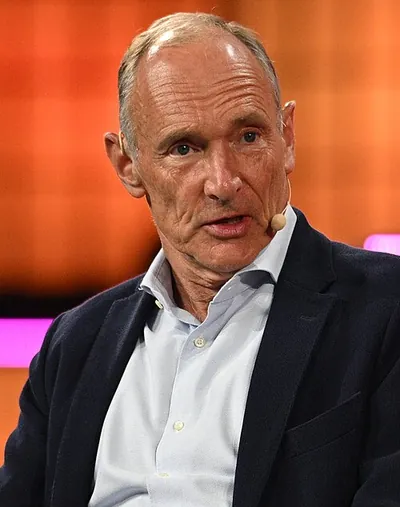 Tim Berners-Lee1955 · Computing
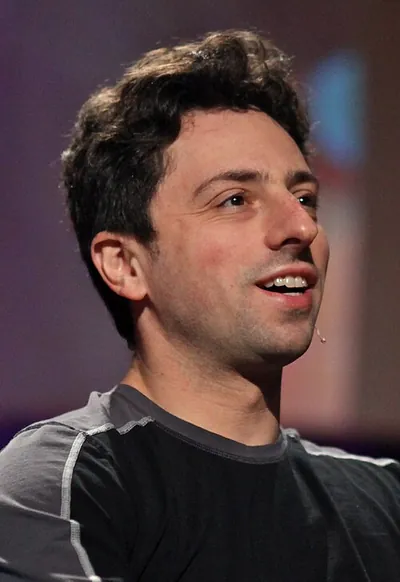 Sergey Brin1973 · Computing
