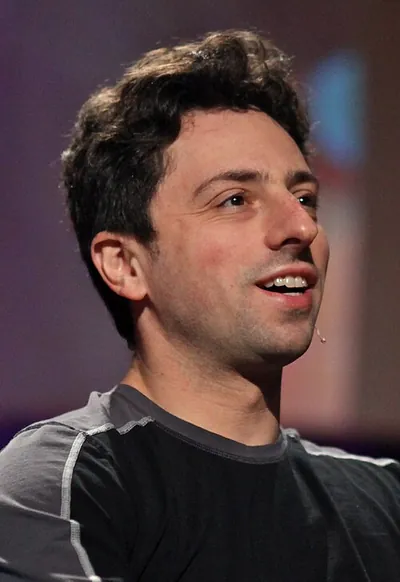
Sergey Brin
American computer scientist and businessman of Russian origin, co-founder of Google with Larry Page · 1973
- Born
- August 21, 1973
- Country
- United States
- Section
- Computing
Extended biography
Childhood and emigration
Sergey Mikhailovich Brin was born on August 21, 1973, in Moscow, then the capital of the Soviet Union, into a Russian-Jewish family. Both of his parents had graduated from Moscow State University. His father, Mikhail, was a mathematics professor, and his mother, Eugenia, known as Genia, worked as a researcher at NASA's Goddard Space Flight Center. The family lived in a three-room apartment in central Moscow, which they shared with Sergey's paternal grandmother.
In 1977, after a mathematics conference in Warsaw, Mikhail announced that the time had come to emigrate. The reason he gave, in the sources available, was antisemitism in the Soviet Union. The family formally applied for exit visas in September 1978. As a consequence, the father was promptly dismissed from his post, and the mother had to leave her job for related reasons. For the next eight months the family had no steady income. They took temporary jobs while they waited, anxious that the request would be refused, as had happened to many people known as refuseniks, Jews whom the Soviet state routinely denied permission to leave.
In May 1979 the exit visas were finally granted. The family spent time in Vienna and Paris while Mikhail secured a teaching post at the University of Maryland, helped by the mathematician Anatole Katok. During this period they received support from the Hebrew Immigrant Aid Society. They arrived in the United States on October 25, 1979, when Sergey was six. He later spoke about this move as the start of a new life shaped by curiosity and by a home where mathematics was taken seriously.
Schooling in Maryland
After a short stay at a friend's house on Long Island, New York, the family moved to Maryland and rented a home in a lower-middle-class neighborhood close to the university campus. At Katok's suggestion, Sergey enrolled at the Paint Branch Montessori School in Adelphi. The Montessori approach gives children considerable freedom to choose their own work, which suited a child with a strong appetite for problems. He also received a good deal of teaching at home. His father encouraged his interest in mathematics, and the family made sure he kept his Russian.
He went on to Eleanor Roosevelt High School. In September 1990 he enrolled at the University of Maryland, where he chose to study mathematics and computer science together, following in the footsteps of his father and grandfather. In 1993 he graduated from the Department of Computer Science with honors in computer science and high honors in mathematics, at the age of 19. That same year he worked as an intern at Wolfram Research, the company behind the Mathematica software, which gave him early experience of building commercial software used by scientists and engineers.
This period left him with an idea that would shape his career: that large collections of data, if organized well, can reveal patterns that are invisible at first sight. Computer science was then facing growing amounts of information, and the methods used to extract knowledge from such data, known as data mining, were becoming an important field of research.
Stanford and the meeting with Larry Page
Brin then moved to Stanford University in California to pursue a doctorate in computer science, supported by a graduate fellowship from the National Science Foundation, the American federal agency that funds basic research. He received a master's degree in 1995. During an orientation for new students, he met Larry Page, a student of about his own age whose interests seemed very different. According to the familiar account, the two seemed to disagree on most subjects. Over time, however, they became close friends and what has been described as intellectual soul mates.
Their partnership worked because their interests fitted together. Brin concentrated on developing data mining systems, meaning ways of finding useful information inside very large sets of data. Page was interested in a specific idea: that the importance of a research paper can be inferred from the number of times other papers cite it. Together they wrote a paper titled The Anatomy of a Large-Scale Hypertextual Web Search Engine, which described how a search engine for a network of linked documents could be built.
The problem they were trying to solve was old and increasingly urgent. The World Wide Web was growing quickly, and finding a useful page among millions was hard. Many existing search tools ranked results largely by how often the search words appeared on each page. Brin and Page tried a different clue: which pages link to a given page. Academic work on citations offered a precedent, but applying the idea to the web on a large scale was still largely unexplored.
PageRank and the birth of BackRub
To turn information about links into a measure of importance, Brin and Page developed an algorithm they called PageRank. The idea, put simply, is that a page is worth more the more links it receives from other pages, and a link from an important page counts for more than one from a rarely visited page. The calculation is repeated many times until the values settle. The result is an order of relevance that depends not only on the words in a text but also on the structure of the network itself.
At first the system was called BackRub, because it analysed backlinks, the links pointing towards a page. The data was gathered by a web crawler, a program that visits pages, follows their links and stores what it finds. BackRub already had the basic functions of a search engine: a user typed a query and received a list of pages ordered by importance. Page later recalled that they realised they had a querying tool, since the overall ranking of pages was good.
The hardware was as modest as the ideas were clever. The team moved its work into Page's dormitory room, which became a small machine laboratory. They used spare parts taken from inexpensive computers to build a device that connected the new search engine to the campus broadband network. Brin's room was then converted into an office and programming centre, where they tested their designs on the web. The growth of the project eventually strained Stanford's computing system. In August 1996 the first version of Google was made available on the Stanford website.
Building Google
The engine's popularity among students and staff at Stanford forced a difficult choice: continue the doctorate, or devote themselves fully to the project. Brin and Page decided to leave their studies and concentrate on the search engine. To pay for it they asked professors, family and friends for financial help, bought servers and rented a garage in Menlo Park, California. The garage belonged to Susan Wojcicki, who would later become the company's 18th employee and, years afterwards, chief executive of YouTube. This is how the company that became Google began.
The business model took longer to emerge. On October 23, 2000, with the aim of funding the company from its own income, they created Google AdWords, an online advertising system in which advertisers pay to have their ads shown alongside particular search results. In 2018 it was renamed Google Ads. It is now one of the largest advertising platforms in the world and the company's main source of revenue, a clear example of a technical idea ending up supporting a very large business.
Over time the company became the centre of a larger group. On August 10, 2015, Brin was elected president of Alphabet Inc., the parent company created that same day after a reorganisation in which Google became one of its subsidiaries. For a period he also oversaw Google X, the company's laboratory for experimental projects. Brin and Page still hold a significant share of control, around 16 percent according to the sources. The unofficial motto often associated with the company, don't be evil, is frequently cited as a summary of how its founders wanted it to operate.
Personal life and philanthropy
In May 2007 Brin married Anne Wojcicki in the Bahamas. Wojcicki is a biologist who graduated in biology from Yale University in 1996 and has worked as an analyst in the biotech sector. Together they took an interest in health information and in ways of making it more accessible. Brin tends to think of genetics as a large database and a computational problem, and from that outlook came one of the couple's best-known ventures, the company 23andMe, co-founded by Wojcicki, which lets people analyse their own genetic map and compare it with others. Humans have 23 pairs of chromosomes, and commercial tests examine specific variants within them rather than reading the full sequence.
Brin's family life has also changed over time. The couple had a son in late 2008 and a daughter in late 2011. In 2013 it was announced that they were living apart, and in June 2015 they finalised their divorce. In November 2018 Brin married Nicole Shanahan, the founder of a legal technology firm, and they had a daughter together. They separated in late 2021, and the divorce was finalised in the summer of 2023. These matters belong to his private life, so they are mentioned here only as far as they have been made public.
His medical interests have a personal side too. His mother, Eugenia, has been diagnosed with Parkinson's disease, a neurological condition that affects movement. In 2008 Brin decided to donate to the University of Maryland School of Medicine, where she had been receiving treatment. He has used the services of 23andMe himself and has said that his results suggested the disease is generally not inherited, a finding that led him to see genetic information as a tool for prevention as well as explanation. Together with Wojcicki he ran The Brin Wojcicki Foundation, a non-profit organisation, for a time, and his later philanthropy has been channelled through other vehicles.
Other interests and recognition
Brin has devoted part of his attention to projects beyond Google. Together with Larry Page he has supported initiatives within the company's philanthropic arm, Google.org, which invests in new sources of renewable energy and looks for answers to the world's energy and environmental problems. The company has said that its founders want to solve humanity's biggest problems using technology. Brin has also backed experimental air transport, including a firm that builds airships, and in 2008 he invested in Space Adventures, a company offering space tourism. The Economist described him as an enlightened man, someone who believed that knowledge is always good and certainly better than ignorance, an outlook reflected in Google's mission to organise the world's information and make it universally accessible and useful.
He has also made public his interest in psychedelic substances. He has described his experiences with psychedelics such as psilocybin, and he has invested in pharmaceutical companies researching compounds of this kind for possible medical uses. These are personal matters, and it is worth separating what he has described himself from what remains at the stage of clinical research.
As for recognition, in 2002 he was named, together with Page, in the MIT Technology Review TR100 list of the world's top innovators under the age of 35. In 2004 the two men received the Marconi Prize and were elected Fellows of the Marconi Foundation, for an invention that the citation said had fundamentally changed the way information is retrieved. In 2009 he was elected to the United States National Academy of Engineering, for his contribution to rapid indexing and retrieval of relevant information from the World Wide Web. In 2008 the Prince of Asturias Award for Communication and Humanities was given to Google, and both founders accepted it on the company's behalf. According to the sources, in October 2026 President Donald Trump awarded him the National Medal of Science.
Quotes
“While I support their goal of reducing copyright infringement (which I don't believe these acts would accomplish), I am shocked that our lawmakers would contemplate such measures that would put us on a par with the most oppressive nations in the world”
“Technology is an inherent democratizer. Because of the evolution of hardware and software, you're able to scale up almost anything. It means that in our lifetime everyone may have tools of equal power”
“If what you’re doing is not seen by some people as science fiction, it’s probably not transformative enough.”
Main contributions
- 1996PageRank: an algorithm that scores a web page by the number and importance of the links it receives, developed from the BackRub crawler.
- 1996Google: a search engine first published on the Stanford website in August 1996.
- 2000Google AdWords: an online advertising system created to fund the company, now called Google Ads.
- 2004Marconi Prize: recognition for an invention that changed how information is retrieved.
- 2009Election to the US National Academy of Engineering for his work on rapid indexing of the web.
Trivia and anecdotes
A garage as first headquarters
Google began in a Menlo Park garage that belonged to Susan Wojcicki, an employee who later led YouTube.
Compared with Gutenberg
Some observers compared the impact of Brin and Page with that of Johannes Gutenberg, although this is an opinion rather than a measurable fact.
A plane fitted with NASA instruments
Brin and Page jointly own a customised Boeing 767 that carries scientific equipment installed by NASA to collect data in flight.
Their contemporaries
While Sergey Brin was alive (1973–)…
Alive at the same time
Discovered or invented in those years
- 1973Mobile phoneA handheld wireless phone that lets people make and receive calls while moving across a cellular network area.
- 1975Global warmingThe long-term rise in Earth's average surface temperature, driven mainly by greenhouse gases released through human activity.
- 1989World Wide WebA system of linked documents and resources, connected by hyperlinks and accessed over the Internet with web browsers.
- 1990Web browserA program that lets people access the web by fetching a page's files from a server and displaying them on screen as an interactive page.
- 1991HTMLThe markup language used to structure web page content so that a browser can display it.
- 1998International Space StationA permanently crewed research laboratory in low Earth orbit, about 400 kilometres up, built and operated by five space agencies from different countries.
 Andrew Y. Ng1976 · Computing
 Linus Torvalds1969 · Computing
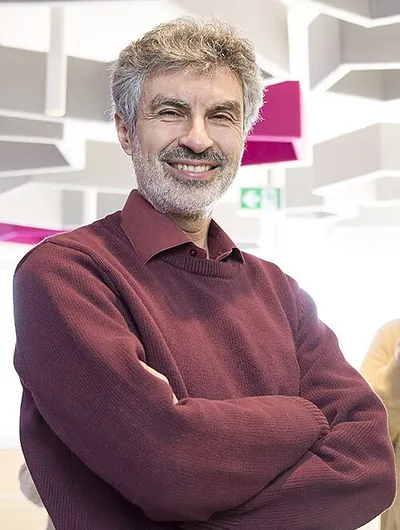 Yoshua Bengio1964 · Computing
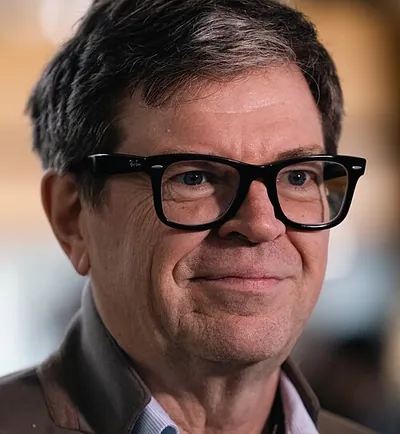 Yann LeCun1959 · Computing
 Shafrira Goldwasser1958 · Computing
 Guido van Rossum1956 · Computing
