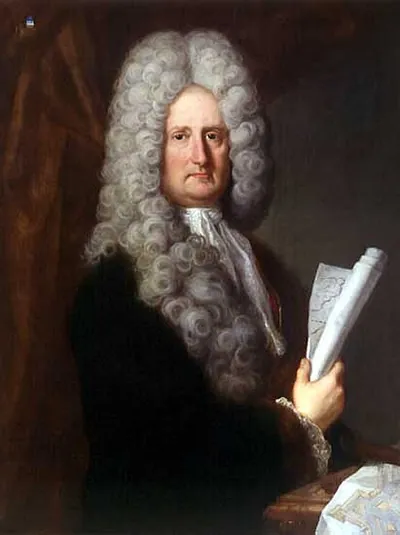
Luigi Ferdinando Marsigli
Italian count, soldier and naturalist, geographer, and considered one of the founding fathers of oceanography · 1658–1730
- Born
- July 10, 1658
- Died
- November 1, 1730
- Country
- Papal States
- Section
- Earth sciences
Biography
Luigi Ferdinando Marsigli (Bologna, 1658-1730) was an Italian count who combined a military career with scientific research. He lived at a time when the Habsburgs were driving the Ottomans out of Hungary, and today he is remembered above all as one of the founding fathers of oceanography, as well as a geographer, naturalist, geologist and botanist.
Born in Bologna into one of the city's oldest patrician families, he received an education suited to his rank from the best local tutors. He took an interest in mathematics, anatomy and natural history, and after completing his studies in his home city he travelled through Asia Minor, gathering information on the military organisation of the Ottoman Empire and on its natural world.
In 1682 he entered the service of Emperor Leopold I and fought against the Turks. During an action on the river Rába he was wounded and captured. Accounts differ on the details, but he was sold to a pasha and secured his release around 1684 after a ransom was paid. Back in the imperial army he distinguished himself as a military engineer and took part in the siege of Buda in 1686. After the Treaty of Karlowitz he led the commission that marked out the Habsburg-Ottoman frontier, a line roughly 850 kilometres long in the former Kingdom of Hungary. Over some twenty years he gathered measurements, observations, specimens and antiquities, helped by Dr Johann Christoph Müller, who prepared the manuscripts for printing.
During the War of the Spanish Succession, Marsigli was second in command to Count d'Arco at the imperial fortress of Breisach on the Rhine, which surrendered in 1703. Count d'Arco was beheaded for capitulating too early. Marsigli was stripped of his titles and honours, and his knightly sword was broken over him. His appeals to the Emperor failed, although public opinion later cleared him of charges of neglect or ignorance.
After leaving the Habsburg army he travelled to Switzerland and France, spending a good deal of time in Marseille studying the sea. He drew plans, made astronomical observations, measured the speed and size of rivers, and studied the fossils, minerals and birds of every land he visited. In 1712 he gave his collections to the Senate of Bologna, and in 1715 his Institute of Sciences and Arts opened, with six professors leading its different divisions and a printing house with type for Latin, Greek, Hebrew and Arabic, entrusted to the Dominicans.
His work on the Danube, Danubius Pannonico-Mysicus, in six volumes, appeared in The Hague in 1726 after a delay of two decades, and its maps were published as an atlas in 1744. His treatise Histoire physique de la mer (1725) led to him being regarded as a founding father of modern oceanography. Carl Linnaeus honoured him with the genus Marsilea, in the family Marsileaceae.
Main contributions
- 1681Observations on the Thracian Bosphorus, the result of his travels in Asia Minor.
- 1691Election as a Fellow of the Royal Society in London, recognising his scientific work.
- 1715Foundation of the Institute of Sciences and Arts in Bologna, with his collections and printing house.
- 1725Histoire physique de la mer, a treatise on the sea that earned him the title of father of modern oceanography.
- 1726Danubius Pannonico-Mysicus, a six-volume work on the Danube with geographical, astronomical and historical data.
- 1732L'État militaire de l'empire ottoman, a description of the Ottoman army based on his observations.
- 1744Publication as an atlas of the maps from his work on the Danube.
Trivia and anecdotes
A commission for the Pope
In 1711 Marsili commissioned Donato Creti to paint eight small pictures of astronomical observations, which were given to the Pope to encourage an observatory in Bologna. The painting of Jupiter shows the Great Red Spot, discovered by Cassini in 1665.
The broken sword
After the loss of Breisach, his knightly sword was broken over him as punishment, although public opinion later acquitted him.
Their contemporaries
While Luigi Ferdinando Marsigli was alive (1658–1730)…
Alive at the same time
Discovered or invented in those years
- 1665CellThe smallest unit of matter that can be considered alive: a compartment enclosed by a membrane that holds genetic material and carries out the functions of life on its own.
- 1676BacteriaSingle-celled prokaryotic microorganisms without a defined nucleus, forming one of the three great domains of life.
- 1687GravityThe attraction that every body with mass exerts on every other, responsible for objects falling and planets circling the Sun.
- 1687ForceA vector quantity that changes the motion of a body or deforms it, measured in newtons.
- 1687Newton's laws of motionThree principles linking the motion of a body to the forces acting on it, the foundation of classical mechanics.
- 1700PianoA keyboard instrument in which each key sets a felt-covered hammer moving to strike a tensioned string, letting the player control loudness through touch.
 Nicolas Steno1638–1686 · Earth sciences
 Jean Baptiste Bourguignon d'Anville1697–1782 · Earth sciences
 James Hutton1726–1797 · Earth sciences
 Jean-André Deluc1727–1817 · Earth sciences
 Horace Bénédict de Saussure1740–1799 · Earth sciences
 Alexander von Humboldt1769–1859 · Earth sciences
