
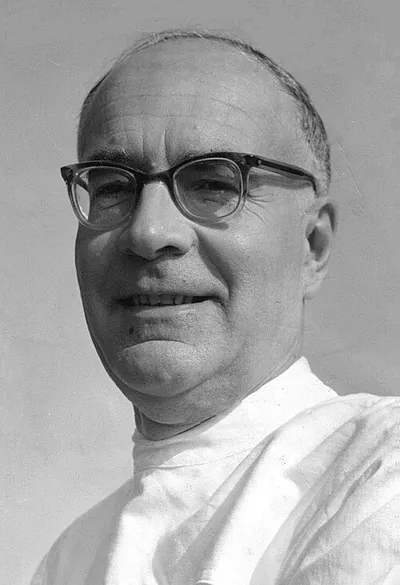
Manson Benedict
American nuclear engineer, pioneer of nuclear engineering at MIT and adviser to the U.S. Atomic Energy Commission · 1907–2006
- Born
- October 9, 1907
- Died
- September 18, 2006
- Country
- United States
- Section
- Energy
Biography
Manson Benedict (Lake Linden, Michigan, 1907 – Naples, Florida, 2006) was an American nuclear engineer and professor at the Massachusetts Institute of Technology (MIT). His work helped shape nuclear energy in the United States: he took part in developing uranium separation during the Second World War and then devoted much of his career to promoting peaceful uses of atomic energy.
Born into a Jewish family, he trained as a chemist. He earned a bachelor's degree at Cornell University and spent two years at the National Aniline and Chemical Co. before returning to graduate school to earn a doctorate from MIT in physical chemistry, the study of how the structure of matter governs its physical properties. It was at MIT that he met his wife, Marjorie, who also earned a chemistry PhD.
He then worked as a research chemist at M. W. Kellogg Limited, where a 1940 paper introduced the Benedict-Webb-Rubin equation, a formula describing how gases behave at high pressures that remained in industrial use for decades. His best-known wartime work came through the Manhattan Project. He developed the gaseous diffusion method for separating uranium isotopes, meaning versions of the element with different atomic weights, and oversaw the engineering and process development of the K-25 plant at Oak Ridge, Tennessee, which produced fissile material for the atomic bomb.
He received many honours for this work and for his later career, including the Perkin Medal in 1966 and the Enrico Fermi Award in 1972, and in 1975 the National Medal of Science from President Gerald Ford. He had joined the National Academy of Sciences in 1956. From 1958 to 1968 he chaired the advisory committee of the U.S. Atomic Energy Commission, appointed by Presidents Eisenhower and Kennedy.
At MIT, Benedict had started a chemical engineering program in 1951 that became a nuclear engineering department in 1958, and he led it until 1971. He helped train more than 500 graduate students.
His legacy combines technical research, teaching and public service. He died at his home in Naples, Florida, aged 98, survived by two daughters, three grandchildren and four great-grandchildren.
Main contributions
- 1940Benedict-Webb-Rubin equation: a formula describing how gases behave at high pressures.
- 1951Chemical engineering program at MIT, the forerunner of the nuclear engineering department.
- 1958Creation of the nuclear engineering department at MIT, which he led until 1971.
- Gaseous diffusion method for separating uranium isotopes, applied at the K-25 plant in Oak Ridge during the Manhattan Project.
Their contemporaries
While Manson Benedict was alive (1907–2006)…
Alive at the same time
Discovered or invented in those years
- 1916Black holeA region of space where gravity is so strong that nothing, not even light, can escape once it crosses a certain boundary.
- 1925TelevisionA system that sends moving pictures and sound over distance and shows them on a receiver, the television set.
- 1925Quantum mechanicsPhysical theory describing how matter and light behave at atomic and subatomic scales, where energy is exchanged in minimal packets and results are expressed as probabilities.
- 1931Big BangA cosmological model describing how the universe expanded from an early state of extreme density and temperature, about 13.8 billion years ago.
- 1945ComputerA programmable machine that takes in data, processes it by following stored instructions, and produces results, able to switch tasks simply by running different software.
- 1969InternetA global network of interconnected computer networks that communicate using the TCP/IP protocol suite.
 John R. Dunning1907–1975 · Energy
 Walter Zinn1906–2000 · Energy
 Igor Kurchatov1903–1960 · Energy
 Felix Wankel1902–1988 · Energy
 Mária Telkes1900–1995 · Energy
 Alvin M. Weinberg1915–2006 · Energy
