
Mary J. Rathbun
American zoologist who specialized in crustaceans · 1860–1943
- Born
- June 11, 1860
- Died
- April 4, 1943
- Country
- United States
- Section
- Biology
Biography
Mary Jane Rathbun (Buffalo, 1860 – Washington, D.C., 1943) was an American zoologist who specialized in crustaceans, the group of animals that includes crabs, lobsters and shrimps. She spent almost six decades at the Smithsonian Institution and described more than a thousand new species and subspecies, making her one of the most productive taxonomists of her era. Her importance lies both in her scientific output and in reaching a position of real responsibility in an institution where men dominated at the time.
Rathbun was born on June 11, 1860, in Buffalo, New York, the youngest of five children of Charles Rathbun and Jane Furey. Her mother died when she was only one year old, and Mary grew up largely on her own resources. She was educated in Buffalo and graduated in 1878, but never attended college. Contemporaries remembered her as tall and dryly funny, and her training in marine biology was entirely practical.
She first saw the ocean in 1881, when she went with her brother Richard to Woods Hole, Massachusetts. Richard was a scientific assistant to Addison Emery Verrill, whose chief assistant was the carcinologist Sidney Irving Smith. Mary helped label, sort and record Smith's specimens, and from then on crustaceans shaped her career. For three years she worked as a volunteer for her brother before Spencer Fullerton Baird, head of the Smithsonian Institution, gave her a clerkship there in 1884.
At the museum she often worked without assistance. After twenty-eight years she was promoted to assistant curator in charge of the Division of Crustacea. Her largest project was a monograph on freshwater crabs, which she first meant as a short paper; it grew into three volumes published between 1904 and 1906. Her first publication, written with James Everard Benedict in 1891, concerned the genus Panopeus. Over her career she wrote or co-wrote 166 papers, describing 1147 new species and subspecies and 63 new genera, along with one subfamily, three families and a superfamily. Among the first taxa she named were commercially important species such as the Atlantic blue crab, Callinectes sapidus.
She officially retired on December 31, 1914, but kept working until her death. In 1915 the Smithsonian named her an honorary research associate, and in 1916 the University of Pittsburgh granted her an honorary master's degree. In 1917 she was recognised as qualified for a doctorate at George Washington University. She died in Washington, D.C., on April 4, 1943, at the age of 82, from complications of a broken hip. Many species bear her name in recognition of her influence on crustacean taxonomy.
Main contributions
- 1891First publication, written with James Everard Benedict, on the crab genus Panopeus.
- 1906Three-volume monograph (1904–1906) on freshwater crabs, her largest work.
- 1914Description of 1147 new species and subspecies and 63 new genera over her career.
Trivia and anecdotes
From volunteer to curator
She began working unpaid alongside her brother and ended up leading the museum's Division of Crustacea.
Species named after her
Dozens of crustacean and other marine species carry the epithet rathbunae in her honour.
Their contemporaries
While Mary J. Rathbun was alive (1860–1943)…
Alive at the same time
Discovered or invented in those years
- 1869Periodic tableAn arrangement of the chemical elements into rows (periods) and columns (groups), ordered by atomic number, that reveals recurring chemical behaviour and lets scientists predict properties.
- 1869Deoxyribonucleic acidA double-stranded molecule that carries the genetic instructions of nearly all living things and many viruses.
- 1876TelephoneA device that carries the human voice over distance by turning sound into electrical signals and back into sound at the other end of the line.
- 1884CarA road vehicle with four wheels and its own engine, mainly built to carry people.
- 1903AirplaneA fixed-wing aircraft, heavier than air, powered by engines or rockets, that stays aloft because its wings generate lift.
- 1925TelevisionA system that sends moving pictures and sound over distance and shows them on a receiver, the television set.
 Thomas Hunt Morgan1866–1945 · Biology
 Santiago Ramón y Cajal1852–1934 · Biology
 Hans Spemann1869–1941 · Biology
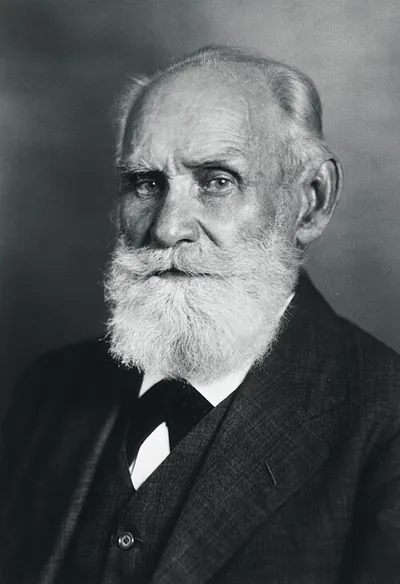 Ivan Pavlov1849–1936 · Biology
 Élie Metchnikoff1845–1916 · Biology
 Robert Koch1843–1910 · Biology
