
Spencer Fullerton Baird
American naturalist, ornithologist, ichthyologist and herpetologist, first curator and later second Secretary of the Smithsonian Institution · 1823–1887
- Born
- February 3, 1823
- Died
- August 19, 1887
- Country
- United States
- Section
- Biology
Biography
Spencer Fullerton Baird (Reading, Pennsylvania, 1823 – Woods Hole, Massachusetts, 1887) was one of the most influential American naturalists of the nineteenth century. For nearly four decades he worked at the Smithsonian Institution in Washington, and he helped turn its natural history collections into one of the largest in the world. His importance lies in how he organized American science: as a network of collectors, museums and exchanges, at a time when the young country was trying to build its own scientific base.
Baird was born into a well-connected family in Pennsylvania; his mother belonged to the prominent Biddle family of Philadelphia. His father, who died of cholera when Spencer was ten, encouraged his interest in nature by taking him on walks and into the garden. Largely self-taught, he learned about birds from his brother William and was taught scientific bird drawing by John James Audubon, whom he met around 1838. He graduated from Dickinson College in 1840 and then moved to New York to study medicine, though he returned to Carlisle about two years later. He walked long distances through the mountains and countryside of the northeast, which gave him first-hand knowledge of the local wildlife.
In 1845 he began teaching natural history at Dickinson, where, because staff were scarce, he also took on chemistry and other subjects. This range of duties shaped his career: he studied reptiles, birds, mammals, fishes, minerals, plants and human cultures. He married Mary Helen Churchill in 1846, and in 1849 the Smithsonian gave him a small sum to collect and ship specimens. It was there that he met Joseph Henry, the institution's first Secretary, and the two became close friends and colleagues.
In 1850 Baird became the Smithsonian's first curator. He brought much of his own collection to Washington and proposed a museum programme focused on the natural history of the United States. He built an exchange network: he asked soldiers and collectors to gather specimens from the West, and he sent duplicate specimens to other museums in return for material the Smithsonian lacked. During the 1850s he described more than fifty new reptile species, some with Charles Frédéric Girard, and in 1853 they published a catalogue of the Smithsonian's snake collection that remains a standard reference. His 1858 volume on birds, part of a railway survey report, was highly influential for American ornithology. When his pupil Robert Kennicott died young, Baird largely left herpetology to take on bigger projects.
After Henry's death in 1878 Baird succeeded him as Secretary. From 1871 he had also been the first U.S. Commissioner of Fish and Fisheries, where he promoted restocking rivers with salmon and examined overfishing along the coast. He proposed limits on fixed nets over weekends, and at Woods Hole, where he had become interested in marine research in 1870, he supported a research station that still operates today. Under his direction the first building of the National Museum was constructed to house objects gathered from the 1876 Centennial Exhibition in Philadelphia. He was also the main author of a major history of North American birds, published between 1875 and 1884 with Thomas Mayo Brewer and Robert Ridgway.
Baird led a demanding working life and travelled often, on foot and by ship. He took part in founding the American Ornithologists' Union in 1883, although his duties kept him from its first meeting. In 1887 he took leave due to exhaustion and died later that year at Woods Hole. His legacy is twofold: the collections and public scientific system he built, and the many animals and plants named after him, including Baird's sparrow and Baird's sandpiper.
Main contributions
- 1850Creation of the Smithsonian's museum programme and an exchange network of specimens among museums and collectors.
- 1853Catalogue of North American reptiles, written with Charles Frédéric Girard, a reference work on the snakes in the Smithsonian collection.
- 1858A book on birds within the reports of a railway route survey, highly influential in American ornithology.
- 1871Appointment as the first U.S. Commissioner of Fish and Fisheries, a post he held until his death.
- 1875History of North American Birds, published between 1875 and 1884, a highly influential ornithology work.
- 1878Succession to Joseph Henry as Secretary of the Smithsonian Institution.
Teachers and students
Trivia and anecdotes
A walking journey
According to his biographers, in 1841 he walked about 640 kilometres through the mountains of Pennsylvania in twenty-one days.
A telephone in every corner
When he took over as Secretary, he had telephones installed throughout the Smithsonian building.
Their contemporaries
While Spencer Fullerton Baird was alive (1823–1887)…
Alive at the same time
Discovered or invented in those years
- 1846NeptuneThe eighth and most distant planet of the Solar System, an ice giant found through mathematical prediction before any direct sighting.
- 1859EvolutionThe process by which the heritable traits of living populations change over generations, explaining the diversity of life from common ancestors.
- 1869Periodic tableAn arrangement of the chemical elements into rows (periods) and columns (groups), ordered by atomic number, that reveals recurring chemical behaviour and lets scientists predict properties.
- 1869Deoxyribonucleic acidA double-stranded molecule that carries the genetic instructions of nearly all living things and many viruses.
- 1876TelephoneA device that carries the human voice over distance by turning sound into electrical signals and back into sound at the other end of the line.
- 1884CarA road vehicle with four wheels and its own engine, mainly built to carry people.
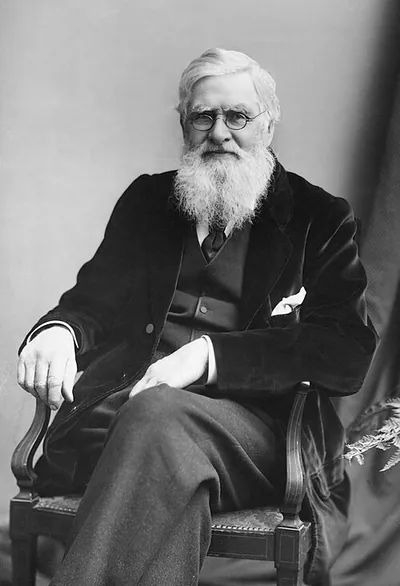 Alfred Russel Wallace1823–1913 · Biology
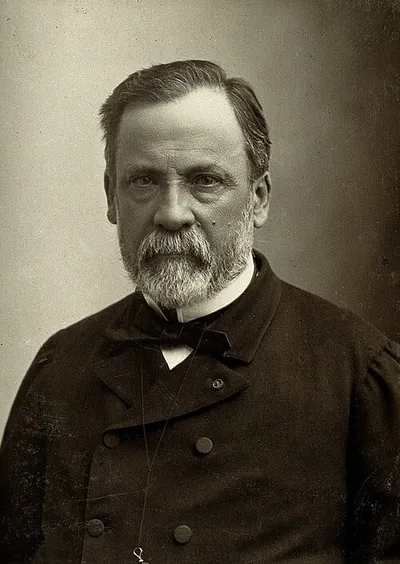 Louis Pasteur1822–1895 · Biology
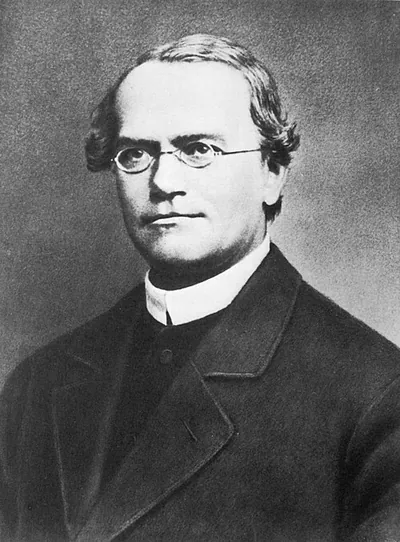 Gregor Mendel1822–1884 · Biology
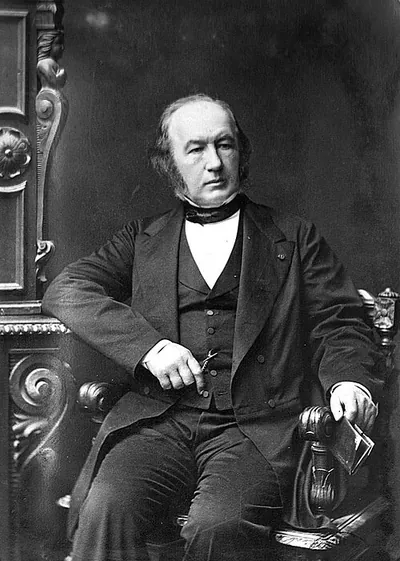 Claude Bernard1813–1878 · Biology
 Theodor Schwann1810–1882 · Biology
 Charles Darwin1809–1882 · Biology
