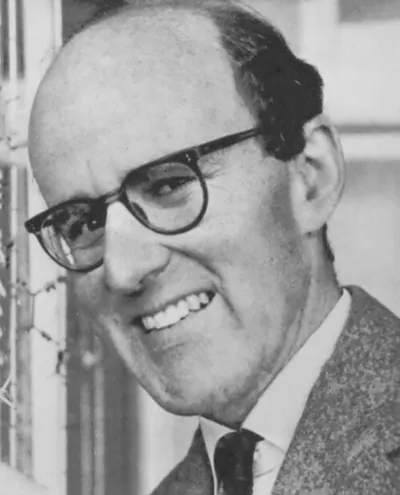
Max Perutz
Austrian-born British chemist and molecular biologist, Nobel Prize in Chemistry in 1962 for his work on the structures of haemoglobin and myoglobin · 1914–2002
- Born
- May 19, 1914
- Died
- February 6, 2002
- Country
- Austria, United Kingdom, United Kingdom of Great Britain and Ireland
- Section
- Biology
- Awards
- Nobel Prize in Chemistry
Biography
Max Ferdinand Perutz (Vienna, 19 May 1914 – Cambridge, 6 February 2002) was an Austrian-born British molecular biologist. He shared the 1962 Nobel Prize in Chemistry with John Kendrew for working out the three-dimensional shapes of two proteins, haemoglobin and myoglobin. His work helped establish structural biology, the field that explains how living things function from the precise arrangement of their molecules.
Perutz was born in Vienna to a family of Jewish ancestry, although his parents had had him baptised as a Catholic. His father, Hugo Perutz, ran a textile business, and the family hoped Max would study law. At school, however, he became fascinated by chemistry, and despite his parents' objections he enrolled at the University of Vienna, graduating in 1936. There a lecturer, Fritz von Wessely, told him about the biochemistry being pursued at the University of Cambridge. Perutz asked his professor, Hermann Mark, to make enquiries on his behalf. Mark forgot, but during a visit to Cambridge he spoke to J. D. Bernal, who needed a student for X-ray crystallography, a technique that reveals the arrangement of atoms in a crystal from the way X-rays scatter through it. Perutz admitted he knew nothing about the subject, and Mark assured Bernal he would learn quickly. Bernal accepted him at the Cavendish Laboratory. His father deposited £500 with a London agent to support him. Perutz learnt fast, and Bernal encouraged him to apply X-ray diffraction to proteins. Protein crystals were hard to grow, so he chose crystals of horse haemoglobin, a subject that would occupy most of his career. He completed his doctorate under Lawrence Bragg in 1940.
The Second World War disrupted his progress. After Hitler annexed Austria in 1938, his parents escaped to Switzerland but lost their money, and Perutz lost their financial support. Shortly before, he had joined a study of how snow turns into ice in Swiss glaciers, drawing on his skill at skiing and his experience of mountains. The work made him known as an expert on glaciers. A Rockefeller Foundation grant allowed him to bring his parents to England in 1939. When war broke out he was arrested with other people of German or Austrian origin and sent to Newfoundland on the orders of Winston Churchill. After several months of internment he returned to Cambridge. His knowledge of ice led to his recruitment in 1942 for Project Habakkuk, a secret scheme to build a floating ice platform in the mid-Atlantic that could refuel aircraft. He tested pykrete, a mixture of ice and wood pulp, in a secret laboratory reportedly beneath Smithfield Meat Market in London.
After the war Perutz briefly returned to glaciology, studying how glaciers flow. In 1947, with the support of Bragg, he secured funding from the Medical Research Council to study the molecular structure of biological systems, and used it to set up the Molecular Biology Unit at the Cavendish. The unit attracted researchers such as Francis Crick, who arrived in 1949, and James D. Watson, in 1951. In the early 1950s Perutz also acted as a mentor to Watson while the two were working on the structure of DNA.
His central technical problem was that X-rays scattered by a protein crystal do not reveal atomic positions on their own, because information about the phases of the waves is lost. In 1953 he found a way round this by attaching heavy atoms, such as gold or mercury, to the protein. Comparing the diffraction patterns with and without these atoms shows, through small shifts in the spots, where the atoms of the molecule lie. Using this approach, he and Kendrew determined the structure of myoglobin in 1959, and in 1960 Perutz presented the first three-dimensional model of haemoglobin. These achievements led to the 1962 Nobel Prize. Around 1970 he proposed how haemoglobin works as a molecular machine: it changes shape when it binds oxygen in the lungs and releases it where the body needs it. Over the following two decades he refined this mechanism and studied haemoglobin diseases such as sickle cell anaemia.
Perutz was also a prolific writer. In his later years he contributed essays on biomedical topics to The New York Review of Books, and many were gathered in I Wish I'd Made You Angry Earlier, published in 1998. He won the Lewis Thomas Prize for writing about science in 1997. His 1994 lecture attacking the ideas of Karl Popper, Thomas Kuhn and Richard Dawkins provoked debate. He argued that science does not advance mainly by refuting hypotheses or through paradigm shifts driven by social pressure, and that scientists who insult religious belief harm the reputation of science. In the days after the attacks of 11 September 2001 he wrote to the British prime minister, Tony Blair, urging him to avoid a military response.
His family life was settled. In 1942 he married Gisela Peiser, a medical photographer and refugee from Germany, and they had two children, Vivien, an art historian, and Robin, a professor of chemistry at the University of York. From 1962 to 1979 he chaired the Laboratory of Molecular Biology of the Medical Research Council, where fourteen scientists later won Nobel Prizes. He died in Cambridge in 2002.
His legacy lies in modern structural biology. The methods he refined for determining protein shapes are now applied to many thousands of molecules, and his model of haemoglobin remains a standard example in textbooks. His reputation also includes a continuing debate over his role in using Rosalind Franklin's unpublished X-ray images, a question that is still discussed today.
Main contributions
- 1947Founding of the Molecular Biology Unit at the Cavendish Laboratory, funded by the Medical Research Council.
- 1953Heavy-atom method: attaching heavy metal atoms to protein crystals makes it possible to work out the phases of X-ray data and so locate the atoms.
- 1959Structure of myoglobin, determined with John Kendrew using X-ray diffraction.
- 1960First three-dimensional model of the haemoglobin molecule, showing how its chains of atoms are arranged.
- 1962Nobel Prize in Chemistry, shared with John Kendrew for their studies of haemoglobin and myoglobin.
- 1970Proposal of the mechanism by which haemoglobin takes up oxygen in the lungs and releases it in the tissues by changing shape.
Teachers and students
Studied under:
Taught:
Trivia and anecdotes
Ice for the war
During the Second World War he worked on Project Habakkuk, a plan for an ice platform in the Atlantic. He tested pykrete in a secret lab, reportedly beneath a London meat market.
A sceptic who respected belief
Although his parents had him baptised as a Catholic, Perutz became an atheist in his later years. Even so, he thought people should not offend others for their religious beliefs.
A letter to the prime minister
A few days after the attacks of 11 September 2001 he wrote to Tony Blair asking him not to respond with military force.
Their contemporaries
While Max Perutz was alive (1914–2002)…
Alive at the same time
Discovered or invented in those years
- 1916Black holeA region of space where gravity is so strong that nothing, not even light, can escape once it crosses a certain boundary.
- 1925TelevisionA system that sends moving pictures and sound over distance and shows them on a receiver, the television set.
- 1925Quantum mechanicsPhysical theory describing how matter and light behave at atomic and subatomic scales, where energy is exchanged in minimal packets and results are expressed as probabilities.
- 1931Big BangA cosmological model describing how the universe expanded from an early state of extreme density and temperature, about 13.8 billion years ago.
- 1945ComputerA programmable machine that takes in data, processes it by following stored instructions, and produces results, able to switch tasks simply by running different software.
- 1969InternetA global network of interconnected computer networks that communicate using the TCP/IP protocol suite.
 Norman Borlaug1914–2009 · Biology
 Peter Medawar1915–1987 · Biology
 Francis Crick1916–2004 · Biology
 Frederick Sanger1918–2013 · Biology
 Jacques Monod1910–1976 · Biology
 François Jacob1920–2013 · Biology
