
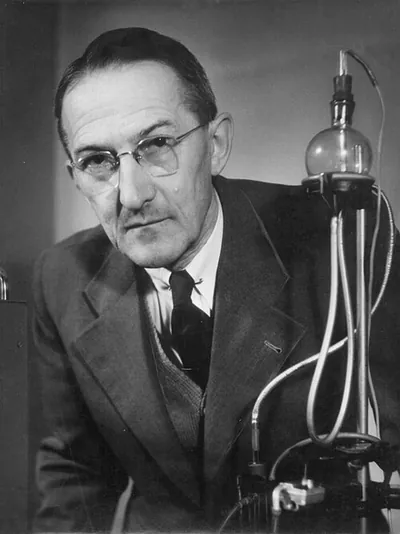
Paul Karrer
Swiss organic chemist and professor at the University of Zurich, Nobel Prize in Chemistry 1937 for his work on carotenoids, flavins and vitamins · 1889–1971
- Born
- April 21, 1889
- Died
- June 18, 1971
- Country
- Switzerland
- Section
- Chemistry
- Awards
- Nobel Prize in Chemistry
Biography
Paul Karrer (Moscow, 1889 – Zurich, 1971) was a Swiss chemist and professor at the University of Zurich. His research on vitamins earned him the Nobel Prize in Chemistry in 1937, which he shared with the British chemist Norman Haworth. He lived in the first half of the twentieth century, when organic chemistry, the branch that studies compounds built mainly from carbon, was beginning to explain the substances essential to life. His importance lies in having worked out the structure of several of these substances, which opened the way to their medical study and their production.
Karrer was born in Moscow on 21 April 1889 to Swiss parents, Paul Karrer and Julie Lerch. In 1892 the family returned to Switzerland, and he was educated at Wildegg and at the old cantonal school in Aarau, where he finished his secondary education in 1908. That year he began studying chemistry at the University of Zurich under Alfred Werner, a chemist who later won the Nobel Prize and is best known for his theory of coordination compounds, in which metal atoms bind to groups of other atoms in fixed arrangements. Werner's influence steered Karrer's first research towards complex metal compounds.
After completing his doctorate in 1911, Karrer spent a further year as an assistant at the Chemical Institute in Zurich. He then took a post as a chemist with Paul Ehrlich at the Georg Speyer Haus in Frankfurt am Main. Ehrlich, a physician, was known for searching for chemical substances that could kill disease-causing microbes, and working with him exposed Karrer to chemistry applied to medicine, a theme that would run through his career. In 1918 he returned to Zurich as an assistant professor of organic chemistry and in 1919 became Professor of Chemistry and Director of the Chemical Institute, a position he held for decades.
His most notable work concerned plant pigments, especially the carotenoids, the yellow and orange compounds that colour carrots, egg yolks and many other plant foods. Karrer worked out their chemical structure and showed that some of them are converted in the body into vitamin A. In other words, the body can make this vitamin from substances found in plants, which is why these are called provitamins. His work culminated in the correct structural formula for beta-carotene, the main precursor of vitamin A. It was the first time the structure of a vitamin or provitamin had been established, a milestone for the chemistry of food.
Alongside this, Karrer studied the flavins, yellow pigments involved in cell processes. His contributions showed that lactoflavin is part of the complex originally thought to be vitamin B2, and clarified how it relates to that vitamin. He later confirmed the structure of ascorbic acid, or vitamin C, and extended his research to vitamins B2 and E. In 1938 he succeeded in synthesising alpha-tocopherol, one form of vitamin E, which corrects the sterility caused by its deficiency in experimental animals. Making such compounds in the laboratory meant they could be produced without relying solely on extraction from natural sources.
His laboratory also attracted researchers from abroad. It is said that the American biologist George Wald worked briefly with him while studying the role of vitamin A in the retina, the layer at the back of the eye that detects light. The anecdote is recorded in reference material, but it gives little detail on the extent of that collaboration, so it is best understood as a brief episode rather than a long joint project.
Recognition came in 1937, when the Nobel Prize in Chemistry was awarded to him jointly with Walter Norman Haworth for research on carotenoids, flavins and vitamins A and B2. Karrer also wrote a highly influential textbook, the Lehrbuch der Organischen Chemie (Textbook of Organic Chemistry), published in 1927. It went through thirteen editions and was translated into seven languages, serving generations of students.
In his private life, Karrer married Helena Froelich in 1914. Accounts differ on the number of children: some say two sons, others three, one of whom died in infancy. He died in Zurich on 18 June 1971, aged 82. His wife died the following year.
His legacy endures on several fronts. In 1959 a group of major Swiss chemical and food companies, among them CIBA, Geigy, Hoffmann-La Roche, Sandoz and Nestlé, established the Paul Karrer Gold Medal and an associated lecture in his honour. The award is given annually or every two years to an outstanding chemist who delivers the lecture at the University of Zurich. A lunar crater also bears his name. His work showed that vitamins, known mainly for their effects on health, could be studied with the methods of structural chemistry, an approach that still shapes nutritional research.
Main contributions
- 1927Lehrbuch der Organischen Chemie, a textbook of organic chemistry that ran to thirteen editions and was translated into seven languages.
- 1937Nobel Prize in Chemistry, shared with Norman Haworth, for his work on carotenoids, flavins and vitamins A and B2.
- 1938Synthesis of alpha-tocopherol, a form of vitamin E, produced in the laboratory.
- Determination of the chemical structure of beta-carotene, the precursor of vitamin A, the first structure of a vitamin or provitamin to be established.
- Identification of lactoflavin as part of the complex originally thought to be vitamin B2.
- Confirmation of the structure of ascorbic acid, that is, vitamin C.
Trivia and anecdotes
A visiting researcher
According to the account recorded in reference material, the biologist George Wald briefly worked in his laboratory while studying vitamin A in the retina.
A textbook with reach
His 1927 organic chemistry book reached thirteen editions and appeared in seven languages, making it a widely used reference.
A crater on the Moon
A lunar crater carries Karrer's name in his memory.
Their contemporaries
While Paul Karrer was alive (1889–1971)…
Alive at the same time
Discovered or invented in those years
- 1903AirplaneA fixed-wing aircraft, heavier than air, powered by engines or rockets, that stays aloft because its wings generate lift.
- 1925TelevisionA system that sends moving pictures and sound over distance and shows them on a receiver, the television set.
- 1925Quantum mechanicsPhysical theory describing how matter and light behave at atomic and subatomic scales, where energy is exchanged in minimal packets and results are expressed as probabilities.
- 1931Big BangA cosmological model describing how the universe expanded from an early state of extreme density and temperature, about 13.8 billion years ago.
- 1945ComputerA programmable machine that takes in data, processes it by following stored instructions, and produces results, able to switch tasks simply by running different software.
- 1969InternetA global network of interconnected computer networks that communicate using the TCP/IP protocol suite.
 Jaroslav Heyrovský1890–1967 · Chemistry
 Harold Urey1893–1981 · Chemistry
 Peter Debye1884–1966 · Chemistry
 Wallace Carothers1896–1937 · Chemistry
 Cyril Norman Hinshelwood1897–1967 · Chemistry
 Otto Hahn1879–1968 · Chemistry