
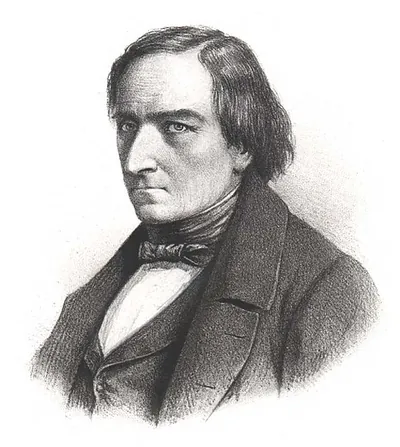
Philippe Lebon
French engineer and chemist, a precursor of gas lighting · 1767–1804
- Born
- May 29, 1767
- Died
- December 1, 1804
- Country
- France
- Section
- Energy
Biography
Philippe Lebon was a French engineer and chemist who, at the turn of the nineteenth century, explored how to make lighting gas from wood and proposed piping it into homes and streets for light and heat. He is best remembered as the inventor of the gas lamp, an early step toward modern city lighting, although his life was short and much of his work remained unfinished.
He was born in Brachay on 29 May 1767 and trained at the École nationale des ponts et chaussées in Paris, France's school for civil engineers. He later taught mechanics there. By 1786, while still a student, he was experimenting with gases released when wood and coal were heated without air, a process called dry distillation, in which solid material turns into gas and liquid vapours inside a closed vessel.
His aim was to produce wood gas on an industrial scale and carry it through pipes to customers, so that streets and houses could stop relying on candles, torches and oil lamps. The gas he made was poor. Besides hydrogen, it contained methane and carbon monoxide, and it gave off an unpleasant smell when burned. That may explain why his demonstrations drew little attention in France, while they caught more interest in England. A popular story says he took inspiration from how people near the Caspian Sea used gases escaping from early oil wells, but this has no firm documentary support.
On 28 September 1799 he patented the thermolamp, a device for lighting with gas. He installed small home systems for lighting and heating that made him locally popular, but he never managed to bring public street lighting into service. In 1801 he filed a patent for a gas engine that used a fuel pump and was ignited by an electric spark. It was an early internal combustion design, inefficient and never fully developed.
His death was surrounded by confusion. For a long time it was claimed that he had been murdered on the eve of Napoleon's coronation, but the records of the time mention no wounds or criminal circumstances, and his letters from his final months show that he was ill and without medical care. He died in Paris on 1 December 1804 and was buried in the Père-Lachaise cemetery. His wife, Cornélie de Brambilla, whom he had married in 1792, later pursued the money he was owed and carried on some of his work.
His legacy reached beyond his own devices. Frederick Albert Winsor, who had followed Lebon's patent closely, improved gas production from coal and in 1807 lit a stretch of Pall Mall in London. Lebon was thus among the first to propose gas as a source of urban light.
Main contributions
- 1786Early experiments with gases obtained by distilling wood and coal, the basis of his first work on wood gas.
- 1799Thermolamp, a patented device for lighting with gas made from wood.
- 1801Gas engine with a fuel pump, ignited by an electric spark, one of the earliest internal combustion designs.
Trivia and anecdotes
A legendary murder
The story of his murder spread through books for young readers, but the documents of the time do not support it.
A widow who pursued his legacy
His wife, Cornélie de Brambilla, fought to collect what he was owed and continued part of his work after his death.
Their contemporaries
While Philippe Lebon was alive (1767–1804)…
Alive at the same time
Discovered or invented in those years
- 1772NitrogenChemical element with atomic number 7, a colourless, odourless gas that makes up about 78% of Earth's air and is an essential part of proteins and nucleic acids.
- 1774OxygenA colorless, odorless gas, symbol O and atomic number 8, that forms the dioxygen in air and is essential for respiration in most living things.
- 1781UranusThe seventh planet from the Sun, an ice giant discovered by William Herschel in 1781, the first planet found with a telescope.
- 1789UraniumA radioactive metal with atomic number 92, used as fuel in nuclear power plants and in nuclear weapons, and in various military and civilian applications.
- 1789CarbonA chemical element with symbol C and atomic number 6, the basis of organic chemistry and a component of all known life, found in materials as different as diamond and pencil lead.
- 1803AtomThe basic unit of a chemical element: a nucleus of protons and usually neutrons surrounded by a cloud of electrons.
 Alessandro Volta1745–1827 · Energy
 Robert Stirling1790–1878 · Energy
 Josef Ressel1793–1857 · Energy
 Abraham Pineo Gesner1797–1864 · Energy
 James Watt1736–1819 · Energy
 Benoît Fourneyron1802–1867 · Energy
