Richard van der Riet Woolley
British astronomer, eleventh Astronomer Royal and specialist in solar astronomy · 1906–1986
- Born
- April 24, 1906
- Died
- December 24, 1986
- Country
- United Kingdom, United Kingdom of Great Britain and Ireland
- Section
- Astronomy and space
Biography
Richard van der Riet Woolley (1906 - 1986) was a British astronomer who became the eleventh Astronomer Royal, the official astronomer of the United Kingdom. He worked mainly in the first half of the twentieth century, a period of rapid growth in observational astronomy, and he is remembered both for his research on the Sun and for leading British astronomy at the start of the space age.
Woolley was born in Weymouth, in Dorset, and spent about eighteen months at Allhallows College in Honiton before his parents retired and moved to the Union of South Africa. There he studied mathematics and physics at the University of Cape Town.
Back in Britain he earned a further master's degree in mathematics and then a doctorate at Gonville and Caius College, Cambridge. After two years at the Mount Wilson Observatory in California, he returned to the United Kingdom in 1931. From 1937 to 1939 he worked at the Cambridge Observatory as senior assistant observer and John Couch Adams Astronomer.
Woolley specialised in solar astronomy, the study of the Sun and its outer atmosphere. In 1939 he was appointed director of the Commonwealth Solar Observatory in Canberra, Australia. He later came back to Britain to serve as Astronomer Royal from 1956 to 1971, succeeding Harold Spencer Jones. He had already been elected a Fellow of the Royal Society in 1953, the year he was appointed an OBE. He was knighted in 1963 and won the Gold Medal of the Royal Astronomical Society in 1971.
From 1972 to 1976 he directed the newly founded South African Astronomical Observatory. He retired in the late 1970s and spent most of his retirement in South Africa.
Woolley is also remembered for his early doubts about the practicality of space flight, a view he shared with Spencer Jones. In a 1936 review of P. E. Cleator's book Rockets Through Space, he argued that the basic difficulties of firing rockets into space were so fundamental that the idea had to be dismissed as impracticable, although the author reminded readers that heavier-than-air flight had also once been considered impossible. On becoming Astronomer Royal he repeated that space travel was utter bilge.
In an interview with Time in 1956 he said that nobody would ever raise enough money for such a project, and argued that the same funds spent on first-class astronomical equipment would teach us far more. His remarks came just a year before the launch of Sputnik 1 in 1957, five years before the Apollo Program began and thirteen years before the first crewed landing on the Moon.
The most quoted line attributed to him was later corrected. In a 1995 letter to New Scientist, two readers argued that the familiar version was a misquotation, and that he had also said that putting a man on the Moon would cost as much as a major war. They noted that this prediction proved quite accurate. They also claimed that his criticism was aimed at the exaggerated newspaper articles of 1956 about colonising the Moon and the planets.
Woolley is remembered as an astronomer who led major institutions on two continents and who, on the question of space travel, held a view that history overturned.
Main contributions
- 1939Directed the Commonwealth Solar Observatory in Canberra, centred on the study of the Sun.
- 1953Book The Outer Layers of a Star, written with Walter Stibbs, on the outer layers of a star.
- 1956Appointed Astronomer Royal, a post he held until 1971.
- 1972Directed the newly founded South African Astronomical Observatory until 1976.
Trivia and anecdotes
A corrected quotation
The line calling space travel utter bilge is attributed to Woolley, but in 1995 two readers argued it was a distorted version of what he said.
An accurate prediction
According to the same readers, Woolley also said that putting a man on the Moon would cost as much as a major war, a forecast they judged quite accurate.
Their contemporaries
While Richard van der Riet Woolley was alive (1906–1986)…
Alive at the same time
Discovered or invented in those years
- 1916Black holeA region of space where gravity is so strong that nothing, not even light, can escape once it crosses a certain boundary.
- 1925TelevisionA system that sends moving pictures and sound over distance and shows them on a receiver, the television set.
- 1925Quantum mechanicsPhysical theory describing how matter and light behave at atomic and subatomic scales, where energy is exchanged in minimal packets and results are expressed as probabilities.
- 1931Big BangA cosmological model describing how the universe expanded from an early state of extreme density and temperature, about 13.8 billion years ago.
- 1945ComputerA programmable machine that takes in data, processes it by following stored instructions, and produces results, able to switch tasks simply by running different software.
- 1969InternetA global network of interconnected computer networks that communicate using the TCP/IP protocol suite.
 Gerard Kuiper1905–1973 · Astronomy and space
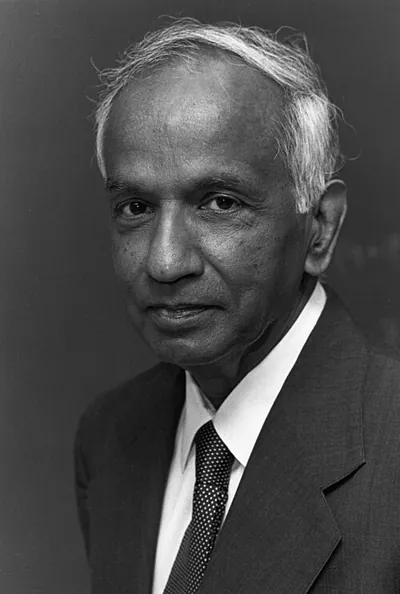 Subrahmanyan Chandrasekhar1910–1995 · Astronomy and space
 Cecilia Helena Payne Gaposchkin1900–1979 · Astronomy and space
 Jan Hendrik Oort1900–1992 · Astronomy and space
 Bernard Lovell1913–2012 · Astronomy and space
 Robert Hanbury Brown1916–2002 · Astronomy and space