
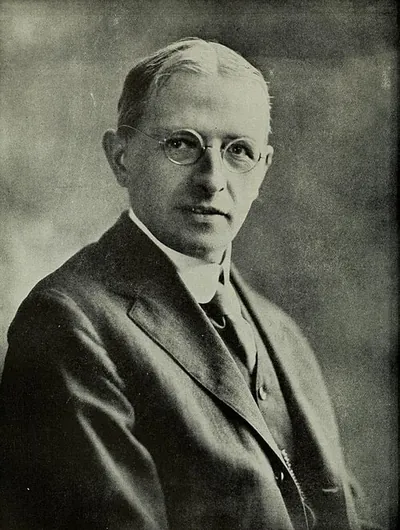
Robert Grant Aitken
American astronomer known for his survey of double stars and his work on comet and satellite orbits · 1864–1951
- Born
- December 31, 1864
- Died
- October 29, 1951
- Country
- United States
- Section
- Astronomy and space
Biography
Robert Grant Aitken (1864-1951) was an American astronomer who spent much of his career studying double stars, pairs of stars that orbit one another. Working mainly at the Lick Observatory in California, he built a large catalogue of such pairs that remained a standard reference for decades and allowed other researchers to estimate the masses of many stars. He lived at a time when precise observational astronomy was producing its first major results, and his name survives today in an asteroid and in a large lunar crater.
Born on December 31, 1864, in Jackson, California, he was the son of a Scottish immigrant father and a mother from a German immigrant family. He studied at Williams College in Massachusetts, graduating in 1887, and then taught mathematics in California. He earned his master's degree from Williams College in 1892 and moved on to teach mathematics at the College of the Pacific. His training was mainly mathematical, and that background suited the calculation of orbits, a task that is at heart a problem of geometry and applied calculus describing how celestial bodies move.
In 1895 he was offered a post as assistant astronomer at the Lick Observatory, perched on Mount Hamilton near San Jose. There he began a systematic study of double stars. The work meant measuring the position of each pair again and again over the years and using the changes to work out the path one star traced around the other. From 1899 he collaborated with William J. Hussey, and together they produced a steadily growing catalogue. When Hussey left the project in 1905, Aitken carried on alone. By about 1915 he had discovered roughly 3,100 new binary stars, on top of the 1,300 found by Hussey. The results appeared in 1932 as the New General Catalogue of Double Stars Within 120 Degrees of the North Pole. The orbital data had practical value: it let astronomers work out the masses of a large number of stars, something otherwise very hard to measure.
For this cataloguing work he received the Bruce Medal in 1926, one of the most prestigious honours in American astronomy. He also measured positions and calculated orbits for comets and for the moons of planets. In 1908 he joined an expedition to observe a solar eclipse from Flint Island in the central Pacific. His book Binary Stars appeared in 1918, with a second edition in 1935. He was also a central figure in the institutional life of his field: he served as president of the Astronomical Society of the Pacific in 1899 and 1915, and edited its Publications from 1898 to 1942. In 1932 he gave the Darwin Lecture to the Royal Astronomical Society in London, and from 1918 to 1928 he chaired the double star committee of the International Astronomical Union.
In his personal life, Aitken was partly deaf and relied on a hearing aid. Around 1888 he married Jessie Thomas, and the couple had three sons and a daughter. Their son Robert Thomas Aitken became an anthropologist who studied the cultures of Pacific islands. Their grandson, Robert Baker Aitken, became a widely known Zen Buddhist teacher and author.
Aitken's legacy rests above all on his catalogue, which served generations of astronomers studying stellar masses and the life of stars. Today he is remembered in the asteroid 3070 Aitken and in the lunar crater Aitken, which lies within the vast South Pole-Aitken basin on the Moon's south pole region.
Main contributions
- 1899Start of the double star catalogue with William J. Hussey, the basis of his major work on binary stars.
- 1906Lalande Prize of the French Academy, shared with William Hussey for their work on double stars.
- 1918Publication of the book Binary Stars, summarising the state of research on these systems.
- 1926Bruce Medal, awarded for his catalogue and study of binary stars.
- 1932Publication of the New General Catalogue of Double Stars, with orbits that allow stellar masses to be estimated.
Trivia and anecdotes
A catalogue with a precise scope
The 1932 catalogue was titled with reference to the North Pole because it covered double stars within 120 degrees of the north celestial pole.
An astronomer who was hard of hearing
Aitken was partly deaf and used a hearing aid, which did not stop him from spending decades observing and calculating.
Their contemporaries
While Robert Grant Aitken was alive (1864–1951)…
Alive at the same time
Discovered or invented in those years
- 1869Periodic tableAn arrangement of the chemical elements into rows (periods) and columns (groups), ordered by atomic number, that reveals recurring chemical behaviour and lets scientists predict properties.
- 1876TelephoneA device that carries the human voice over distance by turning sound into electrical signals and back into sound at the other end of the line.
- 1884CarA road vehicle with four wheels and its own engine, mainly built to carry people.
- 1903AirplaneA fixed-wing aircraft, heavier than air, powered by engines or rockets, that stays aloft because its wings generate lift.
- 1925TelevisionA system that sends moving pictures and sound over distance and shows them on a receiver, the television set.
- 1945ComputerA programmable machine that takes in data, processes it by following stored instructions, and produces results, able to switch tasks simply by running different software.
 Annie Jump Cannon1863–1941 · Astronomy and space
 Henrietta Swan Leavitt1868–1921 · Astronomy and space
 Karl Schwarzschild1873–1916 · Astronomy and space
 Ejnar Hertzsprung1873–1967 · Astronomy and space
 Henry Norris Russell1877–1957 · Astronomy and space
 Milutin Milanković1879–1958 · Astronomy and space
