
Rolf Huisgen
German chemist, creator of the 1,3-dipolar cycloaddition or Huisgen cycloaddition · 1920–2020
- Born
- June 13, 1920
- Died
- March 26, 2020
- Country
- Germany
- Section
- Chemistry
Biography
Rolf Huisgen (born in Gerolstein, 13 June 1920 – died in Munich, 26 March 2020) was a German chemist working in synthetic organic chemistry, the branch that builds complex molecules from simpler ones. He is remembered above all for the reaction that bears his name and for the lasting influence he had on chemistry departments in Germany and Austria after the Second World War, since many of his former students went on to become professors.
Huisgen grew up in Gerolstein, in the Rhineland-Palatinate region. He began studying chemistry and mathematics at the University of Bonn in 1939, but when the war forced that university to close, he moved in 1940 to the Ludwig Maximilian University of Munich to focus on chemistry. There he worked under Heinrich Otto Wieland, a Nobel laureate in chemistry, and in 1943 he completed his doctorate with a thesis on a strychnine alkaloid, a plant-derived substance with a intricate molecular structure. He qualified as a university lecturer in 1947 and in 1949 was appointed professor of organic chemistry at the Chemical Institute of the University of Tübingen, then led by Georg Wittig. In 1952 he returned to Munich as a full professor and director of the Institute of Organic Chemistry, succeeding Wieland. He became emeritus in 1988 but continued doing research for many years afterwards.
His best-known contribution was the development of the 1,3-dipolar cycloaddition, also called the Huisgen cycloaddition. Put simply, it is a method for joining two molecules at their ends to form a ring, and it tends to give products with a well-defined structure. It makes possible the construction of heterocyclic compounds, rings that contain atoms other than carbon, such as those found in certain vitamins, alkaloids and antibiotics. His work earned several honours, including the Liebig Medal in 1961, the Lavoisier Medal of the French Chemical Society in 1965 and the Adolfo Quilico Medal of the Italian Chemical Society in 1987. He had been a member of the American Academy of Arts and Sciences since 1960 and was elected to the US National Academy of Sciences in 1989. He also belonged to the German Leopoldina academy and received several honorary doctorates, including one from the Free University of Berlin in 2010.
In his personal life, his daughter, the mathematician Birge Huisgen-Zimmermann, was born in 1946. Huisgen died in Munich on 26 March 2020, aged 99. His legacy is twofold: a reaction that remains a routine tool for building molecules, and a large school of students who carried his approach into the universities of the postwar years.
Main contributions
- 1943Doctoral thesis on a strychnine alkaloid, completing his training in Munich.
- 1949Appointment as professor of organic chemistry at the University of Tübingen.
- 1952Return to Munich as director of the Institute of Organic Chemistry, succeeding Wieland.
- 1961Liebig Medal, one of the honours of his career.
- 1965Lavoisier Medal of the French Chemical Society.
- 1987Adolfo Quilico Medal of the Italian Chemical Society.
Teachers and students
Studied under:
Taught:
Their contemporaries
While Rolf Huisgen was alive (1920–2020)…
Alive at the same time
Discovered or invented in those years
- 1925TelevisionA system that sends moving pictures and sound over distance and shows them on a receiver, the television set.
- 1925Quantum mechanicsPhysical theory describing how matter and light behave at atomic and subatomic scales, where energy is exchanged in minimal packets and results are expressed as probabilities.
- 1931Big BangA cosmological model describing how the universe expanded from an early state of extreme density and temperature, about 13.8 billion years ago.
- 1945ComputerA programmable machine that takes in data, processes it by following stored instructions, and produces results, able to switch tasks simply by running different software.
- 1969InternetA global network of interconnected computer networks that communicate using the TCP/IP protocol suite.
- 1989World Wide WebA system of linked documents and resources, connected by hyperlinks and accessed over the Internet with web browsers.
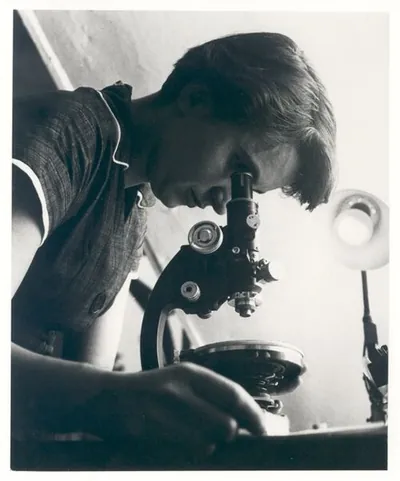 Rosalind Franklin1920–1958 · Chemistry
 Derek Barton1918–1998 · Chemistry
 Robert Burns Woodward1917–1979 · Chemistry
 Ilya Prigogine1917–2003 · Chemistry
 John Pople1925–2004 · Chemistry
