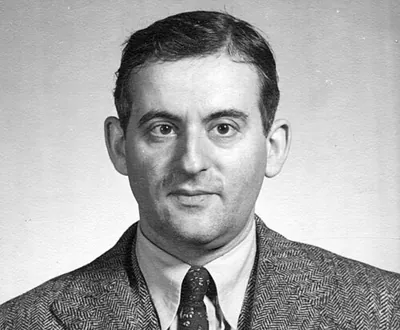
Samuel Goudsmit
Dutch-American physicist, co-proposer of electron spin · 1902–1978
- Born
- July 11, 1902
- Died
- December 4, 1978
- Country
- United States, Kingdom of the Netherlands
- Section
- Physics
Biography
Samuel Abraham Goudsmit was a Dutch-born American physicist best known for proposing, together with George Eugene Uhlenbeck in 1925, that electrons possess a spin, an internal turning motion with a fixed amount of angular momentum that makes each electron behave like a tiny magnet. His work belongs to the years when quantum physics was reshaping the modern picture of the atom. He is remembered for that idea, for his long service as editor of a leading physics journal, and for his role in assessing Germany's wartime atomic research.
Goudsmit was born in The Hague on July 11, 1902, into a Dutch Jewish family. His father, Isaac, manufactured water closets, and his mother, Marianne Goudsmit-Gompers, ran a millinery shop. In 1943 German occupiers deported both parents to a concentration camp, where they were murdered. Goudsmit studied physics at the University of Leiden under Paul Ehrenfest and earned his doctorate in 1927. That same year he began teaching at the University of Michigan, where he stayed until 1946. In 1930 he co-wrote with Linus Pauling a text called The Structure of Line Spectra.
The spin idea grew out of a specific puzzle. Atoms emit light at particular wavelengths, forming spectral lines, and some of these lines split in ways the atomic models of the time could not explain. Goudsmit and Uhlenbeck proposed that the electron carries an intrinsic spin, which accounted for the extra structure. Despite its importance, the two physicists were nominated many times for the Nobel Prize in Physics without ever winning it. I. I. Rabi said that their omission would always remain a mystery to him.
During the war he worked at the Massachusetts Institute of Technology and served as scientific head of the Alsos Mission, part of the Manhattan Project, which was designed to measure how far the Nazi atomic bomb program had progressed. His team reached a German group of nuclear physicists led by Werner Heisenberg and Otto Hahn at Hechingen, in the French zone, ahead of the French physicist Yves Rocard. For this work he received the Presidential Medal of Freedom. In his 1947 book Alsos he concluded that Germany had not come close to building an atomic weapon. He blamed this partly on the inability of science to function under a totalitarian state and partly on German scientists not understanding how to build the bomb. Later historians have disputed both claims. The Soviet Union, also a totalitarian state, produced its bomb shortly after the book appeared, and Goudsmit overlooked the intelligence leaks of Klaus Fuchs from Los Alamos. His assessment that the German program made little progress, however, has largely stood the test of time.
After the war he taught briefly at Northwestern University and, from 1948 to 1970, was a senior scientist at Brookhaven National Laboratory, where he chaired the physics department from 1952 to 1960. His most visible role was as editor-in-chief of Physical Review, the leading physics journal published by the American Physical Society. In July 1958 he launched Physical Review Letters, a journal of short papers with quick publication. When he stepped down as editor in 1974 he joined the faculty of the University of Nevada, Reno, where he remained until his death on December 4, 1978.
His interest in ancient Egypt began during his years in Leiden. He assembled a collection of Egyptian antiquities, which his widow later bequeathed to the Kelsey Museum of Archaeology at the University of Michigan, and he made several scholarly contributions to Egyptology. In 2017 a fragmentary stela in that collection was identified as an object missing from the Egyptian Museum in Berlin. It was believed to have been looted after the museum was bombed and sold to Goudsmit in 1945. It was returned to Berlin in April 2017.
He married Jaantje Logher in 1927, and their daughter Esther was born in Ann Arbor in 1933. The couple divorced in 1960, and that year he married Irene Bejach, whose father, a Berlin physician, also died at Auschwitz. Irene and her sister had left Germany as children on the Kindertransport shortly before the Second World War.
Goudsmit is remembered above all for electron spin, now a basic concept in quantum physics, and for his editorial work that shaped how physics research was published in the twentieth century.
Main contributions
- 1925Electron spin: proposal that the electron has an intrinsic spin that explains splittings in spectral lines.
- 1930The Structure of Line Spectra: a text co-written with Linus Pauling on the structure of atomic spectra.
- 1947Alsos: a book assessing the German atomic bomb program based on the Alsos Mission.
- 1958Physical Review Letters: a journal of short physics papers that he launched as editor.
- 1966Time: a book written with Robert Claiborne on time in science and culture.
Teachers and students
Trivia and anecdotes
A Nobel that never came
Goudsmit and Uhlenbeck were nominated many times for the Nobel Prize in Physics but never won. I. I. Rabi said the omission would always be a mystery to him.
A stela returned to Berlin
In 2017 an Egyptian stela in his collection was identified as an object from the Egyptian Museum in Berlin. It was returned in April 2017.
A childhood marked by war
His parents were deported to a concentration camp in 1943 and murdered there. His later wife Irene had also lost her father at Auschwitz and reached Britain on the Kindertransport.
Their contemporaries
While Samuel Goudsmit was alive (1902–1978)…
Alive at the same time
Discovered or invented in those years
- 1903AirplaneA fixed-wing aircraft, heavier than air, powered by engines or rockets, that stays aloft because its wings generate lift.
- 1925TelevisionA system that sends moving pictures and sound over distance and shows them on a receiver, the television set.
- 1925Quantum mechanicsPhysical theory describing how matter and light behave at atomic and subatomic scales, where energy is exchanged in minimal packets and results are expressed as probabilities.
- 1931Big BangA cosmological model describing how the universe expanded from an early state of extreme density and temperature, about 13.8 billion years ago.
- 1945ComputerA programmable machine that takes in data, processes it by following stored instructions, and produces results, able to switch tasks simply by running different software.
- 1969InternetA global network of interconnected computer networks that communicate using the TCP/IP protocol suite.
 Paul Dirac1902–1984 · Physics
 Eugene Paul Wigner1902–1995 · Physics
 Enrico Fermi1901–1954 · Physics
 Werner Heisenberg1901–1976 · Physics
 Ernest Lawrence1901–1958 · Physics
 J. Robert Oppenheimer1904–1967 · Physics
