Stanford Moore
American chemist and biochemist, Nobel laureate in Chemistry in 1972 for his work on ribonuclease · 1913–1982
- Born
- September 4, 1913
- Died
- August 23, 1982
- Country
- United States
- Section
- Chemistry
- Awards
- Nobel Prize in Chemistry
Biography
Stanford Moore (Chicago, 1913 - New York, 1982) was an American chemist and biochemist who shared the 1972 Nobel Prize in Chemistry. His name is tied to a central question of his era: how a protein is organised, and how that arrangement determines what it does. He spent nearly his whole career at Rockefeller University in New York, and his work produced a method that is still used in laboratories around the world.
Moore was born in Chicago on September 4, 1913. He attended the Peabody Demonstration School in Nashville, known today as the University School of Nashville. He graduated from Vanderbilt University in 1935 with top academic honours, and earned his doctorate in organic chemistry at the University of Wisconsin in 1938. Organic chemistry deals with compounds built around carbon, the element at the core of living matter, and this training gave him the tools he later applied to biological molecules.
After his doctorate he joined the Rockefeller Institute, which later became Rockefeller University. There he worked with Max Bergmann, and in 1952 he was named Professor of Biochemistry. During the Second World War he left the laboratory for a period of government service in Washington, where he worked within the Office of Scientific Research and Development, the body that coordinated scientific work for the war effort.
Around 1945 he began a partnership with William Howard Stein that would define much of his career. The two studied ribonuclease, an enzyme that cuts up RNA, a molecule that carries genetic instructions inside cells. To understand its structure, they needed to know which amino acids make it up and in what order. Separating and counting them was slow and imprecise. Moore contributed a method based on a chromatographic column, a tube packed with material that separates substances according to how they travel through it, which allowed each amino acid to be measured accurately.
With this technique, and with the goal of automating it, the pair developed the first automatic amino acid analyser in 1958, which made it far quicker to study the make-up of proteins. In 1959 they announced the complete amino acid sequence of ribonuclease, a result cited in the Nobel award. Their work showed how the chemical arrangement of the molecule was linked to its catalytic activity, meaning its ability to speed up a chemical reaction without being used up in the process.
In 1972 Moore shared the Nobel Prize with Stein and Christian B. Anfinsen. Half the prize went to Moore and Stein for showing how the chemical structure of ribonuclease related to its activity, and the other half went to Anfinsen for his work on the same enzyme. Moore was not a public figure beyond the laboratory. His professional life was so closely bound to Stein's that his final publication was the biographical memoir of Stein for the United States National Academy of Sciences. When he died he left his estate to Rockefeller University, expressing the wish that it help a young scholar have the same opportunity he had.
His legacy has two parts: the automatic amino acid analyser, which became a routine tool in protein research, and a model of close collaboration that advanced understanding of the chemistry of life.
Main contributions
- 1958First automatic amino acid analyser: a machine that determines the make-up of proteins quickly.
- 1959Complete amino acid sequence of ribonuclease: the first enzyme whose full chain was determined.
- 1972Nobel Prize in Chemistry, shared with Stein and Anfinsen, for linking the structure and catalytic activity of ribonuclease.
- Amino acid analysis by chromatographic column: a technique that separates and accurately measures the amino acids in a protein.
Teachers and students
Trivia and anecdotes
A legacy for a young scholar
On his death, Moore left his estate to Rockefeller University, wishing it to help a young scholar have the opportunity he had had.
An inseparable partnership
His final publication was the biographical memoir of William Howard Stein, with whom he shared much of his career.
Their contemporaries
While Stanford Moore was alive (1913–1982)…
Alive at the same time
Discovered or invented in those years
- 1916Black holeA region of space where gravity is so strong that nothing, not even light, can escape once it crosses a certain boundary.
- 1925TelevisionA system that sends moving pictures and sound over distance and shows them on a receiver, the television set.
- 1925Quantum mechanicsPhysical theory describing how matter and light behave at atomic and subatomic scales, where energy is exchanged in minimal packets and results are expressed as probabilities.
- 1931Big BangA cosmological model describing how the universe expanded from an early state of extreme density and temperature, about 13.8 billion years ago.
- 1945ComputerA programmable machine that takes in data, processes it by following stored instructions, and produces results, able to switch tasks simply by running different software.
- 1969InternetA global network of interconnected computer networks that communicate using the TCP/IP protocol suite.
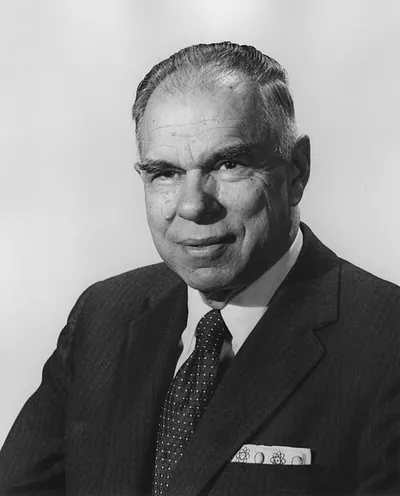 Glenn Theodore Seaborg1912–1999 · Chemistry
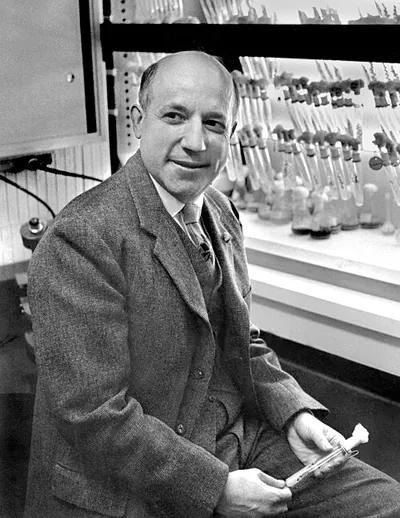 Melvin Calvin1911–1997 · Chemistry
 Dorothy Hodgkin1910–1994 · Chemistry
 Paul Flory1910–1985 · Chemistry
 Robert Burns Woodward1917–1979 · Chemistry
 Ilya Prigogine1917–2003 · Chemistry